| |
Memorial Day was started by former slaves in Charleston, South Carolina to honor 257 dead Union Soldiers who had been buried in a mass grave in a Confederate
prison camp.
They dug up the bodies and worked for
2 weeks to give them a proper burial as gratitude for fighting for their freedom.
They then held a parade of 10,000 people led by 2,800 Black children where they marched, sang and celebrated.
|
 |
 More of the story More of the story |
|
 |
May
Day was called Emancipation Day in 1886 when 340,000
went on strike (though it was Saturday it was a regular
day of work) in Chicago for the 8-hour workday.
May
1, 1890
May Day labor demonstrations spread to thirteen other countries; 30,000
marched in Chicago as the newly prominent American Federation of Labor
threw its weight behind the 8-hour day campaign. |
| More May Day info |
|
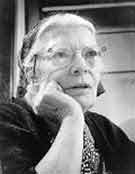 |
The Catholic
Worker newspaper was founded by Dorothy Day and
Peter Maurin. Dorothy Day said, "God meant things
to be much easier than we have made them," and
Peter Maurin wanted to build a society "where
it is easier for people to be good." |

|
| Dorothy Day |
 |
Peter Maurin |
Read more
about the Catholic Worker |
|
 |
Senator
Glen Hearst Taylor (D-Idaho) was arrested in Birmingham,
Alabama, for trying to enter a meeting through a door marked
for "Negroes" rather than using the “whites
only” door, and convicted of disorderly conduct.
Taylor was the Progressive Party candidate for Vice President, running
mate of Henry Wallace. He was in Birmingham to address the Southern Negro
Youth Congress. |
| Senator Glen Hearst Taylor |
|
| Second
Factory for Peace opened in Onllwyn, Dulais Valley, in
south Wales, employing disabled miners. Tom McAlpine, active
in the Committee for Nuclear Disarmament, and a supporter
of cooperatives and industrial democracy, established Rowen
Engineering in both Wales and Glasgow, Scotland.
|
|
| 500,000
Vietnamese marched for an end to the war dividing their
country. |
|
| Soviet
youths openly defied police and danced the twist
in Moscow's Red Square during May Day celebrations.
In the early ‘60s the Twist had been banned in
Buffalo, New York, and Tampa, Florida. The religious
right claimed the Twist was actually a pagan fertility
dance. |

|
Are you old enough to remember Chubby Checker? |
|
| Five days of anti-war May Day protests began in Washington, D.C., resulting in over 14,000 arrests—the largest mass civil disobedience in U.S. history. |
|
 |
One million South Africans demonstrated their opposition to apartheid
in a strike organized by the Congress of South African Trade Unions
(COSATU)
|
COSATU: a brief history |
|
| President George W. Bush landed in a jet on the aircraft carrier USS Abraham Lincoln off the California coast and, in a speech to the nation, declared major combat in Iraq over. The banner his staff posted on the ship read, “Mission Accomplished.” |
|

|
Since that presidential declaration more than 4500 American and allied troops and nearly 9000 members of Iraqi security and police forces (Jan. 2005 through July 2011) have lost their lives. In addition, tens of thousands (more than 32,000 Americans) injured in the hostilities.
|
 |
| The number of Iraqi civilian deaths is open to dispute, but minimally stands at well over 100,000. |
| Details
of Iraq military casualties: |
Civilian
casualties |
|
| Hundreds
of children ranging in age from six to eighteen were arrested
in Birmingham, Alabama, as they marched from Kelly Ingram
Park, across from 16th Street Baptist Church, to downtown
singing, “We Shall Overcome.” |
| Part of an ongoing effort
to end segregation in that city, and following the arrests
of many adults including Rev. Martin Luther King, Jr.,
the children had volunteered to minimize the threat to
families if a breadwinner were jailed. A judge had issued
an order preventing any of 133 civil rights leaders from
organizing a demonstration. |
 |
| Birmingham, the capital of
Alabama, had been the site of 18 unsolved bombings in black
neighborhoods over recent years, and the place where mobs
had attacked Freedom Riders on Mother’s Day in 1961. Leaving
the park in groups of fifty, the kids were put in vans
by police, led by Eugene “Bull” Connor, until there were
959 filling the city jails. |
|
|

|
The Poor People's Campaign began with groups from several locations around
the U.S. setting out for Washington, D.C., to draw attention
to the living conditions of the poorest Americans. It was conceived
and organized by Reverend Martin Luther King, Jr. and, following
his assassination the previous month, led by his successor at
the head of the Southern Christian Leadership Conference (SCLC),
Reverend Ralph David Abernathy. |
|
The first wave of demonstrators arrived in Washington on May 11. One
week later, Resurrection City was built on the Washington Mall,
a settlement of tents and shacks to house the protesters. |

Resurrection
City |
| Read
more |
|
| Civilians
were executed by Napoleonic forces putting down a rebellion
by the citizens of Madrid, Spain on Principe Pio Hill.
The event was memorialized in the painting by Francisco
de Goya, “The Third of May 1808: The Execution of
the Defenders of Madrid.” Aspects of the painting
inspired the design of the peace symbol by Gerald Holtom
in 1958. |
 |
|
 |
At
Haymarket Square in Chicago, a rally was being held because
of a strike at the McCormick Harvester plant, just
two days after an enormous May Day turnout. Though the
mass meeting was peaceful, a force of 176 police officers
arrived, demanding that the meeting disperse. Someone,
unknown to this day, then threw a bomb at the police. |
| In
their confusion, the police began firing their weapons
in the dark, killing at least three in the crowd and wounding
many more. Seven police died (only one by the bomb), the
rest probably by police fire. |
| Read
more |
|
| In
Birmingham, Alabama, Public Safety Commissioner and recently
failed mayoral candidate Theophilus Eugene "Bull" Connor
used fire hoses and police dogs on children near the 16th
Street Baptist Church to keep them from marching out of
the "Negro section" of town. |

|
With
no room left to jail them (after arresting nearly 1000
the day before), Connor brought firefighters out and ordered
them to turn hoses on the children. Most ran away, but
one group refused to budge.
The firefighters turned more
hoses on them, powerful enough to break bones. The force
of the water rolled the protesters down the street. In
addition, Connor had mobilized K-9 (police dog) forces
who attacked protesters trying to re-enter the church. |
| Pictures of the confrontation between the children and
the police were televised across the nation. |
| Read more about the Birmingham Campaign |
|
| More
than 100 black students took over a building at Northwestern
University in Evanston, Illinois. They were demanding attention
to their advocacy for inclusion of African-American history,
literature and art in the curriculum. Their efforts led
to the establishment of an African-American studies department
which now offers a doctoral program. |
| How
it happened |
|
The Nixon administration ordered the arrest of nearly 13,000 anti-war protesters calling themselves the Mayday Tribe who had begun four days of demonstrations in Washington, D.C. on the first. They aimed to shut down the nation's capital by disrupting morning rush-hour traffic and other forms of nonviolent direct action, skirmishing with metropolitan police and Federal troops throughout large areas of the capital.
The slogan of the Mayday tribe: "If the government won't stop the [Vietnam] war, we'll stop the government." |
| Read more |
|
The
first broadcast of National Public Radio’s evening
news and public affairs program, "All Things Considered," was
aired on about 90 public radio affiliates around the
country. The main story was the disruptive anti-Vietnam
protests in Washington.
It is now the fourth most listened-to
radio program
in the U.S. |
 |
| Listen
to that first program |
|
| Sixty
thousand marched on the Pentagon to urge the end of U.S.
military involvement in El Salvador. |
|
|
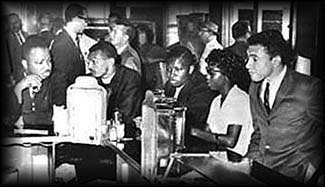
A
group of Freedom Riders left Washington, DC for New Orleans
in a first challenge to racial segregation on interstate
buses and in bus terminals; it was organized by the Congress
of Racial Equality (CORE). |
|
| The
Freedom Riders dining at a lunch counter in Montgomery
before traveling to Jackson, Mississippi and New Orleans,
Louisiana. |
| Read
more about the freedom riders |
| 50 Years After Their Mug Shots, Portraits of Mississippi’s Freedom Riders |
|
Ohio
National Guard troops opened fire on anti-war protesters
at Kent State University, killing four students and wounding nine others,
one permanently disabled. |
|

|
The previous day, President Nixon had announced a widening of the Vietnam
War with bombing in neighboring Cambodia.
|
 |
| There were major campus
protests around the country with students occupying university
buildings to organize and to discuss the war and other issues. |
| Read more about that day at Kent State with pictures |
|
| A “sense
of the Congress” resolution, intended to urge a halt
to all testing of nuclear weapons, was approved by the
U.S. House of Representatives (287-149). The support for
a nuclear freeze, ending all American and Soviet nuclear
weapons testing, was widespread. In ballot resolutions
in 25 states, the freeze had passed in all but one, losing
in Arizona by just two points. |
|
| Political
philosopher, social scientist, historian and revolutionary
Karl Marx was born in Trier, Germany. His ideas, laid out
in the Communist Manifesto and Das Kapital, and in many other
publications, considered the state, class divisions, the
nature of industrial capitalism, and culture and religion
as oppressive forces. |
 |
A young Karl Marx
|
|
| Biology
teacher John T. Scopes was arrested for teaching Darwin’s theory of evolution
in a Dayton, Tennessee, high school in violation of state law.
Working in a public school, he was prohibited by statute “to
teach any theory that denies the story of the Divine Creation
of man as taught in the Bible, and to teach instead that man
has descended from a lower order of animals.”
|
 |
| State of Tennessee v. Scopes ACLU |
John Scopes |
|
| Irish Republican Army hunger-striker Bobby Sands died in Northern Ireland’s Maze Prison (aka Long Kesh); it was his 66th day without food. |
| He had just been elected by a narrow margin to a seat in the British Parliament for the district of Fermanagh and South Tyrone while still serving the last of a 14-year sentence for possession of firearms.
The government introduced and Parliament quickly enacted the Representation of the People Act 1981 which prevented prisoners serving jail terms of more than one year in either the UK or the Republic of Ireland from being nominated as candidates in UK elections. |
 |
| Read
more on Bobby Sands, including some of his poetry |
| “Our
revenge will be the laughter of our children.” -
Bobby Sands |
|
| Over
one million Sicilians, a fifth of the Italian island’s
population, signed a petition against the deployment of more
than 100 U.S. cruise missiles at the Comiso Air Base. |
|
|
The last U.S. cruise missile left Greenham Common Air Base in England, the site of a decade of women's anti-nuclear protests. The encampment persisted for nearly another decade until it was returned to public access.
|
 |
Protesters leave
Greenham Common for the last time |
| Peace
link |
|
|
Reformers allied with President Mohammed Khatami swept run-off
elections, winning control of the 290-seat Majlis
of Iran (parliament) from hard-liners for the first
time since the 1979 Islamic revolution. Results were
subject to certification by the Guardian Council
which reversed the results in eleven of the original
February contests. |
|

|
Alexander Berkman and Emma Goldman started the No Conscription League in the U.S. to discourage young men from registering for the draft which had passed Congress the previous month.
This was prior to American troops’ being sent to Europe in what is known as World War I.
|
| Emma
Goldman and Alexander Berkman |
| Read
the No-Conscription League Manifesto |
|
Mohandas
Gandhi, due to declining health, was released from
his last
imprisonment in India, having spent 2,338 days in jail
during
his lifetime. |
|
| Two
American pilots and most of their crew died flying ammunition
supply missions
to French colonial troops under siege by Vietnamese insurgent
troops under General Vo Nguyen Giap. James “Earthquake McGoon” McGovern
and Wallace Buford became the first U.S. aviators to die in
Vietnam. Pres. Dwight Eisenhower had not wanted to commit the
U.S. military to Vietnam so shortly after the end of the war
in Korea, so McGovern and Buford were working for an organization
contracted by the CIA. |
|
U.S.
Senate hearings began on ratification of the Equal Rights
Amendment (ERA) to the U.S. Constitution: “Equality
of rights under the law shall not be denied or abridged
by the United States or by any State on account of sex.”
Similar
amendments had been introduced in every Congress since
1923. |
Writer
and editor Gloria Steinem testified: “During
twelve years of working for a living, I've experienced much
of the
legal and social discrimination reserved for women in this
country. I have been refused service in public restaurants,
ordered out of public gathering places, and turned away from
apartment rentals, all for the clearly stated, sole reason
that I am a woman.”
|
 |
| Gloria Steinem
in 1970 |
| Steinem’s
full testimony more |
ERA history |
|
|
14 cities across France saw demonstrations against their
country’s nuclear weapons tests in the Pacific
Ocean. |
|
| 125,000
rallied in Washington, D.C. to oppose nuclear power. |
|
The
battle at Vietnam’s Dien Bien Phu ended after 55
days with Viet Minh insurgents overrunning French colonial
forces, and forcing their surrender. An agreement for complete
French withdrawal was negotiated within two months in Geneva,
Switzerland. |
| The battle began in March, when a force of 40,000 Vietnamese
troops armed with heavy artillery surrounded 15,000 French
soldiers holding the French position under siege. The Viet
Minh guerrillas had been fighting a long and bloody war against
French colonial control of Vietnam since 1946. |
 |
| French prisoners being marched
by Viet Minh out of Dien Bien Phu, May 7, 1954 |
|
| The
Reverend George Lee, one of the first black people registered
to vote in Humphreys County, Mississippi, and who used
his pulpit and his printing press to urge others to vote,
was murdered in his hometown of Belzoni. |
 |
The
county sheriff had initially refused to accept Reverend Lee’s
poll tax (a tax collected before someone was allowed to
vote, which became unconstitutional
in 1964), but he was later allowed to vote after contacting federal authorities.
That, and the subsequent registration of 92 other negro citizens he helped register,
angered some white residents of the county. |
| Rev George Lee |
His assailants were never caught,
and Reverend Lee is considered the first martyr of the civil rights movement. |
More
on Reverend Lee |
|
| 
|
American
veterans of the Vietnam War reached a $180-million out-of-court
settlement with seven chemical companies in a class-action
suit relating to use of the herbicide Agent Orange in Vietnam.
The veterans charged they had suffered injury and illness
from exposure to the defoliant used widely in the war to
eliminate jungle cover for Vietnamese forces opposing the
U.S. military presence. |
Book
review about the ongoing effects of Agent Orange |
|
| 15,000
protesters demonstrated against the import of French nuclear
waste to Gorleben, Germany. Water cannons were used to disperse
the crowd. |
|
| The
American Peace Society was established when the peace societies
of Maine, New Hampshire, Massachusetts, New York, and Pennsylvania
merged to become a national organization. Currently based
in Boston, the merged organization was a result of the
leadership of William Ladd, an advocate of a "Congress
and High Court of Nations" for solving international
disputes.
|
 |
| William Ladd, one of the
founders of the American Peace Society |
American Peace Society |
|
 |
Mohandas
Gandhi began a 21-day fast to support political rights
for the Dalit (or untouchables) whom he called Harijans,
the children of God. He had been jailed by the British
to interfere with his movement to end colonial control
of India. He was released the day after he began his personal
purification because the colonial authorities were afraid
he might die in prison. |
Gandhi And His Fasts |
|
| An
estimated 9,000,000 people in Belgium participated
in a ten-minute work stoppage to protest nuclear weapons. |
|
| Nguyen
Thi Co immolated herself where in protest of the Vietnam
War, as did Thich Nu Tinh Nhuan later that month.
|
|
Presbyterian minister Reverend Benjamin Weir was kidnapped in Beirut, Lebanon, while out walking with his wife, Carol.
|
| Members of Islamic Jihad (later known as Hezbollah), a terrorist group in Lebanon, held Weir for sixteen months—twelve of them in solitary confinement—along with six other Americans who were released later, including journalist Terry Anderson. Before the kidnapping, Weir had spent nearly three decades in Lebanon as a Christian missionary and teacher at the Near East School of Theology. In his various positions in the Presbyterian church since his release, Weir has been a voice for reconciliation and tolerance. |
 |
| Reverend Benjamin Weir |
|
In
April, World Heavyweight Boxing Champion Muhammad Ali
had refused induction into
the U.S. Army based on his religious convictions.
|
He
claimed, "I ain't got no quarrel with those Vietcong." On
this day, following his indictment by 24 hours, he was
stripped of his title and his license to fight by the
World Boxing Association.
In June, a court found him guilty of draft evasion, fined
him $10,000, and sentenced him to five years in prison.
He remained free, pending numerous appeals, but was still
barred from fighting for three years. |

|
| Muhammad Ali refuses Army induction |
|
| The
New York Times revealed the United States had been secretly
bombing Cambodia—officially
a noncombatant, neutral country—during the Vietnam
War. |
|
| Five
days after the Kent State killings [see May 4, 1970], 100,000
marched in Washington, D.C. against the Vietnam War. On
the same day, about 600 Canadian protesters defaced the
Peace Arch at the
U.S.-Canadian border in Blaine, Washington. |
|
At least 18 demonstrators
were killed and many wounded after police opened fire
on anti-government protesters outside the Metropolitan
Cathedral in San Salvador, the capital of
El Salvador.
|
 |
CBS
reporter:
"The police continued to fire as
bodies piled
up on the cathedral steps" |
| More (including graphic video) on the cathedral
bloodbath |
|
| In San Salvador six soldiers were
arrested in the slaying of Catholic church workers from the
U.S. |
|
The
Sepoy Rebellion was triggered in Meerut, India, when native
troops (known as Sepoys, which also designated a rank equivalent
to private) turned on their British officers. |
| It was the
first instance of armed resistance against colonial rule.
Indians constituted 96% of the 300,000-man British Army. Loading
the Lee-Enfield Rifled Musket assigned to the Sepoys involved
biting the end of a cartridge greased in a combination of pig
fat and beef tallow. |
 |
"Attack of the Mutineers," a
British illustration of the Sepoy Rebellion |
The
former is haraam (forbidden) under Islamic law, the latter
offensive to Hindus who consider
the cow as aghanya (that which may not be slaughtered). When
the Sepoys, including both Hindu and Muslim Indians, became
aware of this, some refused to load their weapons. Mangal Pandey,
a soldier in the Army shot his commander for forcing the Indian
troops to use the controversial rifles. When others were charged
with mutiny for refusing, Sepoys turned on their officers and
released the imprisoned soldiers.
The rebellion is now considered the first Indian war for independence. |
| More
on the rebellion |
|
Army Captain Howard Levy, a physician,
was imprisoned three years for refusing to train U.S. Special
Forces soldiers for Vietnam. He refused an order to perform
the training as he considered it a violation of his medical
ethics.
"The United States is wrong in being involved in the Viet Nam
War. I would refuse to go to Viet Nam if ordered to do so.
I don't see why any colored soldier would go to Viet Nam: they
should refuse to go to Viet Nam and if sent should refuse to
fight because they are discriminated against and denied their
freedom in the United States, and they are sacrificed and discriminated
against in Viet Nam by being given all the hazardous duty and
they are suffering the majority of casualties.”
- From the Supreme Court case, Parker, Warden, et al.
v. Levy. |
|
| 
|
Peace talks began in Paris between the U.S. and North Vietnam
with businessman, former New York governor, ambassador
and cabinet secretary W. Averell Harriman representing
the United States. Former Foreign Minister Xuan Thuy,
heading the North Vietnamese delegation, immediately
demanded cessation of U.S. bombing.
|
 |
|
Jane
Briggs Hart, the wife of Senator Philip A. Hart
(D-Michigan),
informed the Internal Revenue Service that she wouldn’t
pay some of her taxes; instead, she deposited her quarterly
estimated tax of $6,200 in a special bank account.
She wrote: "I
cannot contribute one more dollar toward the purchase of
more bombs and bullets." |
 |
| Jane
Briggs Hart |
More about Jane Briggs Hart |
|
| 
|
The
National Organization for Women (NOW) organized 85,000
people to march in Chicago in support of Illinois’s
ratification of the Equal Rights Amendment to the U.S.
Constitution.

A
chronology of the Equal Rights Amendment, 1923-1996
|
| Visit the NOW Foundation |
|

|
A federal judge in Salt
Lake City, Utah, found the U.S. government negligent for
its above-ground testing of nuclear weapons in Nevada from
1951 to 1962.
|

The
land of the Nevada Test Site is scarred with craters from
nuclear testing. |
|
| 
|
Nelson
Mandela was inaugurated as South Africa’s first
black president. He had won the country’s first election
in which all South Africans could vote, regardless of race.
Mandela had spent nearly three decades imprisoned for his part
in the struggle to attain political and civil rights for black
and colored citizens. This ended more than three centuries
of white rule, beginning with the Dutch in 1652.
|
Biography of Nelson Mandela |
South
African chronology |
|

|
Charges
against former Pentagon analyst Daniel Ellsberg (including
conspiracy, espionage and larceny) for his role in the
release of The Pentagon Papers (a comprehensive classified
study of the origins and conduct of the Vietnam War) were
dismissed. |
Judge William M. Byrne, cited government misconduct,
including attempts to bribe him with an appointment as
FBI Director, and previously undisclosed wiretaps of Ellsberg.
His compatriot, Tony Russo, a former RAND Corporation analyst,
was also released. |
|
| 80,000 turned out in New
York City's Central Park to celebrate the end of the Vietnam
War. |
|
The
Poor People's Campaign, organized by the Southern Christian
Leadership Conference (SCLC) began when contingents of
the poor, mainly from the south, began pitching tents in
a "Resurrection City" near the Lincoln Memorial.
It was dismantled by police on June 24. |
|
| Aerial view of Resurrection City, next to the Lincoln Memorial |
| How a Photographer Illuminated the Plight of the 'Invisible Poor' |
|
|
Brazil, which had imported more African slaves than any other
country (nearly 40% of the 11 million Africans shipped
to the western hemisphere), abolished slavery.
|
|

|
"We
Want Beer" marches were held in cities all over America,
with 15,000 unionized workers demonstrating in Detroit.
Prohibition (the 18th amendment to the U.S. Constitution
barring “the manufacture, sale or transportation
of intoxicating liquors”) was repealed the following
year. |
|
| Natives
of the Marshall Islands pleaded for an end to atmospheric
H-Bomb testing in the south Pacific. |
| A ground zero forgotton The Washington Post |
|
| During
a goodwill trip through Latin America, Vice President
Richard Nixon's limousine was attacked with rocks and
bottles by an angry crowd and nearly overturned while
traveling through Caracas, Venezuela. The crowd was angered
by U.S. Cold War policies and their effect on Latin America.
Five days earlier in the trip, the Vice President had
been shoved, stoned, booed, and spat upon by protesters
in Peru.
|
 |
| Caracas demonstrators
surround Nixon's limousine |
|
| 250
Chicano students from Los Angeles colleges & universities
met to form the United Mexican American Students (UMAS). |
|

"We are the power"
|
Workers
joined Paris students’ protest in a one-day general
strike calling for the fall of the government and protesting
police brutality. The protest by French students included
occupation of The Sorbonne; by the end of the month over
10,000,000 French citizens had been involved in school
and workplace occupations.
|
| View
and read about the great poster art from Paris ‘68 |
|
| The
Movement for a New Congress—to elect peace candidates—was
founded at Princeton University. |
| May
1968, month of intense protest and political organizing
around the country |
|
| Ecuador's government
granted 148 native communities legal title to more than three
million acres (slightly less than the size of the state of
Washington) in the Amazon Basin. |
|
| The
first groups of WWII conscientious objectors (COs) were
ordered to report
to camp at Patapsco, Maryland. They and others formed
the Civilian Public Service (CPS) during the war. They performed
various duties, among others being trained as smoke jumpers
dealing with forest fires. |
 |
| World
War II COs |
| Conscientious objection
in America ACLU |
More
on the CPS |
|
| In
the “Yankee” nuclear weapons test in the atmosphere
above the South Pacific, a single detonation, expected to yield
9.5 megatons of force, actually yielded 13.5 megatons (equivalent
to thirteen and a half million tons of TNT), the second largest
ever by the U.S. The resultant mushroom cloud extended 25 miles
up and spread 100 miles across. |
 |
| "Yankee" |
|
|
 Phillip
Lafayette Gibbs Phillip
Lafayette Gibbs
|
Two
African-American students were shot to death and 30 others
wounded by local police and state troopers and national
guardsmen at primarily black Jackson State University
in Mississippi. The two were watching demonstrators protesting
the invasion of Cambodia and racial discrimination from
a nearby dormitory tower.
|
 James
Earl James
Earl
Green
|
This happened shortly after
the shooting of students at Kent State University
in Ohio. Two days of riots ensued in Jackson resulting
in curfews and sealing off of the city. |
| Read
more about Jackson State |
|
| 
Julia Ward Howe |
Julia
Ward Howe, suffragist, abolitionist and author of the “Battle
Hymn of the Republic,” proposed Mother's Day as
a peace holiday.
She had seen firsthand some of the worst effects of war during
the American Civil War—the death and disease which killed
and maimed, and the widows and orphans left behind on both
sides and realized that the effects
of the war go beyond the killing of soldiers in battle. Mother’s
Day did not become a national holiday until declared by President Woodrow Wilson in 1914. |
"Disarm!
Disarm!
The sword of murder is not the balance of justice."
Blood does not wipe our dishonor,
Nor violence indicate possession.
As men have often forsaken the plough and the anvil
At the summons of war,
Let women now leave all that may be left of home
For a great and earnest day of counsel.”
Read
about her Mother’s Day Proclamation |
|
| |
Britain
tested its first hydrogen bomb over Christmas Island
in the South Pacific, after just two years of development.
|
 |
| Mushroom
cloud over Christmas Island |
|
A National teach-in to oppose the Vietnam
War was held
in Washington, D.C. |
|
The American Friends Service
Committee, SANE (The Committee for a Sane Nuclear Policy),
and Women March for Peace, along with four other organizations,
sponsored a 10,000+ person anti-war picket at the White House
and a 60,000+ rally at the Washington Monument to oppose
the Vietnam War.
. . . elsewhere the same day . . .
Buddhist altars were placed in streets to impede troops arresting
dissidents in South Vietnam. |
|
Governor Ronald Reagan sent in the National
Guard to reclaim People's Park from 6,000 protesters in Berkeley,
California, who had occupied the space
and created the park.
Police gunfire killed a bystander, James Rector, blinded
another, and injured dozens. |
 |
People's Park March, Friday May 30, 1969, at
the intersection of Haste Street and Telegraph Avenue, in Berkeley |
|
In response
to the U.S. invasion of Cambodia (an expansion of the
Vietnam War) and the killings at Kent State and Jackson
State Universities, several million U.S. students held
campus strikes to oppose the Vietnam War. |

|
|
| The Native American Rights Fund
filed suit on behalf of the Hopi tribe to prevent strip-mining
on sacred Black Mesa in Arizona. |
|
May
15 (since the 1980's) |
| 
|
International
Conscientious Objectors Day, established to honor those
who leave or refuse to enter their country’s armed
forces for reasons of principle. |
Conscientious Objector Day history
|
 |
|
| Denmark became the first country
to outlaw the slave trade. |
| < Read more about this > |
CHRONOLOGY-Who banned slavery when? |
|
|
The
U.S. Congress passed the Sedition Act, legislation designed
to protect America’s participation in World War I.
Along with the Espionage Act of the previous year, the
Sedition Act was orchestrated largely by A. Mitchell Palmer,
the United States attorney general under President Woodrow
Wilson. The Espionage Act, passed shortly after the U.S.
entrance into the war in early April 1917, made it a crime
for any person to convey information intended to interfere
with the U.S. armed forces’ prosecution of the war
effort or to promote the success of the country’s
enemies.
Aimed at socialists, pacifists and other anti-war activists,
the Sedition Act imposed harsh penalties on anyone found
guilty of making false statements; insulting or abusing the
U.S. government, conscription, the flag, the Constitution
or the military; agitating against the production of necessary
war materials; or advocating, teaching or defending any of
these acts. |
The Sedition Act of 1918 |
|
The Nazis crushed the Jewish uprising
in the Warsaw ghetto after a month of bloody fighting.
56,000
died in the struggle. |
 |
| Read more |
|
|
Nhat
Chi Mai immolated herself in Saigon, the capital of South
Vietnam, to protest the war. |
 |
"I
offer my body as a torch / to dissipate the dark / to waken
love among men / to give peace to Vietnam." |
| Read
more |
| The
flower known as Nhat Chi Mai. |
|
| Tens of thousands of Britons supporting
Jubilee 2000 formed a human chain around the meeting place
of the G7 Summit (an annual meeting of the leaders of the largest
industrial countries) in Birmingham, England. Jubilee 2000
urged the major international lending countries to relieve
terms of and forgive the massive indebtedness of poor countries
around the world. |
| Jubilee 2000: Paying Our Debts |
Jubilee 2000 by Noam Chomsky |
|
| |
| The Women's International League
for Peace and Freedom (WILPF) was formally established in Zurich,
Switzerland. |
|
In
a major civil rights victory, the U.S. Supreme Court handed
down a unanimous decision in Brown v. Board of Education,
ruling "separate but equal" public education to
be unconstitutional under the 14th Amendment, which guarantees
equal treatment under the law.
The historic decision, bringing
an end to federal tolerance of racial segregation, specifically
dealt with Linda Brown, a young African American girl denied
admission to her local elementary school in Topeka, Kansas,
because of the color of her skin. |
| Read
more |
and
more |
|

Above:
Nettie Hunt and her daughter Nickie on the
steps
of the U.S. Supreme Court, 1954. |
 |
George
E. C. Hayes, Thurgood Marshall and James M. Nabrit (left
to right), the successful legal team, celebrate the Brown
decision
|
.
. . three years later . . .
|
|
| Martin
Luther King, Jr. led 30,00 on a Prayer Pilgrimage to Washington,
D.C. to mark the third
anniversary of Brown vs. Board of Education decision in which
the Supreme Court declared racial segregation in education
unconstitutional. |
|
|
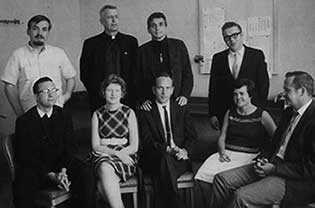
A
group of anti-war activists who came to be known as the "Catonsville
Nine," including Philip and Daniel Berrigan, broke
into the Catonsville, Maryland, draft board center and
burned over 600 draft files.
|
 |
|
The
Catonsville Nine in a picture taken in the police station
minutes after the action.
From
left to right (standing) George Mische, Philip Berrigan,
Daniel Berrigan, Tom Lewis. From left to right (seated)
David Darst, Mary Moylan, John Hogan, Marjorie Melville,
Tom Melville. photo Jean
Walsh |
Read
more about the Catonsville Nine |
|
|

|
100
protesters staged a silent "die-in" at Fifth Avenue and Pine Street
in downtown Seattle to protest shipment through
their city of Army nerve gas being transported from Okinawa,
Japan, to the Umatilla Army Depot in eastern Oregon. |
| Outrage and Rebellion |
|
In Washington, D.C.,
the Senate Select Committee on Presidential Campaign Activities,
headed by Senator Sam Ervin of North Carolina, began televised
hearings on the escalating Watergate affair. One week later,
Harvard Law Professor Archibald Cox was sworn in as Watergate
special prosecutor.
Flashback: On June 17, 1972, five men were arrested for breaking
into the Democratic National Committee headquarters in the
Watergate complex in Washington, D.C. with the intent to set
up wiretaps. One of the suspects, James W. McCord, Jr., was
revealed to be the salaried security coordinator for President
Richard Nixon's reelection committee. |
|
 |
Marcia Kadish, 56, and Tanya McCloskey,
52, of Malden, Massachusetts, were married at Cambridge City
Hall in Massachusetts, becoming the first legally married same-sex
partners in the United States. Over the course of the day,
77 other such couples tied the knot across the state, and hundreds
more applied for marriage licenses. |
The day was characterized
by much celebration and only a few of the expected protests
materialized. |
| Read
more |
|

Bertrand
Russell
|
Birthday of Sir Bertrand Russell, British philosopher, logician, essayist, and social critic, a leading figure in his country’s anti-nuclear movement. In 1954 he delivered his “Man's Peril [from the Hydrogen Bomb]” broadcast on the BBC, condemning the Bikini H-bomb tests, and warning of the threat to humanity from the development of nuclear weapons: “. . . as a human being to other human beings: remember your humanity, and forget the rest.”
A year later, together with Albert Einstein nine other scientists, he released the Russell-Einstein Manifesto calling for the curtailment of nuclear weapons.
|
| Text of the Russell-Einstein Manifesto |
He became the founding president of the Campaign for Nuclear Disarmament in 1958. He resigned in 1960, however, and formed the more militant Committee of 100 with the overt aim of inciting mass civil disobedience, and he himself with Lady Russell led mass sit-ins in 1961 that brought them a two-month prison sentence, at the age of 89. |
 |
Bertrand Russell in front of the British Ministry of Defence,
Whitehall, London |
|
| Supreme
Court endorsed “separate
but equal'' facilities for those of different races with its
Plessy v. Ferguson decision, a ruling that was overturned 58
years later. |
|
Margaret (Maggie) Kuhn founded the Gray Panthers (originally called the Consultation of Older and Younger Adults for Social Change) to consider the common problems faced by retirees — loss of income, loss of contact with associates, and loss of one of society's most distinguishing social roles, one's job. The members discovered a new kind of freedom in their retirement — the freedom to speak personally and passionately about what they believed in, such as their collective opposition to the Vietnam War. |
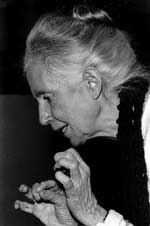 Maggie Kuhn, founder of the Gray Panthers Maggie Kuhn, founder of the Gray Panthers
|

|
Gray
Panther history |
|
In the Rajasthan Desert in the state of Pokhran, India successfully detonated its first nuclear weapon, a fission bomb similar in explosive power to the U.S. atomic bomb dropped on Hiroshima, Japan.
The test fell on the traditional anniversary of the Buddha's enlightenment, and Indian Prime Minister Indira Gandhi received the message "Buddha has smiled" from the exuberant test-site scientists after the detonation. The test, which made India the world's sixth nuclear power, broke the nuclear monopoly of the five members of the U.N. Security Council—the United States, the Soviet Union, Great Britain, China, and France. |
Detailed background on India’s nuclear weapons program and its first test |
|
A jury in a federal court in Silkwood v. Kerr-McGee established a company’s responsibility for damage to the health of a worker in the nuclear industry. Karen Silkwood worked for the Kerr-McGee Nuclear Corporation at their Cimmaron, Texas, plant where plutonium was manufactured. |
|
Silkwood had become the first female member of the Oil, Chemical and Atomic Workers bargaining committee, focusing on worker safety issues, but had suffered radiation exposure in a series of unexplained incidents. The jury in Judge Frank G. Theis’s court awarded her estate $505,000 in actual damages, and $10 million punitive damages.
|

|
| Karen Silkwood's sisters and parents |
She had died in a car accident on her way to a meeting with a The New York Times reporter five years earlier. |
| Karen Silkwood remembered |
The Supreme Court upheld the decision and the award |
|
| 10,000
participated in a "No
More War" march in New York City. |
|
Playwright and activist Lillian Hellman advised the U.S. House Committee on Un-American Activities (HUAC) that she refused to testify against friends and associates, saying, “I cannot and will not cut my conscience to fit this year's fashions.” |
 Lillian Hellman Lillian Hellman |
| Learn
more about Lillian Hellman |
Text of her letter to HUAC |
|
| Two
international human rights workers, Mario Calderón
and Elsa Alvarado, as well as her father, were shot dead
in Bogotá, Colombia, by a paramilitary gang. |
| Their
one-year-old was hidden and thus spared, her mother wounded.
The couple worked for the Center for Investigation
and Popular Education (Centro de Investigación
y Educación
Popular, or CINEP), a non-governmental organization founded
by the Jesuits (the Roman Catholic Society of Jesus) to foster
education, understanding, justice and sustainable development
in Colombia. |
 Mario
Calderón and Elsa
Alvarado Mario
Calderón and Elsa
Alvarado |
| CINEP’s peace program |
|
Emma Goldman spoke to garment workers in Union Square about the benefits of birth control. |
 |
Goldman speaking to a crowd of garment workers about birth control in New York City's Union Square |
| Read more about Emma Goldman: Birth Control Pioneer |
|
A mob of 300 white segregationists, with the tacit assent of the local police, attacked a busload of both black and white “Freedom Riders” in Montgomery, Alabama’s bus depot.
Among those beaten was Justice Department official John Seigenthaler who had tried to negotiate their safety. |
|

|
Attention to the violence forced Attorney General Robert Kennedy to send in U.S. Marshals to protect the Riders. They had been seeking to guarantee equal access to interstate transportation by riding the bus but had been met by violence elsewhere in Alabama as well as South Carolina. |
Freedom
Riders challenged racial segregation at Montgomery bus
depot. |
| 50 Years After Their Mug Shots, Portraits of Mississippi’s Freedom Riders |
|
In the first such instance during the Vietnam War, Arlington Street Unitarian-Universalist Church in Boston offered sanctuary to Robert Talmanson and William Chase, both of whom had refused to participate in the war.
Talmanson had been convicted of refusing induction, and Chase had gone AWOL (absent without leave) as an army private after having served nine months at Cam Ranh Bay in Vietnam.
Church leaders had declared theirs a “liberated zone” on the first day of the trial of Dr. Benjamin Spock and four others in federal court for counseling draft resistance. They believed that individuals had a right to decide not to kill as nonviolent persons, most especially in a war they considered unjust. |
|
A
delegation of U.S. pacifists traveled to Cuba to exchange
children's art. |
|
Sarojini Naidu, a renowned Indian poet, was arrested as a leader of the nonviolent “raid” on the Dharasana Salt Works, a salt production facility. She had assumed leadership of the effort to break the salt monopoly after the arrest of Mahatma Gandhi.
She and as many as 2500 filled the local jails for their civil disobedience. Column after column of Indians advanced toward the gates and had been severely beaten by the native police under British direction. |
Not one satyagrahi (one who works for justice with courage and sacrifice but without violent force) raised a hand to defend himself; many lost consciousness, and some died.
The British Raj, the ruling colonial authority, controlled all production of salt, a dietary necessity in the tropics; the government taxed it as well. Gandhi decided to focus attention on salt as an example of unfair British oppression in his effort toward national independence for India.
British public opinion was deeply affected by the Dharasana nonviolent movement, which revealed the violence inherent in the British colonial system. |
 |
| Sarojini Naidu |
| More on the Dharasana Salt Works The Pinch Heard "Round the World" |
|
|
The United States conducted the first airborne test of an improved hydrogen bomb, dropping it from a B-52 bomber over the tiny island
of Namu, part of the Bikini Atoll in the Pacific Ocean. The United States first detonated a hydrogen bomb in 1952 in the Marshall Islands,
also in the Pacific. This bomb was far more powerful than those previously tested and was estimated at 15 megatons or larger (one megaton is roughly equivalent to one million tons of TNT). Observers said that the fireball caused by the explosion measured at least four miles in diameter and was “brighter than the light from 500 suns.”
|
|
| The U.S. Senate approved a $20 billion program to return the U.S. to full-scale production of chemical and nerve-gas weapons (CW). |
|

|
Though the U.S. maintained a public policy opposing chemical weapons, it extended financial and military assistance to Iraq in its war against Iran (1980-88), despite the Iraqi military’s frequent use of such weapons. Iraq had developed its “CW production capability, primarily from Western firms, including possibly a U.S. foreign subsidiary” (from a memorandum to Secretary of State Alexander Haig).
|
President Reagan’s Special Envoy to the Mideast Donald Rumsfeld meeting Saddam Hussein in 1983. Rumsfeld had become a member of the President's General Advisory Committee on Arms Control the previous year. |
| Watch
a video on the U.S./Saddam Hussein partnership |
|
|

|
Eugene V. Debs, president of the American Railway Union, was imprisoned in Illinois for
his role in the Pullman Palace Car Company strike and boycott, which had stalled most rail traffic west of Detroit. |
Read
more about the Pullman strike
|
|
|
Federal marshals entered Boston’s Arlington Street Unitarian-Universalist Church to arrest Robert Talmanson, who had been convicted of refusing induction into the U.S. Armed Forces. He had been offered sanctuary there by the leaders of the church who shared his opposition to the Vietnam War.
When the marshals tried to remove him, access to their car was blocked by 200-300 nonviolent sanctuary supporters. |
 |
Draft resister Robert Talmanson dragged by authorities
from Arlington Street Church. |
| The story from Confronting the War Machine: Draft Resistance During the Vietnam War by By Michael S. Foley |
|
Four thousand protesters occupied the site of the Trident nuclear submarine base in Bangor, Washington. The base was built for the maintenance and resupply of Ohio-class submarines.
Though built as part of the U.S. nuclear deterrent, they were perceived by some as giving the U.S. a nuclear first-strike capability with their ability to each deliver 24 missiles with multiple warheads from very close to the borders of other countries. The 14 vessels are at sea 2/3 of the time and can travel as deeply as 800 feet for a time limited only by its food supply. |
| Read
more about Ground Zero |
|
Delegates from 127 countries formally voted approval of the Stockholm Convention on Persistent Organic Pollutants (POPS), a treaty calling for the initial elimination of 12 of the most dangerous manmade chemicals, nine of which are pesticides.
|
 |
| POPS are often toxic at very low levels, resist degradation and thus persist for decades or longer, because they become concentrated in living tissue, are readily spread by atmospheric and ocean currents. |
Swedish Prime Minister Goran Persson, lauding the agreement, said,
“. . . we have to go further. Dangerous substances must be replaced
by harmless ones step by step. If there is the least suspicion that new chemicals have dangerous characteristics it is better to reject them.”
|
POPS background
|
|
U.S. General Winfield Scott began the forced removal of the Cherokee Indians from North Carolina, Georgia, Alabama, and Tennessee, and their detention in forts built for that purpose. He was implementing the Treaty of New Echota, signed by a few members of the tribe relinquishing their lands for a payment of $5 million, under orders from President Martin VanBuren.
|
 |

|
16,000 Cherokee were then driven on foot to “Indian Territory” (what is now Oklahoma). Of those who set out on the forced march known as the “The Trail of Tears,” nearly one-quarter died along the way or as a result of the relocation. |
| Detailed history of the Trail of Tears |
| Cherokee letter protesting the Treaty of New Echota from Chief John Ross |
|
| 10,000 marched in London protesting British Prime Minister Margaret Thatcher’s Falklands War. The Falklands are islands off the coast of Argentina (known there as the Malvinas), and Great Britain was fighting to maintain colonial control over them, which they originally claimed in 1833. |

an
anti-war demonstration in Argentina
|
|
| 400,000 demonstrated for peace and disarmament in Tokyo, Japan. |
|
|
Belarus, Kazakhstan and Ukraine, which had inherited strategic nuclear weapons from the Soviet Union, ratified the START I treaty and joined the Nuclear Non-Proliferation Treaty as non-nuclear states. Through the Lisbon Protocol, Belarus, Kazakhstan, Russia and Ukraine became parties to START I as legal successors to the Union of Soviet Socialist Republics. The breakup of the Soviet Union delayed START's entry into force nearly three-and-a-half years.
|
The Strategic Arms Reduction Treaty (START I)
|
|
|
|
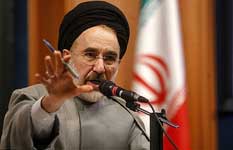
Iranians elected a new president, Mohammad Khatami, with 70% of the vote, over hard-liners in the ruling Muslim clergy. Khatami won largely due to young people and women, who voted for him because he promised to improve the status of women and respond to the demands of the younger generation in Iran. |
| Khatami in 2009 |
| Political situation in Iran before and after Khatami’s election |
Khatami today |
|
| Congress passed a third major tax cut proposed by President George W. Bush in his first two years in office: $330 billion. The budget deficit in the following year was the largest ever and a record percentage of the Gross Domestic Product. |
|
| The Virginia House of Burgesses declared this a day of “fasting, humiliation and prayer” in reaction to the British closure of the Port of Boston. |
|
 Dora Montefiore Dora Montefiore
|
British suffragist Dora Montefiore protested the lack of women’s right to the vote by refusing to pay taxes, and barricading her house against bailiffs sent to collect. |
| Dora Montefiore biography |
|
| An Anti-Conscription Parade was held in Victoria Square, Montreal, Quebec, in resistance to a Canadian draft to send soldiers to the European war. Riots nearly a year later resulted in the death of four demonstrators in Quebec City. |
 |
| Anti-Conscription
Parade, Victoria Square |
|
|

|
Senator Barry Goldwater (R-Arizona), running for the Republican Party nomination for president, gave an interview in which he said he would consider the use of low-yield atomic bombs in North Vietnam.
|
|
| Four protesters, including
Phil Berrigan and Tom Lewis, were sentenced in Baltimore,
Maryland, to six years each in prison for pouring blood on
draft records. |
|
At
Fort Bragg, North Carolina, an anti-war newspaper advertisement,
signed by 29 U.S. soldiers supporting the Concerned Officers
Movement, resulted in controversy.
The group had been formed in 1970 in Washington, D.C. by a small group of junior naval officers opposed to the war. |
| The newspaper advertisement at Fort Bragg was in support of the group's members, who had joined with anti-war activist David Harris and others in San Diego to mobilize opposition to the departure of the carrier USS Constellation for Vietnam. No official action was taken against the military dissidents, though many were forced to resign their commissions. |

|
| GI resistance to the Vietnam War |
|
May
24, 1981 (since 1981) |
International Women's Day for Disarmament was declared, calling for the peaceful resolution of conflict, and an end to the horror and devastation of armed conflict. |
| IFOR's Women Peacemakers Program |
|
| More
than 200,000 people participated
in a massive anti-nuclear demonstration in Tokyo, Japan. |
|
| Israeli troops completed their withdrawal from southern Lebanon, ending 18 years of occupation. Prime Minister Ehud Barak: “From now on, the government of Lebanon is accountable for what takes place within its territory, and the Lebanese and Syrian governments are responsible for preventing acts of terror or aggression against Israel, which is from today deployed within its borders.” |
|
A
group of African slaves in Massachusetts Bay colony petitioned
the British royal governor for freedom as their natural right: “. . . we have in common with all other men a natural right to our freedoms without Being depriv’d of them by our fellow men as we are a freeborn Pepel [people] and have never forfeited this Blessing by aney compact or agreement whatever.”
|
|
|
John T. Scopes was indicted for teaching Darwin's theory of evolution. Scopes, a football coach and substitute high school biology teacher in Dayton, Tennessee, agreed to be arrested and put on trial for teaching evolution. He was challenging the legitimacy of a four-day-old state law barring Darwin’s theory from the public school curriculum. |
 |
| The Scopes "Monkey Trial" ACLU |
|
|
|
Leaders of 32 African nations met in Addis Ababa, Ethiopia, to set up the Organization of African Unity (OAU), giving them a united voice for the first time in the continent’s history. The primary aim of the OAU was to end European colonial control in the countries where it still existed at the time: Southern Rhodesia (now Zimbabwe), South Africa, Mozambique and Angola. |
 OAU
flag OAU
flag
|
Read
more |
|

|
An estimated 7 million Americans participated in Hands Across America, forming a line across the country from Los Angeles to New York to raise public awareness of the issues of hunger and homelessness in the U.S. Participants paid ten dollars [almost $20 in 2009]to reserve their place in line; the proceeds were donated to local charities to feed the hungry and help the homeless. |
|
Four activists, members of the Catholic Worker movement and known as “Riverside Ploughshares,” were arrested for pouring blood and hammering on the USS Philippine Sea's Tomahawk cruise missile hatches. The ship was visiting New York City for the annual “Fleet Week.” |
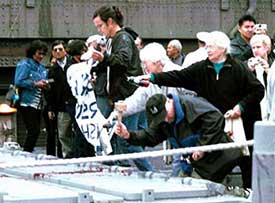
pouring
blood and hammering..
|
| “With
hammers we have initiated the process of disarming
this battle ship, of transforming this carrier of mass
destruction into a vessel for peace...” |
| Details of the Riverside Ploughshares action |
|
|
|
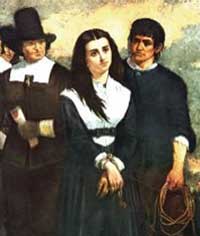
The first person in America was executed for the crime of witchcraft. Alse Young was arrested, tried in Windsor, Connecticut, and hanged at Meeting House Square in Hartford, the site of what is now the Old State House.
There is no further record of Young's trial or the specifics of the charge — only that she was a woman, as 80% of those executed for witchcraft were. The Salem witch trials would not begin for another 45 years.
|
| Some
300 years later the U.S. experienced another “witch
hunt” as Senator Joe McCarthy and the House Un-American
Activities Committee pursued communists. Arthur Miller
makes this comparison in his famous play “The Crucible.” |
Read
more about the play “The Crucible” The Guardian |
|
|
United Auto Workers organizers and Ford Service Department men clashed in a violent confrontation on the Miller Road Overpass outside Gate 4 of the Ford River Rouge Plant in Dearborn, Michigan. It became known as “The Battle of the Overpass.” Henry Ford announced: "We'll never recognize the United Automobile Workers Union or any other union." Though General Motors and Chrysler
signed collective bargaining agreements with the UAW
in 1937, Ford held out until 1942.
|
| More
background and photos |
Read
more |

The
Ford Servicemen (goons) approach Walter Reuther and
Richard Frankensteen, third and second from right,
and the other unionists.
|

UAW
official Richard Frankensteen being beaten
by
Ford goons |
|
|
A patent was filed in the U.S. for the H-Bomb, the hydrogen, or fusion-based, nuclear explosive device.
|
 |
|
 |
John Lennon and Yoko Ono (along with her 5-year-old daughter Kyoko) held their second Bed-in for Peace at the Queen Elizabeth Hotel in Montreal, Quebec. A late-night rendition of “Give Peace a Chance,” recorded in the hotel room with their visitors singing and accompanying, reached No.14 on the Billboard pop music charts. |
John
and Yoko meet cartoonist Al Capp in their hotel room |
|
The Anti-Ballistic Missile (ABM) Treaty was signed by U.S. and U.S.S.R. (Union of Soviet Socialist Republics which included Russia and 15 other republics). The two countries agreed not to build defensive missile systems and thus to limit escalation of the nuclear arms race. It was reasoned that if either side deployed defensive missiles, the other would be forced to respond by increasing the number, explosive yield or effectiveness of their offensive nuclear weapons and delivery systems to maintain the balance of nuclear deterrence.
Research and development of defensive systems was allowed under the ABM treaty, the U.S. having spent about $100 billion in the 20 years before the treaty was abrogated by President George W. Bush in the first months of his presidency. |
|
| 20,000 Israeli Jews and Palestinians participated in a peace rally in Israel’s capital, Tel Aviv. |
|
The U.S. Supreme Court ruled a sit-down strike was not a violation of the Sherman Anti-Trust Act even if it interfered with interstate commerce. The company had sued for treble damages (triple their financial loss) under the Act. The Court said that if the strike were found to be a restraint of trade, then “practically every strike in modern industry would be brought within the jurisdiction of the federal courts under the Sherman Act.”
The American Federation of Full Fashioned Hosiery Workers under its president, William Leader, had declared a strike at Apex Hosiery Co. in Philadelphia, and had organized support among other workers in the city. When Apex refused to recognize the union, he declared a sit-down strike and led an occupation of the factory which lasted for
seven weeks.
Unlike the UAW sit-down at the GM plant in Flint, however, violence was committed against the management personnel and significant damage was done to manufacturing equipment. |
Summary and full text of the Supreme Court decision |
|
 |
The record album, The Freewheelin’ Bob Dylan, which featured the song “Blowin' in the Wind,” was released. The song warns of the perils of nuclear war. |
“ ...how
many times must the cannon balls fly
Before they're forever banned?” |
| The
song and the lyrics |
|
 |
The Sierra Club, America's oldest, largest and most influential grassroots environmental organization, was organized in San Francisco with wilderness explorer John Muir as its first president. The organization’s initial effort was to defeat a proposed reduction in the boundaries of Yosemite National Park.
Muir introduced President Theodore Roosevelt to Yosemite the following year, inspiring him during his presidency to establish the U.S. Forest Service, create 5 national parks, and sign the 1906 Antiquities Act, under which he proclaimed 18 national monuments. |
“Everybody
needs beauty as well as bread, places to play in and pray
in, where nature may heal and give strength to body and soul
alike.”
– John Muir, The Yosemite (1912) |
 |
| The
Sierra Club today |
| John Muir |
|
 |
Amnesty International (AI) was founded on this date in Great Britain.
It is a worldwide movement of people who campaign for internationally recognized human rights, particularly as laid out in the United Nations Universal Declaration of Human Rights. Members of AI help maintain a media focus on political prisoners, and organize public pressure to afford them their legal rights and obtain their release. |
|
Visit
Amnesty International |
Read the Universal Declaration of Human
Rights: |
|
Amnesty International projects |
|
Black
and white civil rights advocates were attacked as they
sat-in at a Woolworth’s lunch counter in Jackson,
Mississippi. They were defying state laws against serving “colored” citizens
at “whites-only” public facilities.
According to John Salter, AKA Hunter Bear, one of those who sat
in:
“This was the most violently attacked sit-in during the 1960s and is the most publicized. A huge mob gathered, with open police support while the three of us sat there for three hours. I was attacked with fists, brass knuckles and the broken portions of glass sugar containers, and was burned with cigarettes. I'm covered with blood and we were all covered by salt, sugar, mustard, and various other things.” |
 Attacked
for trying to eat at Woolworth’s Attacked
for trying to eat at Woolworth’s
(L to R): John Salter (Hunter Bear), Joan Trumpauer (now Mulholland), and Anne
Moody. |
| More
photos and the story of the struggle against segregation |
| Freedom Movement Bibliography |
|
| Seven women fasted for 10 days in Springfield, Illinois, in support of ratification of the Equal Rights Amendment by the Illinois state legislature. The amendment had already been ratified by 35 other states of the 38 required. |
|
| Pakistan exploded five underground nuclear devices in response to India's most recent nuclear tests. |
.  |
Since the British partitioned the subcontinent in 1947, there have been three wars between the two countries and numerous border clashes over the disputed Kashmir province. Kashmir had a majority (77%) Muslim population at the time of partition, but became part of predominantly Hindu (80%), though constitutionally secular, India. |
 |
Dr.
Abdul Qadeer Khan, widely proclaimed as the
" Father
of Pakistan's atomic bomb," stands in the access tunnel
inside
the Chagai Hills nuclear test site before Pakistan's
28 May 1998 underground nuclear test. |
Read
more |
|
| In the depths of the Great Depression, the “Bonus Expeditionary Force,” a group of 1000 World War I veterans seeking to cash in their veterans’ bonus certificates, arrived in Washington, D.C. Though issued to the veterans in 1924, the certificates were not scheduled to be paid until 1945. By mid-June, the vets had set up a massive “Hooverville,” a contemporary term for an encampment of the homeless. |
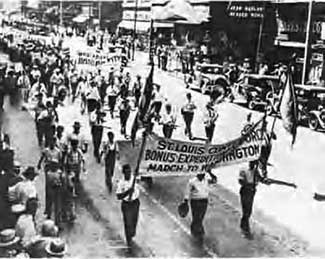 |
One month later, other veteran groups made their way to the nation's capital, swelling the Bonus Marchers to nearly 20,000 strong, most of them unemployed veterans in difficult financial straits.
President Herbert Hoover ordered the Army to clear out the veterans when they resisted being evicted by Washington police. Infantry and cavalry supported by six tanks were dispatched with Chief of Staff General Douglas MacArthur in command. |
| The St. Louis contingent of the Bonus Expeditionary
Force is pictured here as it starts for Washington, D.C., in
May 1932. |
| Major Dwight D. Eisenhower served as his liaison with Washington police and Major George Patton led the cavalry. This was a direct violation of the Posse Comitatus Act, which prohibits the armed forces’ being used against U.S. citizens. |
| More
on the Bonus Army |
|
 |
In
one of the first demonstrations promoting equal treatment
of homosexuals, Jack Nichols, Barbara Gittings and others
picketed in front of the White House.
Her sign read, “Sexual preference is irrelevant to federal employment.” |
Early protest for rights of homosexuals |
|
| More about Barbara Gittings |
|
| The Christic Institute filed a lawsuit charging U.S. government complicity in an assassination bombing at La Penca, Nicaragua, and that the CIA had a role in smuggling cocaine into the U.S. to fund the Contras, an insurgent military force working to bring down the government of Nicaragua. |
| Find
out more about the Christic Institute |
|
Memorial Day, originally known as Decoration Day, was first observed some say [see May 1, 1865] when two women in Columbus, Mississippi, placed flowers on the graves of Civil War soldiers, both Confederate and Union. War widow Augusta Murdoch Sykes, one of the Columbus planners, pointed out that “after all, they are somebody’s sons.” It is now celebrated to honor all those who have died in America’s wars.
|
 |
“The
30th day of May, 1868, is designated for the purpose of strewing
with flowers, or otherwise decorating the graves of comrades
who died in defense of their country....” -from an order from the Grand Army of the Republic |
|
 |
1000 striking steel workers (and members of their families), on their way to picket at the Republic Steel plant in south Chicago where they were organizing a union, were stopped by the Chicago Police. In what became known as the “Memorial Day Massacre,” police shot and killed 10 fleeing workers, wounded 30 more, and beat 55 so badly they required hospitalization. |
| More
on the incident |
Watch a video oral history with historic footage |
|
| The U.S. Supreme Court ordered (in a unanimous decision known as Brown II after the 1954 decision Brown v. Board of Education) that school integration be implemented “with all deliberate speed,” ordering the lower federal courts to require the desegregation of public schools. |
| Between
1955 and 1960, federal judges held more than 200 school
desegregation
hearings. The decision reiterated “the fundamental principle that racial discrimination in public education is unconstitutional . . . . All provisions of federal, state or local law requiring or permitting such discrimination must yield to this principle.” |
 |
A timeline of school integration |
|
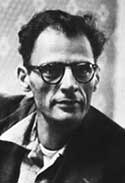 |
U.S. playwright Arthur Miller was convicted of contempt of Congress for refusing to reveal the names of associates who were alleged to be Communists.
The conviction was ultimately set aside on appeal. |
| More about Arthur Miller |
| Arthur Miller |
|
| Nguyen Thi Can, a 17-year-old Buddhist girl, committed suicide by setting herself afire (self-immolation) on a street in the city of Hue, Vietnam. She was protesting against the South Vietnamese regime and the war being waged by the U.S., the separate armies of the north and south, and the insurgent Viet Cong; it was the fifth such death in three days. |
 |
|
| A bipartisan majority (69-19) of the U.S. Senate voted to cut off funds for the bombing of Cambodia (Vietnam’s neighbor) despite pleas from U.S. President Richard Nixon’s Secretary of State, Henry Kissinger. |
|
May 1 2 3 4 5 6 7 8 9 10 11 12 13 14 15 16 17 18 19 20 21 22 23 24 25 26 27 28 29 30 31
visit
another month
Jan
• Feb
• March • April
• May • June
• July
• Aug • Sept
• Oct • Nov
• Dec
|
We make custom buttons
your design or ours
email your idea and info |
|
If you are not already on our email list and would like to have our free calendar delivered to your inbox then please . . .
|
 |
Sign up for our
Peace and Social Justice history newsletter.
Just send me an email |
|
|
Please
support this newsletter visit
peacebuttons.info
Because of your support peacebuttons has been able to donate to
several peace and justice organizations.
see list
Thank you ! |
|
|
|
|




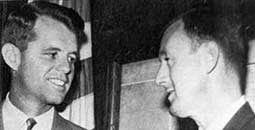 Robert
Kennedy and John Seigenthaler
Robert
Kennedy and John Seigenthaler