| |
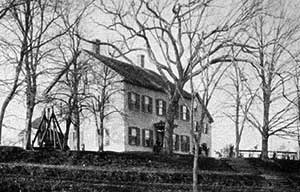 |
Brook
Farm, perhaps history's most well-known utopian community,
was founded by George and Sophia Ripley near West Roxbury,
Massachusetts. Its primary appeal was to young Bostonians
who were uncomfortable with the materialism of American
life, and the community was a refuge for dozens of transcendentalists,
including authors Ralph Waldo Emerson and Nathaniel Hawthorne. |
Following
four days of demonstrations against the Military Services
Act that devolved into rioting in Quebec City, Canadian
Prime Minister Robert Borden sent in troops from Ontario
to stop the violence. Orders from the soldiers were read
only in English to the mostly Francophone demonstrators,
and when the they didn’t disperse, the troops fired,
killing four and wounding 70.
[see March 28, 1918] |
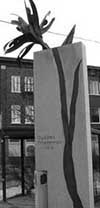 |
A
memorial in Quebec to those who died
protesting conscription
into World War I |
More about Brook Farm  |
|
| 500 schoolchildren,
in the depth of the Depression, paraded through Chicago's downtown
section to the Board of Education offices, demanding that the
school system provide them with food. |
|
The
African National Congress had called on parents to withdraw
their
children by this day from South African schools in resistance
to the Bantu Education Act. That 1953 law transferred education
of the Bantu (blacks) from religious missions to state-controlled
schools. Mission education, argued then-Minister of Bantu
Education Dr. H.F. Verwoerd, not only tended to create “false
expectations” amongst the natives, but was also in
direct conflict with South Africa’s racially separatist
apartheid policies.
Whites, who were in complete control of government and society,
comprised only 14% of South Africa’s population. Verwoerd
presented to Parliament:
"When I have control of native education, I will reform
it so that natives will be taught from childhood to realize that
equality with Europeans is not for them. There is no place for
him (the black child) in European society above the level of
certain forms of labour…What is the use of teaching a Bantu
child mathematics when it cannot use it in practice?" |
|
|
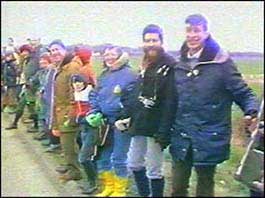
Tens
of thousands in the United Kingdom formed a “peace
chain” 22.5 kilometers (14 miles) long to express
their opposition to nuclear weapons. The chain started
at the American airbase at Greenham Common, passed the
Aldermaston nuclear research center, and ended at the
ordnance factory in Burghfield.
|
|
| At the same time 15,000 people took part in the first of
a series of anti-nuclear marches in West Germany. They were
protesting the siting of American cruise missiles on West
German territory. |
| Contemporaneous
coverage of the Peace Chain |
|
| The U.S. Environmental
Protection Agency ordered an end to the dumping of sludge
off the New Jersey coast into the Atlantic Ocean. |
21st
century sludge |
|
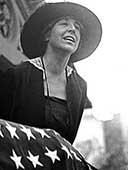 |
Jeannette Rankin, a Republican from Montana, took her seat in the U.S. House of Representatives. The first woman ever elected to Congress, she became the only member to vote against U.S. entry into both world wars.
Rankin lost her seat in the next election but was re-elected twenty years later when she opposed entry into World War II. She again served just one term. |
Though American women weren’t guaranteed the right to vote for three more years with passage of the 19th amendment, women in Montana, Wyoming, Utah and Washington had full voting rights even before statehood.
Rankin was instrumental in passing laws that made married women citizens in their own right. |
Jeannette Rankin biography |
|
| One hundred thousand Vietnamese demonstrated in DaNang against both the U.S. and their South Vietnamese governments. Civil unrest spread also to Hue and the capital, Saigon. |
|
|
Massachusetts, in the midst of the Vietnam war, enacted a law which exempted its citizens from having to fight in an undeclared war.
The U.S. Congress had never formally declared war on North Vietnam
as required by Article 1, Section 8 of the U.S. Constitution.
|
|
|
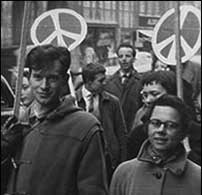
10,000
British joined a rally in advance of a three-day, fifty-mile
peace march from Trafalgar Square, London, to
Aldermaston, Berkshire. Berkshire was the site of the
AWRE (Atomic Weapons Research Establishment). This march
marked the beginning of many protests against Britain's
devel-opment of nuclear weaponry. Thousands made the march
along the same route for many years.
|
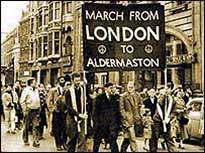 |
| Some
10,000 people joined the 1958 rally. |
|
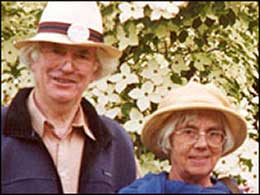
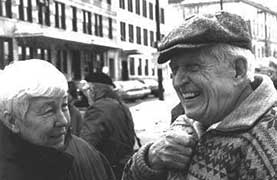
David
and Renee Gill at the first Altermaston march 1958 (left)
and at the April 2004 march (right)
...still
protesting for
nuclear
disarmament.
Their story
|
 |
|
| Black residents of Birmingham, Alabama, sat in at several lunch counters seeking to be served as customers. It was part of "Project C" (for Confrontation) on "B Day" (for Birmingham) organized by Reverends Fred Shuttlesworth of the Alabama Christian Movement for Human Rights and Martin Luther King, Jr. of the Southern Christian Leadership Conference (SCLC). They issued a Birmingham Manifesto: “. . . the patience of an oppressed people cannot endure forever.”
|
|

|
The
Reverend Martin Luther King, Jr. delivered his "I've
been to the mountaintop" speech in Memphis, Tennessee.
King was there to support sanitation workers striking to
protest low wages and poor working conditions.
|
“.
. . I've seen the Promised Land. I may not get there with
you.
But I want you to know tonight, that we, as a people, will
get to the promised land!And so I'm happy, tonight. I'm not
worried about anything. I'm not fearing any man! Mine eyes
have seen the glory of the coming of the Lord!”
King was assassinated the next day. |
| Read
the speech ...or
listen |
| Watch
an excerpt of his final and prophetic speech |
|
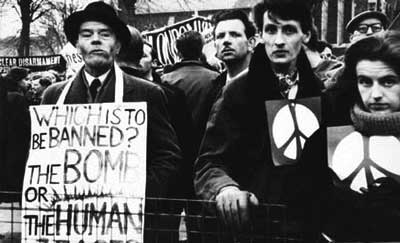 |
Four thousand began the first of eleven consecutive annual Easter protest marches. It took three days on foot from London to Aldermaston AWRE (Atomic Weapons Research Establisment) base in England.
|
Aldermaston March, 1st Day, 1958. |
Watch
one of the marches
|
Interviews with participants |
|
| Reverend Martin Luther King, Jr., head of the Southern Christian Leadership Conference, in a speech to Clergy and Laity Concerned at the Riverside Church in New York City, called for common cause between the civil rights and peace movements. The Nobel Peace Prize winner proposed the United States stop all bombing of North and South Vietnam; |
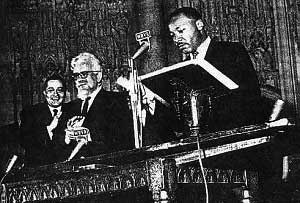 |
| MLK delivering the important speech |
| declare a unilateral truce in the hope that it would lead to peace talks; set a date for withdrawal of all troops from Vietnam; and give the National Liberation Front a role in negotiations. |
| " .
. . this war is a blasphemy against all that America
stands for . . . ." |
| Read
the speech or
listen |
Impact of the speech |
|
| Martin
Luther King, Jr., 39, was assassinated in Memphis, Tennessee,
where he had come to help with a strike by sanitation workers. |
 |
Riots
in reaction to the assassination broke out in over a
hundred cities across the U.S., lasting up to a week;
cities
included Chicago, Baltimore, Washington, DC, Cincinnati, Boston,
Detroit, Philadelphia, San Francisco, Toledo, Pittsburgh, and
Seattle. The federal government deployed 75,000 National Guard
troops. 39 people died and 2,500 were injured.
|
Reverends Ralph Abernathy, Jesse Jackson, and King on the balcony
of
the Lorraine Motel
shortly before he was shot. |
In
Indianapolis, Indiana, Senator Robert F. Kennedy (D-New York)
was campaigning for president. Learning
about the assassination just before speaking to a large rally,
he said, “we can make an effort, as Martin Luther King
did, to understand and to comprehend, and replace that violence,
that stain of bloodshed that has spread across our land, with
an effort to understand, compassion and love.”
Indianapolis
experienced no rioting that night. |
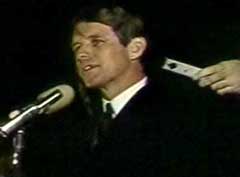 |
Senator
Robert Kennedy speaking to a large, mostly African-American
rally
about the death of Dr. Martin Luther King, Jr. |
| Video
and text of Kennedy's speach |
The
building now houses the National Civil Rights Museum. visit
the museum
|
James
Earl Ray confessed to the slaying, was sentenced to 99
years in prison, but later recanted. Numerous people originally
involved in investigating him have raised serious doubts
about his involvement; after Ray's death, a 1999 civil
jury trial in Memphis concluded that Ray did not act alone.
|
|
| CBS
cancelled “The Smothers Brothers' Comedy Hour," a
television show which featured edgy political satire and
such rock bands as the Beatles, the Who, Jefferson Airplane
and the Doors. |
|
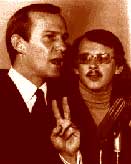
Smothers
brothers
|
The
brothers had refused to censor a comment made by Joan
Baez. She wanted to dedicate a song to her husband, David,
who was about to go to jail for objecting to the draft
during the Vietnam War.
|
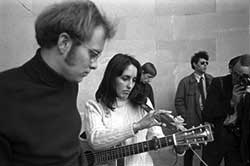
David
Harris and Joan Baez
|
More about
the show
|
| Joan Baez and the Smothers Brothers sing Dylan’s “I Shall Be Released” |
|
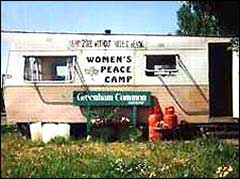 |
The women of the main peace camp at Greenham Common in Berkshire, England, were evicted by British authorities. They had been encamped for over two years to oppose the presence of U.S. nuclear-armed cruise missiles at the military base there. They said their eviction would not end their protest. |
Read more |
|
Emil Seidel was elected mayor of Milwaukee and became the first socialist mayor of a major city in the United States. During his administration the first public works department was established, the first fire and police commissions were organized, and a city park system came into being.
In 1912, the Socialist Party nominated Emil Seidel as their vice presidential candidate to run with Eugene Debs. |
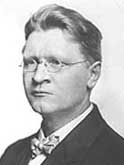 |
| Emil Seidel |
| Read more about Emil Seidel |
Milwaukee's Socialist Era |
|
Mohandas Gandhi and his followers reached the end of their 400 km (240 mile) march to the Indian Ocean coast at Dandi. He had left his ashram with 78 satyagrahis (“soldiers” of peaceful resistance), but the procession grew over the 23 days of traveling on foot until it stretched more than 3 km (2 miles).
When they arrived at the seaside, Gandhi made salt by allowing seawater to evaporate. This simple task was an act of civil disobedience because the British Raj, the governing colonial authority, had made salt-making a monopoly and a crime for others; additionally, there was a tax on salt, a necessary element of the Indian diet. |
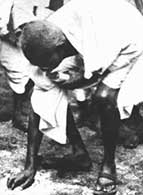 Gandhi picking up salt. Gandhi picking up salt. |
Gandhi had chosen this issue to demonstrate how British control affected all Indians, regardless of ethnicity, religion or caste. The nature of this “crime” allowed him to resist that power without violence. And the British were faced with potentially arresting millions who might now be willing to flout the Salt Laws.
He had written to Lord Irwin, the Viceroy of India, a month earlier:
“Dear
Friend, I cannot intentionally hurt anything that lives, much
less fellow human beings, even though they may do the greatest
wrong to me and mine. Whilst, therefore, I hold the British rule
to be a curse, I do not intend to harm to a single Englishman
or to any legitimate interest he may have in India . . . .” |
| Read Gandhi’s letter |
|
| The
Harrisburg Seven case ended in mistrial after 11 weeks. |
|
The Seven were charged with plotting to kidnap Secretary
of State Henry Kissinger, among other alleged crimes.
The defense attorney, recent former U.S. Attorney General
Ramsey Clark, asked by the presiding judge to call his
first witness said, "Your Honor, the defendants
shall always seek peace. They continue to proclaim their
innocence.
|
 |
| Elizabeth McAllister and Philip Berrigan,
two of the Harrisburg Seven |
The defense rests." Only Philip Berrigan
and Sister Elizabeth McAllister were declared guilty—of
smuggling letters in and out of prison.
They later married, co-founding Baltimore's Jonah
House. |
Visit
Jonah House |
|
| Demonstrations and sit-ins began at regional offices of the U.S. Department of Health, Education & Welfare (HEW, now Department of Health & Human Services) urging HEW Secretary Joseph Califano to implement an extension of civil rights that included the disabled. Since non-discrimination protection had been part of the Rehabilitation Act of 1973, the department had failed to agree to regulations (under Section 504) that would give the law practical effect in the lives of those it intended to protect. Discrimination on the basis of disability was to be illegal in any program which received federal funds. |
| At all the offices the demonstrators left at the end of the working day, except two: Washington, DC and the San Francisco regional headquarters. |
| Though negotiations were continuing between the Carter administration and the American Coalition of Citizens with Disabilities, those in San Francisco, led by Judith Heumann, held their ground until Califano signed the Sec. 504 regulations on April 28. It had been the longest sit-in of a federal office in history. |
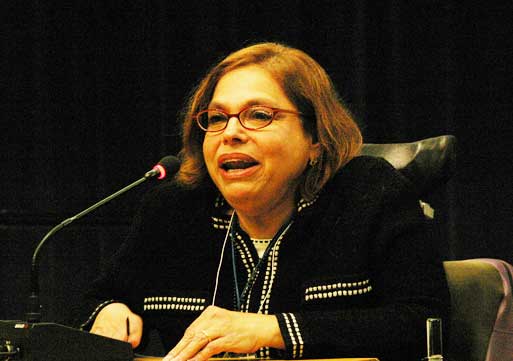 |
| Judith Heumann, Advisor for Disability and Development. |
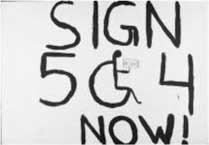 sign from the campaign sign from the campaign |
Short film about the sit-in
(“Recalling an invigorating act of civil disobedience”)
|
How Section 504 became law and how its supporters prevailed
|
|
Dublin, Ireland,
declared itself a nuclear-free zone by vote of
its City Council. |
|
| Columbia University students occupied Hamilton Hall to demand divestment by the university of its assets invested in companies doing business with South Africa. The selling off was intended to pressure the racially separatist government to eliminate its racially separatist policy of apartheid. |
|
| Solidarity
(Solidarnosc in Polish) became the first independent
labor union given
legal status in Poland. |
|
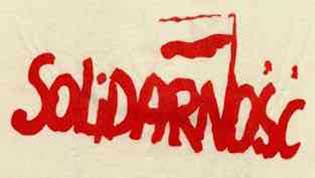
|
It started out as a strike committee
among shipyard workers advocating democratic reforms during
the summer of 1980 in Gdansk (FKA Danzig). A very high
percentage of the Polish workers, a broad representation
of the political and social opposition to the communist
military regime, became members despite the union’s
having been declared illegal in October of 1982.
|
| Solidarity’s
legacy |
|
| The March for Women’s Lives, in support of women's reproductive rights and equality, drew several hundred thousand people to Washington, D.C. There were students representing 600 college campuses. |
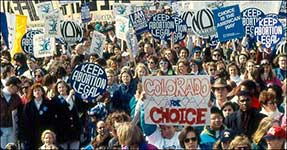 |
One of the largest protests ever in the nation's capital, the pro-choice rally occurred as the U.S. Supreme Court was about to consider the constitutionality of a Pennsylvania law that limited access to abortions. |
| Part
of the huge turnout taking part in the March for Women's
Lives |
Many abortion-rights advocates feared that the high court, with its conservative majority, might find the Pennsylvania law constitutional,
or even overturn the 1973 Roe v. Wade ruling that made abortion legal. |
| Read
more about this march |
|
|
54
were arrested in a Good Friday protest at Livermore Nuclear
Weapons Laboratory in California.
|
|
| The first major slave rebellion in the North American British colonies took place in New York City. One out of every five New Yorkers was enslaved at the time. Twenty-three black slaves set fire to buildings, killed six white British subjects and wounded six others. |
| More
on the rebellion and its aftermath |
Slavery
in New York |
|
Robert
Peary, his negro servant, Matthew Henson, and four Eskimos
reached the geographic North Pole for the first time. |
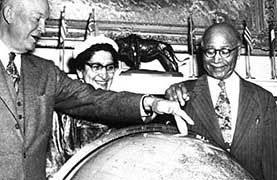
|
|
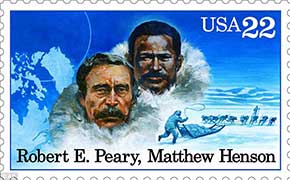 |
| Matthew Peary at the White House, 1954 |
Stamp issued 2005 |
| Though
Henson was alongside Peary, widely hailed as a courageous
explorer, during that and subsequent Arctic expeditions,
Henson achieved little notice until much later in life. |
| Article
about the unsung hero of the polar expedition |
|
| Dozens of major cities in the United States experienced an escalation of rioting in reaction to the assassination of Martin Luther King, Jr. two days before. At least 19 people had already died in the arson, looting and shootings. Several hundred had also been injured and about 3,000 arrested—most of those in Washington, D.C. |
|
| Bobby
Hutton, the 17-year-old first member of the Black Panther
Party was
gunned down by officers of the Oakland Police Department. Police
opened fire on a car of Black Panthers returning from a meeting.
The Panthers escaped their vehicle and ran into a house. Police
attacked the house with tear gas and gunfire. After the building
was on fire, the Panthers tried to surrender. Hutton came out
of the house with his hands in the air. |
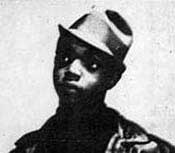 Bobby
Hutton Bobby
Hutton |
| But a police officer
shouted, "He's got a gun." This prompted further
police gunfire that left Hutton dead and Panthers co-founder
Eldridge Cleaver wounded. Police later admitted that Hutton
was unarmed. |
|
President
Ronald Reagan’s
interior secretary, James Watt, banned all rock 'n' roll groups
from the Fourth of July celebration on the Washington Mall. |
| The bands scheduled to play included the Beach Boys, generally
considered very wholesome. But Watt said such acts attracted
the “wrong element.” ”We're not going to
encourage drug abuse and alcoholism as was done in the past.” The
president’s wife, a fan, complained directly to Secretary Watt, but he claimed never to have heard of the band. |
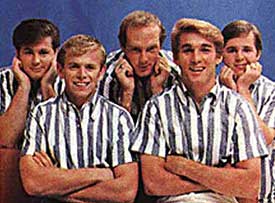 |
|
|
Eleven
were arrested at the main post office near Capitol Hill
in Washington, D.C., for attempting to mail medical supplies
to Iraq in defiance of the U.S.-led embargo. Between
1990 and 1995 with the first Gulf War and the sanctions
regime imposed by the U.S., its coalition and the U.N.,
infant and under-5 mortality rates in Iraq had more than
doubled.
|
| More about Voices in the Wilderness |
|
Thousands protested against the nuclear industry in Sydney, Australia. The country is by far the world’s largest exporter of uranium (and thorium ores and concentrates), the radioactive heavy metal necessary for the power generation and weapons industries.
The marchers were from groups concerned about many related issues: the link between the uranium industry and weapons proliferation; the environmental destructiveness of nuclear power; |
| the impact of uranium mining on Aborigines and workers in the industry; weapons testing in the Pacific, and the secret history of the British nuclear weapons tests in the region; and the Cold War nuclear arms spiral and Australia's contribution to it through the hosting of U.S. military bases, allowing nuclear warships to use Australian ports through the ANZUS alliance (among Australia, New Zealand and the U.S.); weapons
testing in the Pacific, and the secret history of the British
nuclear weapons tests in the region. |
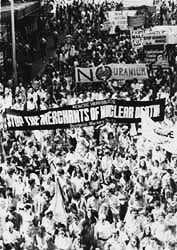 |
Sydney anti-uranium
protest
Photo: Paul Keig |
| Today's Australian Nuclear Free Alliance |
|
Genocide
in Rwanda began. Over the following 90 days at least a
half million people were killed by their countrymen, principally
Hutus killing Tutsis. |
 |
This day is commemorated annually
with prayer vigils in Rwanda.
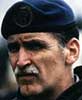
Canadian General Romeo Dallaire, head of the U.N. Peacekeeping
Force in Rwanda, a tiny African nation formerly a Belgian colony,
had warned of impending slaughter, but was ordered not to attempt
to intervene.
|
PBS interview with General Dallaire, what he
knew and what he watched happen
|
 |
|
|
|
| President
Harry S. Truman attempted to nationalize the steel industry
in order to avert a nationwide strike. He was concerned about
a shortage of steel needed for the war effort in Korea. |
Read more from the Truman library
The dilemma Truman was trying to resolve (with study guide) |
|
Women
in Black of Lund, Sweden, demonstrated in solidarity with
their Serbian sisters suffering amidst the conflicts resulting
from the dissolution of the former Yugoslavia. “We
dressed in black. We knew that despair and pain needed
to be transformed into political action. Our choice of
black meant that we did not agree with everything that
the Serbian regime was doing. We refused their language
which promotes hate and death." We repeated: "DO NOT
SPEAK FOR US, WE WILL SPEAK FOR OURSELVES" |

|
|
| Ida Wells-Barnett,
a journalist, speaker and advocate for suffrage, wrote
to President William McKinley requesting federal action against
those who lynched the U.S. Postmaster of Lake City, South
Carolina. |
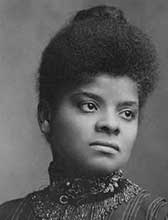
Ida
Wells-Barnett
|
Though
the federal government had previously refused to involve
itself
with the thousands of lynchings, leaving them to be dealt
with at the state level, Ms. Wells-Barnett insisted that
a postmaster’s murder was a federal matter.
“We most earnestly desire that national legislation be enacted
for the suppression of the national crime of lynching . .
. .
|
| Her
open letter to President McKinley |
|
|
|
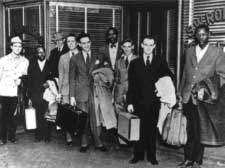
The
first freedom ride, the "Journey of Reconciliation," left
Washington, D.C. to travel through four states of the upper
South.In
response to a Supreme Court decision (Morgan v. Virginia)
outlawing segregation on interstate busses, the group
of both black and white Americans rode together despite “Jim
Crow” state laws making it illegal.
|
| Together on the bus, and arrested several times for being so,
were George Houser, Bayard Rustin, James Peck, Igal Roodenko,
Nathan Wright, Conrad Lynn, Wallace Nelson, Andrew Johnson,
Eugene Stanley, Dennis Banks, William Worthy, Louis Adams,
Joseph Felmet, Worth Randle and Homer Jack. |
| Two
African-American members of the group, Rustin and Johnson,
served on a chain gang for 30 days after their conviction
in North Carolina. The integrated bus tour was sponsored
by CORE (Congress for Racial Equality) and FOR (Fellowship
of Reconciliation) |
| Read
more about the freedom rides |
|
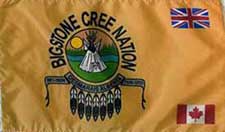
Members of the Bigstone Cree band of indigenous people
ended a 250-mile march to the capital, Edmonton,
to highlight their economic plight in northern Alberta,
Canada.
|
 |
|
|
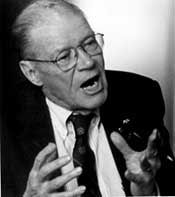
Former
Secretary of Defense Robert McNamara first publicly acknowledged
error in prosecution of the war in Vietnam. "Yet we were wrong, terribly wrong. We owe it to future generations to explain why."
|
McNamara
in the movie, Fog of War
(resources
include comprehensive lesson plans)
|
|
Jubilee
2000 National Mobilization Day in Washington, D.C. brought
together individuals and groups demanding cancellation
of
third world debt. |
| "Every
child in Africa is born with a financial burden which
a lifetime's work cannot repay. The debt is a new form
of
slavery as vicious as the slave trade." |
| Jubilee
USA Network |
|
| In
what was the first ghetto, Jews in Venice, Italy, were
forced to live in a specific, restricted area of the city
known as Campo del Ghetto Nuovo. The word "ghetto" comes
from the Venetian word "geto," meaning foundry.
Prior to becoming an exclusively Jewish neighborhood, the
Venice ghetto was the site of a foundry. |
After
its establishment the city’s Jews, who were allowed
to attend to their business during the day (though required
to wear a yellow badge or scarf indicating their religion),
were forced to return to the ghetto where gates were locked
to keep them inside overnight.
Venice also restricted the living quarters of Germans and Turks, all to satisfy
the demands of the Roman Catholic Church. |
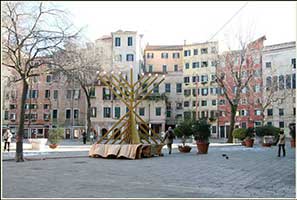 |
| The site of the
Ghetto Nouvo today |
|
|
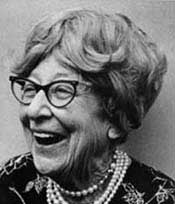
Ninety-year-old
Jeannette Rankin, the first female member of Congress
(R-Montana), and the only one to vote against U.S. entry
into both World Wars, led 8000 in protest of the Vietnam
War in a women's peace march on the Pentagon. |
 |
| Visit the Jeannette Rankin Peace Center |
|
|
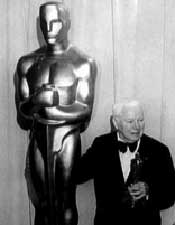
Charlie
Chaplin received an honorary Oscar for "the incalculable
effect he has had in making motion pictures the art form
of this century.” The British native’s political
views had previously been criticized, as had been his failure
to apply for U.S. citizenship.
Pressed for back taxes and accused of supporting subversive
causes during the McCarthy era, Chaplin left the United States
in 1952. |
| Informed that he would not be welcomed back, he retorted, "I
wouldn't go back there if Jesus Christ were president." He
returned briefly from exile, however, to accept this award
and received the longest standing ovation in Academy Award
history, lasting a full five minutes. |
| Charlie
Chaplin, one of PBS’s American Masters |
|
| The United Nations Convention on
Certain Conventional Weapons (also known as the Inhumane
Weapons Convention) started gathering signatures of nations
willing to abide by its limitations. |
Currently,
109 countries have agreed to ban or limit munitions
that cause unnecessary or unjustifiable suffering to
combatants, or affect civilians indiscriminately. So
far the restrictions cover mines, booby traps, incendiary
weapons (such as Napalm) and blinding laser weapons.
This
Life photograph of a naked child running down a street
in Vietnam screaming in agony captures the effects of
Napalm. Nick Ut's photograph of Kim Phuk, taken in 1972,
won the Pulitzer Prize ( Associated Press). |
 |
| Not
all country signatories have agreed to all its provisions |
How
militaries think about incendiary weapons |
|
France, Belgium, the U.S., among other countries airlifted
their nationals out of Rwanda as the wholesale slaughter of
Tutsis at the hands of the Hutu majority proceeded. Rwandan
employees of Western governments were left behind.
The International
Red Cross was already estimating the death toll in the tens
of thousands.
|
|
| The
Northern Ireland peace talks ended with an historic
accord—called
the Good Friday Agreement—reached after nearly
two years of talks and 30 years of conflict. Former
U.S. Sen. George Mitchell (D-Maine) was chair of the
talks
which established a Northern Irish Assembly for both
the Irish Catholic republicans and the British Anglican
unionists. |
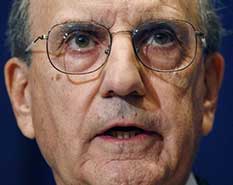 |
| Senator George Mitchell |
|
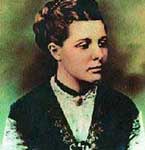 |
Annie Besant, a Briton and active suffragist who moved
to India, established the Home Rule League with autonomy
for India from British colonial rule as its goal. Head
of the Theosophical Society of India, she was also the
publisher of the newspaper, New India, and CommonWeal. |
| Annie Besant,
founder of the India Home Rule League and publisher of New
India. |
|
The trial of Nazi war criminal Adolf Eichmann began in Israel.
The man accused of leading Hitler’s effort to
exterminate the Jewish people and others faced 15 charges,
including crimes against humanity, crimes against the
Jewish people, and war crimes, all of which took more
than an hour to enumerate.
|
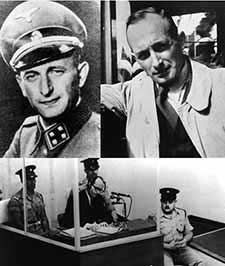 |
The charges against
Eichmann |
| Adolf Eichmann |
|
| The Civil
Rights Act of 1968 was signed into law by President Lyndon Johnson
just one week after the assassination of Reverend Martin Luther
King, Jr. Known as the Fair Housing Act, it first outlawed
discrimination in the sale, rental or financing of housing
and now bans it for reasons of race, color, national origin,
religion, sex, familial status, or handicap. |
| The
struggle for Fair Housing |
|
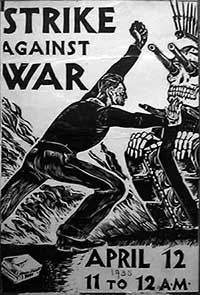
60,000 students across the
U.S. took part in the first nationwide student strike. The
protest was against fascism and
participation in any war. |
|
Posters
from the anti-war movement of the 1930's
|
|
Martin Luther King, Jr. and his fellow ministers Fred Shuttlesworth and Ralph Abernathy, along with 60 others were arrested on Good Friday in Birmingham, Alabama, for marching downtown. |
| They had been denied a parade permit, and were violating a court order banning them from all protest activities. Public Safety Commissioner Theophilus Eugene "Bull" Connor had sought the injunction to put an end to a series of sit-ins, kneel-ins, boycotts and other nonviolent actions designed to challenge the local and state segregation laws.
|
 |
Fred Lee Shuttlesworth (left), Ralph
David Abernathy (center),
and Martin Luther King Jr. (right)
march on Good Friday on April 12, 1963, in Birmingham. |
| The Birmingham campaign of 1963 |
Arrest
in Birmingham |
|
|
|
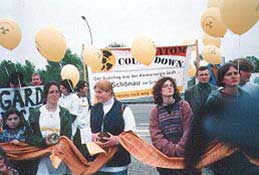
The
first European demonstration against nuclear power brought
together 1300 peacefully to oppose construction of
a nuclear power plant at Fessenheim, on the Rhine
in the Alsace region of France. The four 900 megawatt
reactors have been in operation since 1977.
|
| Protest at Fessenheim |
|
|
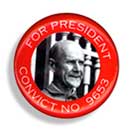
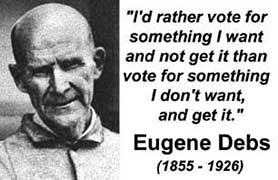
Socialist, pacifist, and
labor leader Eugene V. Debs was imprisoned for opposing U.S.
entry into World War I.
While in prison, he received nearly
one million votes for President in the 1920 election (as
he had in 1912). |
 |
All
aspects of Debs from the Eugene Debs Foundation |
|
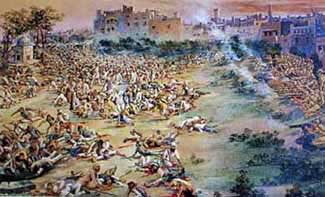
| In
Amritsar, holiest city of the Sikh religion (in India’s Punjab
province), British and Gurkha troops fired without warning
and killed at least 379 and wounded another 1200 Sikhs
meeting in a park known as Jallianwala Bagh to celebrate
their new year’s festival of Baisakhi Mela. |
|
In the
previous three days, two key Sikh leaders had been deported,
Mohandas Ghandi had been barred from entering the Punjab,
and a general strike and demonstration had been met with
deadly fire from British troops, sparking violent reaction.
|
 |
| Background
of the Amritsar massacre
|
|
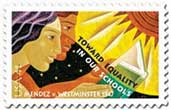 |
Segregation
of Mexican-American children, common in California at the
time, was declared unconstitutional by the Federal Appeals
Court for the Ninth Circuit. Suit had been brought against
several school districts in Orange County by Gonzalo Méndez
and several World War II veterans. |
| Separate
schools for those of Mexican parentage was struck down
in Méndez et al. v. Westminster School District: “ .
. . commingling of the entire student body instills and develops
a common cultural attitude among the school children which
is imperative for the perpetuation of American institutions
and ideals. It is also established by the record that the
methods of segregation prevalent in the defendant school
districts foster antagonisms in the children and suggest
inferiority among them where none exists . . .” |
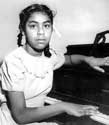 Sylvia Mendez Sylvia Mendez |
| Sylvia Mendez honored |
Mendez v Westminster History |
|
|
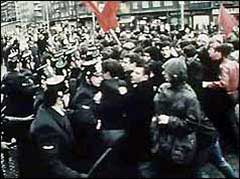
A massive student rally
in West Berlin blocked the city's main thoroughfare, the
Kurfurstendamm. It ended in violent clashes between police
and the marchers. The students were protesting the shooting
a week earlier of one of their leaders, Rudi Dutschke,
outside the offices of the German Socialist Students Federation
(SDS).
|
 |
Read more |
|
|
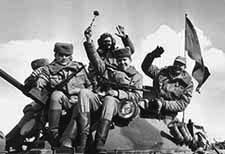
The
Soviet Union signed an agreement pledging to withdraw
its troops from Afghanistan after nearly ten years. The
pact, drawn up in negotiations between the United States,
the USSR, Pakistan and Afghanistan, was signed at a United
Nations ceremony in the Swiss capital of Geneva.
|
 |
Entertaining and basically factual
story of what pushed the Soviets out of Afghanistan |
|
Denmark’s
parliament, the Folketing, insisted that foreign warships
affirmatively state whether or not they carry nuclear weapons
before being allowed to enter Danish ports. |
Previously,
their non-nuclear policy had not been enforced and such
weapons were routinely carried on nuclear-capable NATO
ships visiting Denmark. U.S. and other allies had abided
by a policy known as “neither confirming nor denying” (NCND).
|
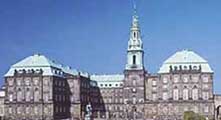 Denmark’s
Folketing Denmark’s
Folketing |
| The
policy and its consequences |
|
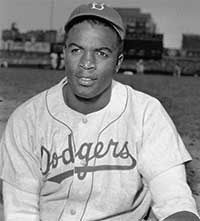
Jackie
Roosevelt Robinson became the first African American to play
in a major league
baseball game in the 20th century. His stepping onto Ebbets
Field in a Brooklyn Dodgers uniform broke the “color
line,” the segregation of professional teams. |
The International League in 1887 began a wave of League-wide
black exclusion, and it had been complete since 1899, when
Bill Galloway became the last African-American player in white
organized ball (Woodstock, Ontario).
Though hitless in three at-bats, Robinson started at first
base, and the Dodgers beat the Boston Braves
that day, 5-3.
|
|
 |
"Jackie,
we've got no army. There's virtually nobody on our side.
No owners, no umpires, very few newspapermen. And I'm
afraid that many fans will be hostile. We'll be in a
tough position.
We can win only if we can convince the world that I'm
doing this because you're a great ballplayer, a fine
gentleman."
"There was never a man in the game who could put mind and muscle together
quicker and with better judgment than (Jackie) Robinson."
-Branch Rickey |
| Jackie Robinson signing his contract with Branch
Rickey, general manager of the Brooklyn Dodgers |
Jackie
Robinson and his work on civil rights from the National
Archives
(with teaching activities and worksheets)
|
|
|
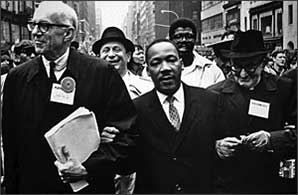
Amidst
growing opposition to the war in Vietnam, large-scale anti-war
protests were held in New York, San Francisco and other
cities. In New York, the protest began in Central Park,
where over 150 draft cards were burned, and concluded at
the United Nations with speeches by Rev. Martin Luther King,
Jr. and others.
|
| King and Dr. Benjamin
Spock lead an anti-war march to the United Nations, 15 April
1967 |
| King’s
opposition to the war, excerpts of his speeches and reaction
throughout the country |
|
|
The
Internal Revenue Service (IRS) estimated over 2,000 people
openly refused to pay part or all of their income tax.
“If
a thousand [people] were not to pay their tax bills this
year, that would not be a
violent and bloody
measure, as it would be to pay them and enable the state
to commit violence and shed innocent blood.”
Henry David Thoreau on the Mexican War |
 |
| National
War Tax Resistance Coordinating Committee |
|
Between
10,000 and 20,000 activists blockaded meetings of the
World
Bank and International Monetary Fund in Washington, D.C.
Sitting down at intersections and locking arms to form
human chains, the protesters were opposed to Bank and IMF
policies that increased third-world indebtedness and did
little to directly benefit the poor in those countries.
“The World Bank is subjugating our economic and social independence,” Vineeta
Gupta, a doctor from the Punjab in India, said in a letter
he delivered to World Bank President James Wolfensohn at his
home. “It is time that we shut the bank down, and this
boycott is a great start.” |
|
22 were arrested
in New York City for refusing to take shelter
during a civil
defense drill. |
|
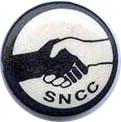
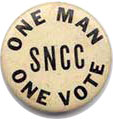
Inspired
by the Greensboro sit-in of four black college students
at an all-white lunch counter, nearly 150 black students
from nine states formed the Student Nonviolent Coordinating
Committee (SNCC). Meeting in Raleigh, North Carolina, with
Ella Baker, James Lawson and Martin Luther King, Jr., the
founders set SNCC’s initial goals as overturning
segregation in the South. |
|
|
They also considered it important
to give young blacks a stronger voice in the civil rights
movement, as many had participated in sit-ins that had
proliferated to dozens of cities over the previous three
months.
At the Raleigh conference Guy Carawan sang a new version
of “We Shall Overcome,” an adaptation of an old
labor song. This song would become the national anthem of
the civil rights movement. |
People joined hands and gently
swayed in time singing “black and white together,” repeating
over and over, “Deep in my heart, I do believe, we
shall overcome some day.” |
| History
of SNCC |
What
SNCC did to make change happen |
 |
Get a
WE SHALL OVERCOME
1.25" button
Re-issued from the 1960's

Union printed Detroit made
|
|
|
|
|
An
army of 1500 anti-Castro Cuban exiles, mercenaries equipped
and trained at a secret Guatemala base by the CIA, landed
at Bahia de Cochinos (Bay of Pigs) in an attempt to “liberate” Cuba
from Communist rule. Within three days, the invasion proved
disastrous with nearly 1200 members of Brigade 2506 (who
had been trained in the U.S.) taken prisoner. |
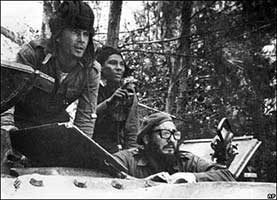
| Cuban
leader Fidel Castro during the Bay of Pigs invasion. |
| Known
as Operation Zapata, it was conceived by Vice President
Nixon, planned and approved by the Eisenhower administration,
and executed shortly after President
John Kennedy’s inauguration. |
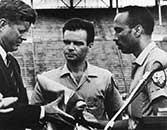 |
President
Kennedy receives the Brigade 2506 flag in Miami
in 1962
and declares:
"I
promise to return this flag in a free Havana." |
Soviet General Secretary Nikita Kruschev
sent a telegram to President Kennedy:
"Mr. President, I send you this message in an hour of alarm,
fraught with danger for the peace of the whole world. Armed
aggression has begun against Cuba. It is a secret to no one
that the armed bands invading this country were trained, equipped
and armed in the United States of America. The planes which
are bombing Cuban cities belong to the United States of America,
the bombs they are dropping are being supplied by the American
Government . . . ."
|
| What
actually happened |
|
|
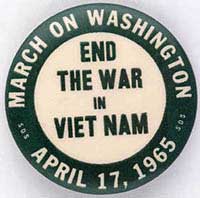
The
first national demonstration against the Vietnam War
took place in the nation’s capital. Students for
a Democratic Society (SDS), the organizers, had expected
about 2000 marchers; the actual count was 15,000–25,000.
This was the largest anti-war protest ever to have been
held in Washington, D.C. up to that time. The number
of marchers approximately equaled the number of U.S.
soldiers in Vietnam. Several hundred students in the
protest broke away from the main march and conducted
a brief sit-in at the U.S. Capitol’s door.
|
| An exam prepared by SDS
about the Vietnam War (answers available) |
|
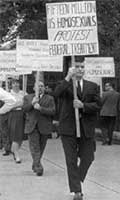
|
The first demonstration promoting equal treatment
of homosexuals, Jack Nichols, Barbara Gittings and others
picketed in front of the White House.
There was no media present..
|
| Read more |
| Gay rights advocate Jack Nichols |
|
Reverend
Jesse Jackson, future congresswoman Maxine Waters and
others co-founded the Rainbow Coalition, initially
intended as a progressive public-policy think tank
within the Democratic Party.
|

|
Brief history of Rainbow Push Coalition
|
Representative Maxine Waters, Harry Belafonte,
John
Sweeney, President of the AFL-CIO,
Reverend Jesse Jackson,
and Willie Nelson
August
6, 2005-Atlanta, Georgia. |
|
|
On Good Friday morning, about
50 people accompanied Fr. Carl Kabat and Carol Carson to
Missile Silo Site N5 at Whiteman Air Force Base in Missouri,
the same silo that Carl and other members of the Silo Pruning
Hooks (see below) disarmed in 1984. They cut through a
fence and, once inside, Carol used a sledgehammer on the
concrete lid of the silo while Carl performed a rite of
exorcism.
|
| Eventually, the police arrived and arrested Carl and Carol.
They were jailed and held until their court appearance. At
that time, they made a preliminary agreement with federal
prosecutors wherein they would plead “no contest” to
trespass in exchange for the property destruction charge
being dropped; they were sentenced to six and three months, respectively,
in a halfway house. |
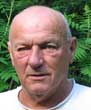 Carl Kabat Carl Kabat |
| A History of Direct Disarmament Actions |
About
the Silo Pruning Hooks action |
|
Members
of the United Mine Workers of America on Paint Creek in
Kanawha County, West Virginia, demanded wages equal to
those of other area mines. The operators rejected the wage
increase and miners walked off the job. Miners along nearby
Cabin Creek, having previously lost their union, joined
the Paint Creek strikers and demanded:
• the right to organize
• recognition of their constitutional rights to free speech and assembly
• an end to blacklisting union organizers
• alternatives to company stores
• an end to the practice of using mine guards
• prohibition of cribbing
• installation of scales at all mines for accurately weighing coal
• unions be allowed to hire their own checkweighmen to make sure the companies'
checkweighmen were not cheating the miners. |
| When
the strike began, operators brought in mine guards from
the Baldwin-Felts Detective Agency to evict miners and
their families from company houses. The evicted miners
set up tent colonies and lived in other makeshift housing.
The mine guards' primary responsibility was to break
the strike by making the lives of the miners as uncomfortable
as possible. |
 |
| Striking
miners and their families being evicted from company houses. |
| Deep
background on the W. Virginia coal business and the strike |
|
|

|
Bus
companies in New York City agreed to hire 200 black drivers and mechanics after
a four-week boycott by riders led by Reverend Adam Clayton Powell,
Jr. of Harlem’s Abysinnian Baptist Church, the largest
Protestant congregation in the U.S. Powell ran and won a City
Council seat later that year and became a member of Congress
four years later.
|
| Reverend Adam Clayton
Powell, Jr. |
|
|
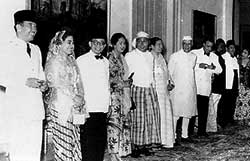 Sukarno
hosts Bandung conference Sukarno
hosts Bandung conference
|
A conference bringing
together government representatives from 29 Asian and African
countries began in Bandung, Indonesia. The intention was
to promote economic and cultural cooperation, and to oppose
Western colonialism, then still prevalent on both continents.
At the same time, many countries were worried about communism
and the power of the Soviet Union.
|
| The
principal actors were Sukarno of Indonesia, one of the
countries that organized the meeting; Jawahrlal Nehru,
prime minister of recently independent India; Kwame Nkrumah,
prime minister of the Gold Coast (now Ghana); Gamal Abdel
Nasser, president of Egypt; Chou En Lai, premier of China;
and Ho Chi Minh, prime minister of Vietnam. |
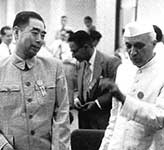 |
Chou En-Lai and Jawaharlal
Nehru
at the Bandung Conference |
| Many
concepts of international cooperation and mutual interest
were discussed at the week-long conference, including Pan-Islam,
Pan-Arabism, Pan-Asianism,
and Pan-Africanism. The meeting was a precursor to what became known as the Non-Aligned
Movement (aligned neither with Washington nor Moscow). |
| Bandung Conference background info |
|
| The first march against
nuclear arms in West Germany took place. |
|
|
|
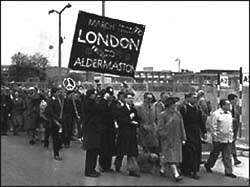
Tens
of thousands of people marked the end of the Aldermaston "ban
the bomb" march at a rally with at least 60,000 gathering
in Trafalgar Square, the largest demonstration London had
seen to date.
|
| Read more |
|
|
Thousands
of Chinese students from several universities took to the
streets to protest government policies and issue a call
for greater democracy in the communist People's Republic
of China (PRC). Mourning over the death of Hu Yaobang began
on the 15th in Tiananmen Square. As Secretary General of
the Chinese Communist Party, he had called for rapid reform
in the PRC, but had been pushed out of office over the
Democracy Wall protests. Students in the Square demanded
response from government officials, and began a sit-in
and other activities that persisted for weeks.
|
| Timeline
of the Beijing democracy protests |
|
| More
than 6,000 Grand Rapids, Michigan, furniture workers—Germans,
Dutch, Lithuanians, and Poles—put down their tools
and struck 59 factories in what became known as the Great
Furniture Strike. |
For
four months they campaigned and picketed for higher pay,
shorter hours, and an end to the piecework pay system that
was common in the plants of America’s “Furniture
City.” Although the strike ended after four months
without a resolution, Gordon Olson, Grand Rapids city historian
emeritus, said once employees returned to work, most owners
did increase pay and reduce hours.
|
 |
| The
Spirit of Solidarity -- a $1.3 million granite sculpture,
plaza and fountain -- sits on the land of the Gerald Ford
Presidential Museum on the banks of the Grand River near
the Indian mound. |
| The Strike's history from the APWU |
On the 100th anniversary of the strike |
|
On
the eve of Passover, the Warsaw Ghetto Uprising began when
Nazi forces attempted to clear out the Jewish ghetto in
Warsaw, Poland, to send them to concentration camps. The
Germans were met by unexpected gunfire from Jewish resistance
fighters. The destruction of the ghetto had been ordered
in February by SS Chief Heinrich Himmler: |
| “An
overall plan for the razing of the ghetto is to be submitted
to me. In any case we must achieve the disappearance from
sight of the living-space for 500,000 sub-humans (Untermenschen)
that has existed up to now, but could never be suitable
for Germans, and reduce the size of this city of millions—Warsaw—which
has always been a center of corruption and revolt.” |
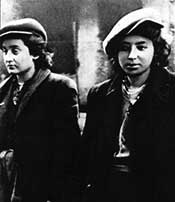
These
two women, soon to be executed, were members of the Jewish
resistance.
" ...Jews and Jewesses shot from two pistols at the same time...
The Jewesses carried loaded pistols in their clothing with the safety catches
off...
At the last moment, they would pull hand grenades out...and throw them at the
soldiers...."> |
 |
| |
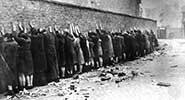 |
Captured Jews in the Warsaw Ghetto Uprising
|
| Learn
more about The Warsaw Ghetto Uprising |
|
|
As
a prelude to a massive anti-war protest, Vietnam Veterans
Against the War (VVAW) began a five-day demonstration in
Washington, D.C. The generally peaceful protest was called
Dewey Canyon III in honor of the operation of the same name
conducted in Laos.
They lobbied their congressmen, laid wreaths
at Arlington National Cemetery, and staged mock "search-and-destroy" missions.
|
 |
| Read more about this action |
|
|
Two
Swedish Plowshares peace activists, Cecelia Redner, a
priest in the Church of Sweden, and Marija
Fischer, a student, entered the Bufors Arms factory in
Karlskoga, Sweden, planted an apple tree and attempted
to disarm a naval cannon being exported to Indonesia. Cecelia
was charged with attempt to commit malicious damage and
Marija with assisting in what was called the Choose Life
Disarmament Action. Both were also charged with violating
a law which protects facilities “important to society.”
Both women were convicted, arguing over repeated interruptions
by the judge, that, in Redner’s words, “When
my country is arming a dictator I am not allowed to be passive
and obedient, since it would make me guilty to the crime
of genocide in East Timor. I know what is going on and I
cannot only blame the Indonesian dictatorship or my own government.” Fischer
added, “We tried to prevent a crime, and that is an
obligation according to our law.” Redner was sentenced
to fines and three years of correctional education. Fischer
was sentenced to fines and two years’ suspended sentence.
Both the prosecutor and defendants appealed the case.
No
jail sentences were imposed.
|
|
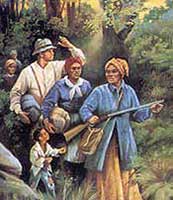 |
Harriet Tubman began
her Underground Railroad, a network of people and places
that aided in the escape of slaves to the north.
Story
of a liberator of her people from bondage
|
|
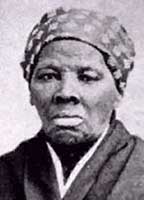
| Harriet Tubman |
|
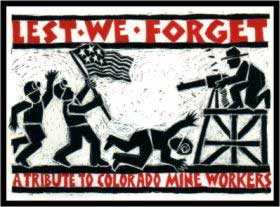
| Troops
from the Colorado state militia attacked strikers, killing
25 (half women and children), at Ludlow. |
|
Having
struck the Rockefeller-owned Colorado Fuel and Iron Company
the previous September for improved conditions, better
wages, and union recognition, the workers established
a tent camp which was fired upon and ultimately torched
during a 14-hour siege.
|
The Ludlow Massacre |
|
| In
his closing statement at the Rivonia Trial, African National
Congress leader Nelson Mandela addressed the court: “We
want a just share in the whole of South Africa . . . We want
security and a stake in society. Above all, my lord, we want
equal political rights, because without them our disabilities
will be permanent.” He was in Pretoria Supreme Court
in South Africa where he and eight co-defendants were charged
with 221 acts of sabotage designed to “ferment violent
revolution,” and were facing the death penalty. At
the time, black South Africans had no civil or political
rights whatsoever, though they comprised over 80% of the
population. |
|
He
concluded: “During my lifetime I have
dedicated my life to this struggle of the African people.
I have
fought
against white domination and I have fought against black
domination.
“ I have cherished the ideal of a democratic and free society in which
all persons will live together in harmony and with equal opportunities. It
is an ideal for which I hope to live and to see realised. But, my lord, if it
needs
be, it is an ideal for which I am prepared to die." |
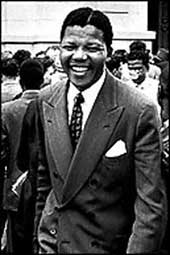 Mandela in 1958 Mandela in 1958
|
|
|
On
the site of a parking lot owned by the University of
California, Berkeley, a diverse group of people came
together, each freely contributing their skills and resources
to create People’s Park.
|
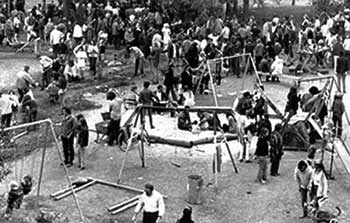 |
| People's Park history and photos |
|
Seven
women were arrested in an anti-nuclear protest outside Mather
Air Force Base, near Sacramento, California, in what had
become a weekly vigil. Speaking after her arrest, Barbara
Weidner, 72, said,
“As a mother and grandmother, I
could no longer remain silent as our world rushes on its
collision course with disaster which threatens the lives
and futures of all children, everywhere, and the future of
this beautiful planet itself.”
She later said, “I hope people will not think we are
encouraging people to break the law,” she said. “But
our actions should teach people, and children, to scrutinize
laws against human life, and they should be broken to prove
a point.” |
|
| More
than 75,000 marched in Washington, D.C. to protest U.S.
policies in the Middle
East, specifically regarding Palestine and the threatened
war in Iraq. The demonstration was organized by the A.N.S.W.E.R.
Coalition (Act Now to Stop War & End Racism) and included
members of the Arab-American, Muslim and South Asian communities. |
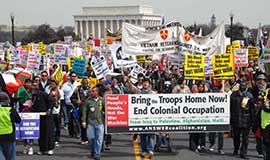 |
|
| Stonemasons
and other construction workers on building sites around Melbourne,
Australia, stopped work and marched from the University of
Melbourne to Parliament House. They advocated eight hours
for work, eight hours for recreation, and eight hours for
rest. Their direct action protest was a success, becoming
the first organized workers in the world to achieve an eight-hour
workday, inspiring the celebration of Labor Day and May Day. |
|
Six days after
the death of Hu Yaobang, the deposed reform-minded leader
of the Chinese Communist Party, some 100,000 students from
more than 40 universities gathered at Beijing's Tiananmen
Square to commemorate Hu prior to his funeral. |
| They voiced
their discontent with China's authoritarian communist government,
and called for greater democracy. Ignoring government warnings
of violent suppression of any mass demonstration, the students
were joined by workers, academics, and civil servants. |
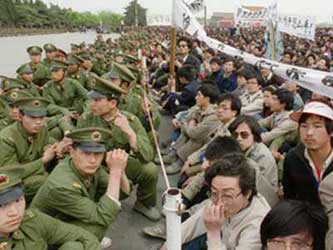 |
Pro-democracy
student protesters face-to-face with policemen outside the
Great Hall of the People in Tiananmen Square the day of Hu
Yaobang's funeral. |
|
| The
Mothers for Peace, a group made up of Catholic Workers,
members
of PAX (which became Pax Christi in 1972), Women Strike
for Peace, Women’s International League for Peace
and Freedom (WILPF), the Fellowship of Reconciliation,
and others, met with Pope John XXIII to plead for a condemnation
of nuclear war and the development of nonviolent resistance. |
| About
Women Strike for Peace |
|
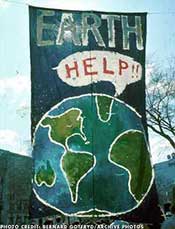 Banner
at the first Earth Day Banner
at the first Earth Day
|
On
the first Earth Day observance, an estimated 20 million
participated in peaceful demonstrations of concern for
the environment across the U.S. including ten thousand grade schools
and high schools, two thousand colleges across one thousand communities.
|
 1st
Earth Day, 1970 1st
Earth Day, 1970
|
|
|
50,000 attended "Don't Count On Us," an anti-war rock concert in Belgrade, Serbia. It was to the nationalist regime of President Slobodan Milosevic an expression of the resistance within society to the military aggression he had been pursuing in the name of Serbian nationalism. Following the collapse of the Soviet Union, the various constituent republics of the former Yugoslavia—Slovenia, Croatia, Macedonia and Bosnia-Herzegovina—had declared their independence.
Following a military draft call-up, fewer than 10% had reported for duty, and there was considerable dissension within what was then still called the Yugoslav People's Army. |
|
| On
Earth Day, Plowshares activists Donna and Tom Howard-Hastings
used handsaws to cut down three poles in northern Wisconsin
supporting the ELF (Extremely Low Frequency) transmitter
for communication with submerged Trident nuclear submarines.
After the poles were cut they were decorated with photos
of children and posted with documents about international
law and treaties outlawing nuclear weapons. They also placed
stakes to mark tree seedlings under the transmission lines
that they said were “doomed to the cutting bar.” |
They
cut a section of one of the downed poles, carrying it to
the nearby transmitter site where they turned themselves
in to security personnel.
They were then taken into custody by county sheriffs. An ABC-TV
news affiliate, along with reporters from two public radio
stations, were on hand to observe what happened. |
| During the three-day jury trial on charges of sabotage and
property destruction in Ashland County District Court, the
defense was allowed to present several expert witnesses, including
a retired Navy captain, Trident missile designer Bob Aldridge,
and international law expert Francis Boyle. Both Howard-Hastings
defendants were acquitted of the sabotage charge, which carried
ten years and a $10,000 fine, but were convicted of destruction
of property. |
At sentencing, they claimed the court had no jurisdiction over
them, seeing that a jury had determined that their action was
reasonable, and that they did not damage the national defense.
They also made a passionate appeal to the judge to heed international
law and the World Court decision to outlaw nuclear weapons.
Donna was sentenced to 114 days she had already served, with
a three-year period of probation and restitution. Tom was sentenced
to one year in prison, with credit for time served and three
years of intensive probation, including electronic home monitoring,
and restitution.
The name Laurentian Shield refers the granite geological formation
at the ELF site. |
More Plowshares actions |
|
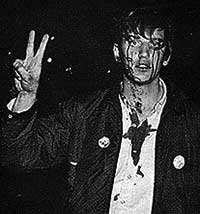 |
Students
at Columbia University in New York City occupied campus
buildings to protest military research and the razing of part
of the neighboring Morningside Heights section of Harlem to
make way for a new student gymnasium.
|
Perspective from 40 years on by Mark Rudd,
one of the Columbia
leaders
|
| Read
more and view protest posters |
|
|
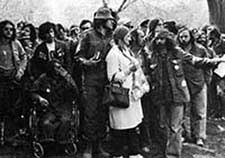
In the final event of Operation Dewey Canyon III, nearly 1,000 Vietnam War veterans threw their combat ribbons, helmets, and uniforms on the U.S. Capitol steps along with toy weapons. |
Read
more about Operation Dewey Canyon III
|
 |
|
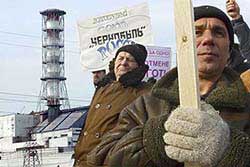 |
Nineteen Ukrainian demonstrators were arrested in the capital, Kiev,during an illegal anti-nuclear protest marking the 10th anniversary of the nuclear reactor explosion and fire at Chernobyl, Ukraine, until then the largest and deadliest nuclear accident in history, now exceeded by Fukushima.
[see April 26, 1986]. |
| Chernobyl
veterans |
|
| The Chernobyl Nuclear Disaster W.I.S.E. |
|
The Ottoman Turkish government arrested
200 of the most prominent political and intellectual leaders
of the Armenian community in the capital, Constantinople (now
Istanbul). These men and hundreds more were then imprisoned
from throughout Anatolia (present-day Turkey) and, shortly
thereafter, most were summarily executed.
This is the day on which the genocide of more than a million
Armenians is commemorated: when the intention of the Turkish
government to eliminate the Armenian people became clear. Already
Armenian recruits in the Ottoman Turkish army had been disarmed
and organized as laborers working under slave-like conditions. |
| The plan for Armenian genocide from University of Michigan-Dearborn |
|
| The
Easter Uprising began when between 1,000 and 1,500 members
of the Irish Republican Brotherhood attempted to seize Dublin
and issued the declaration of Irish independence from Britain. |

The
seven signatories of the Irish Proclamation |
Read
the Proclamation
|
Read
more |
|
|
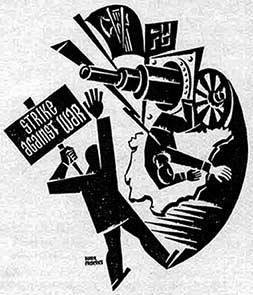
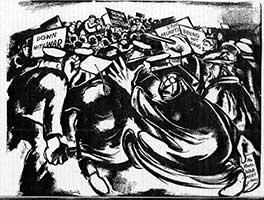
This editorial cartoon appeared in New
Masses magazine.
It refers to the attempt of anti-radical vigilantes and
repressive college administrators to disrupt the first
national student strike against war.
|
 |
|
|
President John F. Kennedy authorized high-altitude atmospheric testing of nuclear weapons to determine whether missile-borne warheads could be used to black out military communications.
|
|
| At
a news conference in Washington, D.C., General William Westmoreland,
senior U.S. commander in South Vietnam, said that the
enemy (considered to be North Vietnam and the Viet Cong
southern insurgents) had “gained support in the
United States that gives him hope that he can win politically
that which he cannot win militarily.” |
| Though
he said that ninety-five percent of the people were behind
the United States effort
in Vietnam, he asserted that the American soldiers in Vietnam
were “dismayed, and so am I, by recent unpatriotic acts
at home.” This criticism of the anti-war movement was
not received well by many in and out of the movement, who believed
it was both their right and responsibility to speak out against
the war.
|
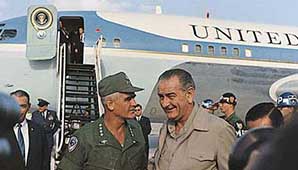 |
| General
Westmoreland meeting President Lyndon Johnson later in 1967,
Cam Ranh Bay, Vietnam |
|
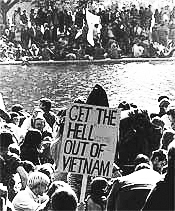
| 500,000 demonstrated against the Vietnam War in
Washington, D.C. It was the largest-ever demonstration
opposing U.S. war; 150,000 marched at a simultaneous
rally in San Francisco. |
|
|
On the World Day for Laboratory
Animals, nationally coordinated demonstrations occurred in
California, Arizona, Florida, New York, Minnesota, Louisiana,
Michigan, Pennsylvania, Nevada, Tennessee, and other states.
It was the largest display of civil disobedience for animal
rights ever. Hundreds of activists across the country blocked
access to university laboratories and more than 150 were arrested
nationwide.
The day was designated to bring attention to the treatment
of lab animals used in testing of medical and other products,
sponsored in Congress by the late Tom Lantos (D-California). |
World Day Laboratory Animals |
|
Delegates from
some 50 countries met in San Francisco for the United Nations
Conference on International Organization. Over the next two
months they would negotiate the principles and structure of
the United Nations.
Pres. Franklin D. Roosevelt had just died and had been working
on his speech to the conference: "The work, my friends,
is peace; more than an end of this war—an end to the
beginning of all wars . . . As we go forward toward the greatest
contribution that any generation of human beings can make in
this world—the contribution of lasting peace—I
ask you to keep up your faith . . . ." |
|
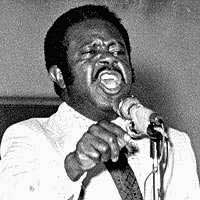 |
The
Reverend Ralph David Abernathy, head of the Southern Christian
Leadership Conference, and 100 others were arrested while
picketing a Charleston, South Carolina, hospital to support
unionization by its workers. |
| Read
more about Reverend Ralph David Abernathy |
|
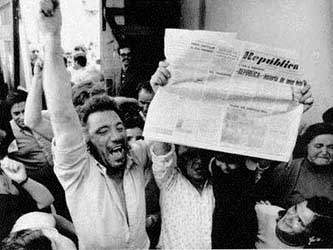
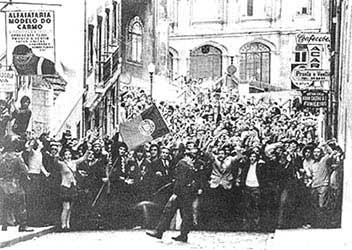
| A peaceful uprising by both the army and civilians, known as the Carnation Revolution (Revolução dos Cravos), ended 48 years of fascism in Portugal. People holding red carnations urged soldiers not to resist the overthrow and many placed the flowers in the muzzles of their rifles. The regime killed four before giving in to the popular resistance. |
| Read
more about the Carnation Revolution |
Lisbon demonstration '74 |
|
| Women in Canberra, Australia, laid
a wreath to remember women of all countries raped during wartime. |
|
| Tens of thousands marched on Washington,
D.C. to demand an end to U.S.-sponsored and -supported wars
in Central America. |
|
| Nearly one million marched for homosexual
rights and liberation in Washington, D.C. |
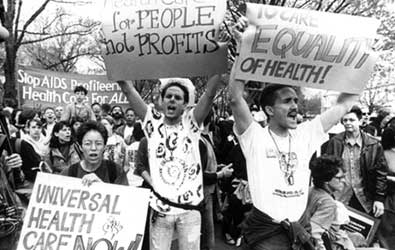
| Health Care Rally at April 25, 1993 |
The AIDS quilt
on display as part of the event. |
|
|
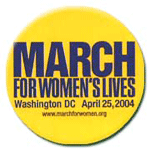
The March for Women's Lives drew
a record 1.15 million people to Washington, D.C. The marchers
wanted to protect legal
and safe access to reproductive services including abortion,
birth control and emergency contraception. |
| Organized by a
coalition that included the National Organization for Women
(NOW), Black Women's Health Imperative, Feminist Majority,
National Abortion Rights Action League (NARAL), the National
Latina Institute for Reproductive Health, and Planned Parenthood,
along with the American Civil Liberties Union (ACLU). |
| The
March for Women's Lives was the largest protest in U.S. history. |
Read
more |
|
The Geneva Conference began for
the purpose of bringing to an end the conflicts in Korea and
Indochina. This followed
the defeat of the French in Vietnam at Dien Bien Phu. France
had been trying to reassert colonial control over Indochina
following World War II.
The conferees included Cambodia, France, Laos, the People’s
Republic of China, the Democratic Republic of Vietnam, the
Soviet Union, Vietnam, the U.S. and the United Kingdom.
As a result, Vietnam was temporarily partitioned pending elections
on reunification to be held in 1956; those elections were never
held. |
|
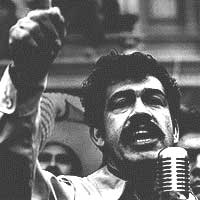 |
Rodolfo "Corky" Gonzales
founded the Crusade for Justice, a Chicano activist group,
in Denver, Colorado, and marked his departure from the Democratic
Party. It was the beginning of a nationalist strategy for the
attainment of Chicano civil rights. |
| Read
more video Democracy Now |
| Rodolfo "Corky" Gonzales |
|
| A national student strike against
the Vietnam war enlisted as many as one million high school
and college students across
the U.S. |
|
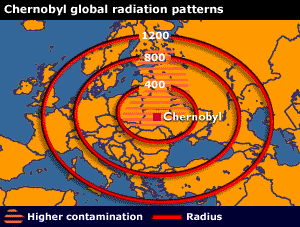
A major accident occurred at the Chernobyl nuclear power plant in the Ukraine near the border with Belarus, both then part of the Soviet Union (Union of Soviet Socialist Republics). An explosion and fire in the No. 4 reactor sent radioactivity into the atmosphere. Only after Swedish authorities reported the fallout over their country 1385 km away (860 miles), did Soviet authorities reluctantly admit that an accident had occurred.
During a fire that burned for 10 days, 190 tons of toxic materials were expelled into the atmosphere (3% of the reactor core). Winds blew 70% of the radioactive material into neighboring Belarus. |
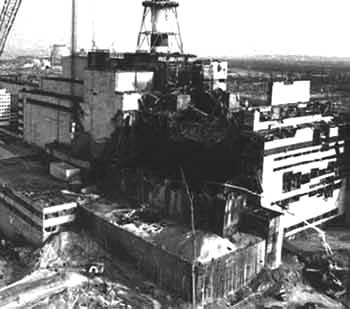 |
The explosion at Chernobyl was the world's largest-scale nuclear accident. Approximately 134 power-station workers were exposed to extremely high doses of radiation directly after the accident. About 31 of these people died within 3 months. Another 25,000 “liquidators”—Soviet soldiers and firefighters who were involved in clean-up operations — have died since the incident of diseases such as lung cancer, leukemia, and cardiovascular disease. |
400,000 were evacuated and over 2,000 towns and villages were bulldozed to the ground in areas considered permanently contaminated.
Deaths and illnesses directly attributable to radiation exposure continue. |
"Chernobyl
is a global environment event of a new kind. It is characterized
by the presence of
thousands of environmental refugees, long-term contamination
of land, water and air, and possibly irreparable damage to
ecosystems."
– Christine K. Durbak, Chairwoman of the
World Information Transfer, New
York |
 |
Chernobyl for Kids
|
|
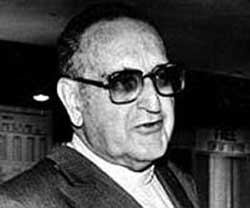 |
Bishop
Juan Gerardi Conedera, a leading human rights activist
in Guatemala, was bludgeoned to death two days after a
report
he had compiled was made public. The report blamed the U.S.-backed
Guatemalan military government and its agencies for atrocities
committed during Guatemala's 36-year civil war. |
| Bishop Juan Gerardi Conedera |
About Bishop Gerardi's murder (Democracy Now) |
|
| The UAW (United Automobile, Aerospace,
and Agricultural Implement Workers of America), gained autonomy
from the AFL (American Federation of Labor), becoming the first
democratic, independent labor union concerned with the rights
of unskilled and semi-skilled laborers. |
|
| The
Social Security Administration began operation by making
its first payment to an American
protected under the law, principally the elderly, and children
who’ve lost their parents. |
|
| Sixteen pacifists, including Evan Thomas and A.J. Muste, refused to register for the World War II draft. Muste was a Quaker activist, founder of the Fellowship of Reconciliation, and author of two pamphlets that same year, War is the Enemy and Wage Peace Now. |
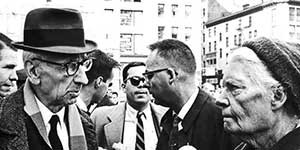 |
A.J. Muste still working for peace 25 years
later
with Dorothy Day, leader of the Catholic Worker movement. |
Read about War is the Enemy |
|
| Ten thousand marched in Washington,
D.C., calling for impeachment of President Richard M. Nixon. |
|
| Central Intelligence Agency
headquarters in Langley, Virginia, was blockaded by people
protesting U.S. policies in Central America and Southern
Africa. 700 were arrested. |
|
Thousands
of Chinese students took to the streets in Beijing to protest
government policies and issued a call for greater democracy
in the communist People's Republic of China. |
The protests
grew until the Chinese government ruthlessly suppressed
them in June during what came to be known as the Tiananmen
Square Massacre. Ignoring government warnings of violent
suppression of any mass demonstration, students from more
than 40 universities began a march to Tiananmen this day.
|
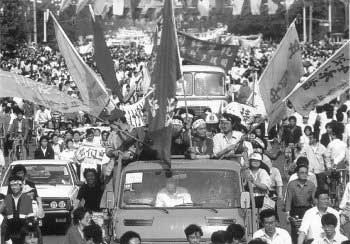 |
| The students were
joined by workers, intellectuals, and civil servants and, by
mid-May, more than a million people filled the square. |
|
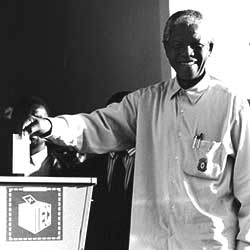 |
South Africa held its first multiracial
elections and chose anti-apartheid leader Nelson Mandela (with
more than 62%
of the vote) to head a new coalition government that included
his African National Congress Party.
|
| More
on that historic election |
Nelson Mandela casting his first vote |
|
| The International Conference of Women for a Permanent Peace convened on this day in 1915 at The Hague in the Netherlands. More than 1,200 delegates from 12 countries—Britain, Germany, Austria-Hungary, Italy, Poland, Belgium and the United States—were all dedicated to the cause of peace and a resolution of the great international conflict that is now referred to as World War I. |
 |
The conference selected a delegation of women that spent May and June meeting with government officials of the belligerent nations to demand an end to the war. |
| Often called the Women's Peace Congress, the meeting was the result of an invitation by a Dutch women's suffrage organization, led by Aletta Jacobs, to women's rights activists around the world. Jacobs believed that a peaceful international assemblage of women would "have its moral effect upon the belligerent countries," as she put it. |
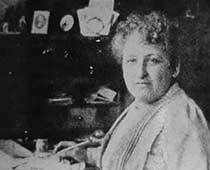 |
| Aletta
Jacobs, Dutch suffragist and an organizer of the Women's
Peace Congress |
| This was the origin of the organization known
today as the Women's International League for Peace and
Freedom. |
|
| U.S.
troops landed in the Dominican Republic. In an effort to
forestall what he claimed would be a "communist dictatorship" in
the Dominican Republic, President Lyndon B. Johnson sent more
than 22,000 U.S. troops to restore order on the island
nation and to support the military junta. |
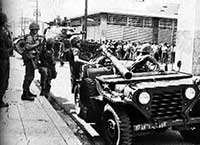 |
| U.S.
troops in the Dominican Republic, 1965 |
| Learn
more about the history: |
|
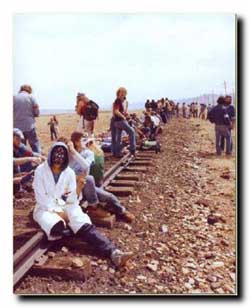 |
At the Rocky Flats nuclear weapons facility, near Denver, over 5,000 protested and nearly 300 were arrested over the following eight months for blocking railroad tracks entering the plant where plutonium bombs used
as detonators in hydrogen bombs
were produced. |
Demonstrators blocking the rail line into the Rocky Flats weapons facility |
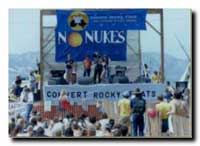 |
| Concert at the Rocky Flats demonstration in 1979 |
|
| A few weeks after the Three Mile Island nuclear accident in Pennsylvania [see March 28, 1979], a crowd of close to 15,000 assembled at the Rocky Flats nuclear weapons production plant near Denver, Colorado. Singers Jackson Browne and Bonnie Raitt took the stage along with various speakers including Dr. Helen Caldicott. The following day, 286 protesters, including Pentagon Papers source Daniel Ellsberg, were arrested for trespassing in their civil disobedience at the Rocky Flats facility. |
|
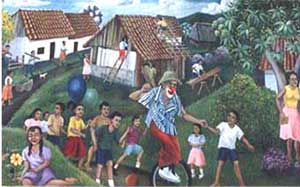 |
Benjamin
Linder, a volunteer engineer from Seattle, was murdered
in Nicaragua by the U.S.-sponsored insurgents known as
the contras (characterized by then-President Ronald Reagan
as "the moral equivalent of our founding fathers").
Linder had been working on a hydroelectric project in rural
Nicaragua. |
Mural of Ben Linder unicycling in El Cua
painted on a wall in BarrioMonseñor Lezcano
in Managua, Nicaragua, 1990 |
|
| Sixty-one
were arrested for dismantling railroad tracks leading out
of the Gundremmingen nuclear power station in Bavaria,
Germany. |
|
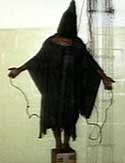
| The
first photos of the Abu Ghraib prisoner abuse scandal were
shown on CBS's ''60 Minutes II.'' The photos had been taken
by U.S. military personnel responsible for detaining and
interrogating Iraqi prisoners arrested following the U.S.
invasion of Iraq. |
 |
Article
by investigative journalist Seymour Hersh, who helped break
the story:
|
About
Standard Operating Procedure, a new documentary by Erroll
Morris on Abu Ghraib
|
|
| Exclusion Order No. 20 affected 660 people living in the area bounded by Sutter and California streets and Presidio and Van Ness Avenues in San Francisco. The Japanese Americans living in those neighborhoods were ordered to report to 2031 Bush St. for registration, and then, on this day, for removal to internment camps for the duration of the Second World War, and faced loss of their homes and businesses. |
Presentation
on what happened |
|
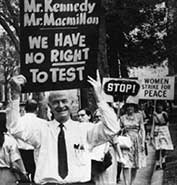
Nobel Prize-winner (for chemistry in 1954) Linus Pauling picketed the White
House with others protesting the resumption of nuclear weapons testing.
He had been invited there by President John Kennedy, to be honored at
a dinner along with other Nobelists.
|
 |
|
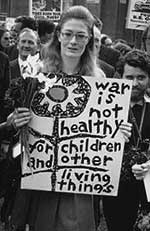 |
Actress Vanessa Redgrave was among 826 British anti-nuclear protesters arrested during a London demonstration protesting the Vietnam War.
|
Film from the BBC and their take on the demonstration that day
|
Peace
message, Vanessa Redgrave, 1968
photo:
Frank Habicht |
|
U.S.
and South Vietnamese troops invaded Cambodia and began
a bombing campaign, known as Arclight, that widened the
Vietnam War. They were after North Vietnamese and Vietcong
troops and supplies that had been moved into Cambodia.
By the time the bombing
ceased in 1973, the U.S. had dropped
more than half a million tons of ordnance on Cambodia,
three and a half times that dropped on Japan in World War
II. |
Background
on the Cambodia “incursion” |
|
Deadly rioting erupted in Los Angeles after an all-white jury in Simi Valley acquitted four Los Angeles police officers of almost all state charges in the beating of Rodney King, an African-American motorist who had been stopped for a traffic offense. |
Videotape of the abuse had been seen around the world. 17 other officers, who had been present and had not intervened, were never charged. The National Guard was called out to help restore civil order.
By the time schools were able to re-open on May 4, more than 50 had been killed, over 4000 injured, 12,000 people arrested, and $1 billion in property damage. |
 |
| The
Riot |
The
trial |
|
Gary Tyler was released from Angola penitentiary in Louisiana.
He was just 16 years old when charged with shooting a
white student in 1974. |
 |
Gary was wrongly convicted and sentenced to death by an all-white jury and became the youngest person on death row.
His case sparked a movement to gain his release which persisted for 40 years. |
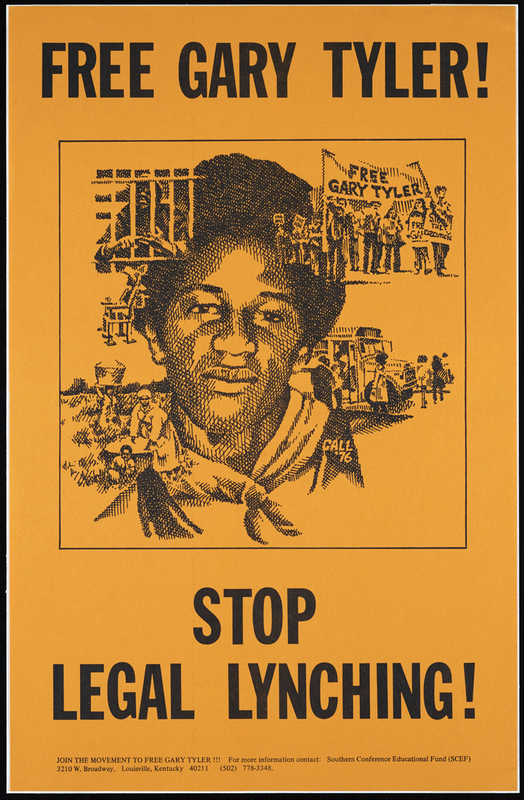 |
|
| The
American Friends Service Committee was founded to provide
young Quakers and other conscientious objectors the opportunity
to serve those in need as an alternative to military service
in what was later known as World War I. They worked with
British Friends assisting refugees from that conflict.
|
 Quaker
values in action Quaker
values in action |
|
Reverend
Martin Luther King, Jr. delivered a sermon entitled, "Why
I Am Opposed to the War in Vietnam" at the Ebenezer Baptist Church in Atlanta, Georgia.
“The time has come for America to hear
the truth about this tragic war. In international conflicts,
the truth is hard to come by because most nations are deceived
about themselves. Rationalizations and the incessant search
for scapegoats are the psychological cataracts that blind us
to our sins. But the day has passed for superficial patriotism.” |
| Read the speech |
|
President
Richard Nixon took responsibility for the Watergate scandal,
though denying any personal involvement, as he accepted
the resignations of his two closest advisors (H.R. “Bob” Haldeman,
John Ehrlichman) and Attorney General John Mitchell, who
had been in charge of his presidential re-election campaign.
He also fired his White House counsel, John Dean. Nixon
said later that evening,
“I’m never going to
discuss the . . . Watergate thing again—never, never,
never, never.” |
|
The U.S. presence in Vietnam ended as U.S. Marines and Air Force helicopters, flying from aircraft carriers offshore, began a massive airlift, Operation Frequent Wind.
In all, 682 flights went out — 360 at night. |
5,000 people were evacuated by helicopter from the military compound near Saigon's Tan Son Nhut airport; about 2500 from the U.S. Embassy (1000 Americans total, the rest Vietnamese).
That morning, two U.S. Marines, Darwin Judge and Charles McMahon Jr., Marine security guards, were killed in a rocket attack at the airport. They were the last Americans to die in the Vietnam War (the final total was 58,193). At dawn, the last Marines guarding the U.S. embassy lifted off. |
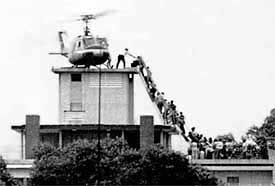 A
helicopter lifts off from inside the U.S. Embassy grounds. A
helicopter lifts off from inside the U.S. Embassy grounds. |
| The war in Vietnam ended as the government in Saigon (then the southern capital, now Ho Chi Minh City) announced its unconditional surrender to the North Vietnamese Army (NVA). Vietnam was reunited after 21 years of U.S. domination and 100 years of French colonial rule. In 15 years, nearly a million NVA and Vietcong troops and a quarter of a million South Vietnamese soldiers had died. Hundreds of thousands of civilians had been killed. |
|
| A
group of 14 mothers who had met in the waiting rooms of
police stations while trying to discover the whereabouts
of their children, organized the first of a continuing
series of demonstrations in front of the Presidential Palace
on the Plaza de Mayo in Buenos Aires, Argentina. Their
children were among the “disappeared” (los
desaparecidos), victims of the Argentina’s “dirty
war” against its own people. |
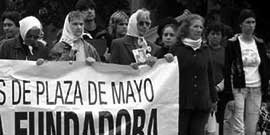 |
Each
Thursday afternoon they gathered at the Plaza to demand
that the fate of the victims be made known. Some of the
mothers, including Azucena de Villaflor, their first president,
themselves disappeared. In spite of this, the group soon
counted some 150 members and eventually grew to several
thousand in 1982-83. |
| The
mothers created a formidable national network and obtained
the support of Amnesty International and the United Nations
Human Rights Commission. |
| Argentina’s
Dirty War |
|
| Following
a 24-hour occupation at the site of two proposed nuclear
power plants in Seabrook, New Hampshire, 1,414 people
were arrested. |
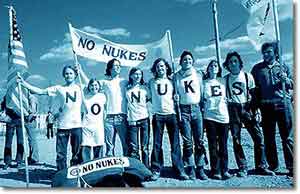
|
The non-violent civil disobedience, organized
by the Clamshell Alliance, became a model for anti-nuclear
direct actions across the country. National and international
news coverage brought the issue of nuclear power into
public focus and no nuclear reactors were ordered after
that time. Those plants already approved eventually went
online, including Seabrook Unit I, but Unit II was never
built.
|
There is still no permanent methed for long-term safe storage of highly redioactive nuclear waste generated by such plants. Most of the radioisotopes in high-level waste have extremely long half-lives (some
longer than 100,000 years).
Currently, it is stored on-site at nuclear plants around the country. |
| Seabrook
1977 - the movie |
10 Blows That Stopped Nuclear Power:
|
 |
From 1975 and reissued by peacebuttons.info
click to purchase
see the history of the symbol > read
has been translated into 44 languages > watch
|
|
 |
About
120 activists were arrested over the following eight days
in Washington, D.C., in support of a fast by Sister Dianna
Ortiz. The Ursuline nun had been kidnapped, tortured, and
raped by U.S.-trained and supported Guatemalan Army officers
in 1989; she was fasting to demand that the U.S. government
release information on her assailants. |
Sister Dianna Ortiz |
Video
or audio of Sr. Dianna |
|
 |
ABC-TV
aired the ''coming out'' episode of the sitcom ''Ellen,''
in which the title character, played by Ellen DeGeneres,
acknowledged she was a lesbian.
|
|
April
1 2 3 4 5 6 7 8 9 10 11 12 13 14 15 16 17 18 19 20 21 22 23 24 25 26 27 28 29 30
visit
another month
Jan
• Feb
• March • April
• May • June
• July
• Aug • Sept
• Oct • Nov
• Dec |
Please
support this newsletter visit
peacebuttons.info
Because of your support peacebuttons has been able to donate to
several peace and justice organizations.
see list
Thank you ! |
|
|
|
|