| |
1" pins
 |
 |
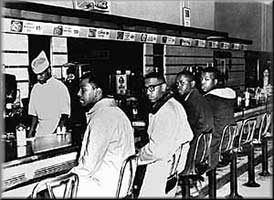
Four black
college students sat down at the Woolworth's lunch counter
in Greensboro, North Carolina, and were refused service because
of their race. To protest the segregation of the eating facilities,
they remained and sat-in at the lunch counter until the store
closed. |
| Greensboro first day: Ezell A. Blair, Jr. (now Jibreel Khazan), Franklin
E. McCain, Joseph A. McNeil, and David L. Richmond leave the Woolworth
store after the first sit-in on February 1, 1960. |
Four
students returned the next day, and the same thing happened.
Similar protests subsequently took place all over the
South and in some northern communities.
By September
1961, more than 70,000 students, both white and black,
had participated, with many arrested, during sit-ins. |
|
| On
the second day of the Greensboro sit-in, Joseph A. McNeil
and Franklin E. McCain are joined by William Smith and
Clarence Henderson at the Woolworth lunch counter in Greensboro,
North Carolina. |
| “Segregation
makes me feel that I'm unwanted," Joseph
McNeil, one of the four, said later in an interview, “I
don't want my children exposed to it.” |
Listen
to Franklin McCain’s account of what happened  |
|
| On
the first anniversary of the Greensboro sit-in, there were
demonstrations all across the south, including a Nashville
movie theater desegregation campaign (which sparked similar
tactics in 10 other cities). Nine students were arrested
at a lunch counter in Rock Hill, South Carolina, and chose
to take 30 days hard labor on a road gang. The next week,
four other students repeated the sit-in, also chose jail. |
|
 |
Saigon police chief Nguyen Ngoc Loan summarily executed Nguyen Van Lem,
suspected leader of a National Liberation Front (NLF aka Viet
Cong) assassination platoon, with a pistol shot to the head on
the street. AP photojournalist Eddie Adams’s Pulitzer Prize-winning
photograph of the incident became one of the most famous, ubiquitous
and lasting images of the war in Vietnam, affecting international
and American public opinion regarding the war.
|
| General
Nguyen Ngoc Loan executes Nguyen Van Lem a NLF officer. |
|
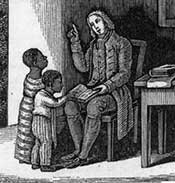
Anthony
Benezet and John Woolman, both prominent Quakers (Society
of Friends), urged refusal to pay taxes used for arming
against Indians in Pennsylvania. Since William Penn established
the state two generations earlier, the Friends had dealt
with the Indian tribes nonviolently, and had been treated
likewise by the native Americans. Benezet and the Quakers
were also early and consistent opponents of slavery. |
 |
More about Anthony Benezet |
|
The Treaty of Guadalupe
Hidalgo was signed in the Mexican city of the same name,
ending the Mexican War. In 1845 Congress had voted to annex
Texas, and President James K. Polk sent General Zachary Taylor and
troops to patrol the border, newly defined by Congress as
the Rio Grande, though it previously had been the Nueces
River.
Following an encounter between Mexican and U.S. troops, Polk
called for Congress to declare war on Mexico. General Winfield
Scott and troops eventually seized Mexico City. |
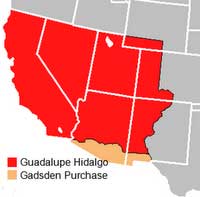
The
treaty’s
provisions called for Mexico to cede 55% of its territory
(present-day California, Nevada and Utah, New Mexico, most
of Arizona,
and portions of New Mexico, Wyoming and Colorado), and to recognize
the Rio Grande as the southern border of Texas, in exchange
for fifteen million dollars in compensation for war-related
damage to Mexican property. According to the treaty, U.S. citizenship
was offered to any Mexicans living in the 500,000 sq miles
(1.3 million sq km) of new U.S. territory. |
 |
The Treaty of Guadalupe Hidalgo |
Land
ceded to the U.S. after the Mexican War. |
|
| The
first of well over 400,000 Mexican-Americans from across
the country, some of
them citizens and many of them U.S. residents for as long
as 40 years, were "repatriated" as Los Angeles
Chicanos were forcibly deported to Mexico. |
| More
on those deported, Los Repatriados |
|
| The
Conference on the Reduction and Limitation of Arms, the
world’s first disarmament
meeting, opened in Geneva, Switzerland. Sponsored by the
League of Nations, and attended by delegates from 60 nations,
no agreement was reached. The U.S. delegation called for
the abolition of all offensive weapons as the basis for negotiations
but found little support. |
|
The first
burning of Australian military conscription papers as
a protest against the Vietnam War occurred in Sydney,
Australia.
|
 |
|
|
|
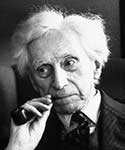
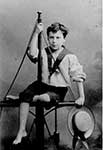
Bertrand
Russell, mathematician, Nobel laureate in literature and
philosopher of peace, died in Penryndeudreaeth, Merioneth,
in Wales at age 97. |
 |
| Bertrand
Russell later in life |
Bertrand
Russell at age 10 |
“Patriots
always talk of dying for their country but never of killing
for their country.”
— Bertrand Russell |
| More
of Russell’s wisdom |
|
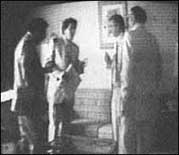
Reports surfaced that the FBI had conducted a sting operation targeting
members of Congress. In what became known as ''Abscam,'' members
suspected of taking bribes were invited to meetings with FBI agents
posing as Arab businessmen, offering $50,000 and $100,000 payments
for special legislation.
Audio and video recordings of the meetings were made surreptitiously. Six
members of the house were convicted of accepting bribes. Another member
of the House and one senator were targeted but took no money. |
|
 |
| FBI
agents in Abscam sting operation |
| Actual
FBI videotape of one attempted scam |
|
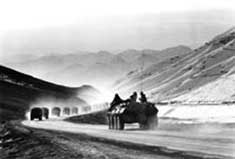 |
Soviet
participation in the war in Afghanistan ended as Red Army
troops withdrew from the capital city of Kabul. They left
behind many of their arms for use by Afghan government
forces. They were driven out principally by the insurgent
mujahadin, armed through covert U.S. funding.
|
| Read
more |
| “Charlie
Wilson’s War” movie trailer |
|
|
South African
President F.W. De Klerk unbanned (lifted the legal prohibition
on) opposition parties: the African National Congress (ANC),
the Pan-Africanist Congress and the South African Communist
party were officially considered legal. He also announced
the lifting of restrictions on the UDF, COSATU and thirty-three
other anti-apartheid organizations, as well as the release
of all political prisoners and the suspension of the death
penalty. This was the result of his negotiations with the
imprisoned Nelson Mandela, a leader of the ANC.
|
| The
ecstatic reaction to De Klerk’s beginning the end of
apartheid on BBC video |
|
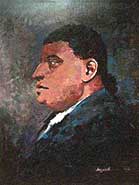
| Paul Cuffee, a shipowner
and a free negro (born to slave parents in Massachusetts),
arrived in Sierra Leone with 38 African Americans intent
on setting up a colony for free blacks from the United States.
He had earlier set up the Friendly Society of Sierra Leone,
a trading organization, to encourage commerce between England,
the U.S. and the British colony on the Atlantic coast of
Africa. |
 |
More
on Paul Cuffee |
|
| Abigail Ashbrook of Willingboro,
New Jersey, refused to pay taxes because she was denied the
right to vote because she was a woman. |
|
| In New York City, more than 450,000 students, mostly black and Puerto Rican, comprising nearly half the citywide enrollment, boycotted the New York City schools to protest the system's de facto segregation. The Parents' Workshop for Equality, led by Reverend Milton Galamison, had proposed a plan to integrate the city's schools but it was rejected by the school board. Freedom Schools were set up for the kids during the one-day direct action. |
| More
detail on one of the largest collective civil rights
actions in history |
|
Three
decades of armed conflict in Vietnam officially ended when
a cease-fire agreement signed in Paris the previous month
went into effect. Vietnam had endured almost uninterrupted
hostility since 1945, when a war for independence from France
was launched. A civil war between the northern and southern
regions of the country began after the country was divided
by the Geneva Convention in 1954 following France’s
military defeat and troop withdrawal. American military "advisors" began
arriving in 1955.
Between 1954 and 1975, 107,504 South Vietnamese government
troops, approximately 1,000,000 North Vietnamese and National
Liberation Front soldiers, and 58,209 American troops died
in combat. The number of Vietnamese civilian deaths is unknown,
estimated between one and four million killed, and millions
more wounded or affected by defoliants such as Agent Orange. |
|
| President Richard
Nixon signed the Endangered Species Act, intended to avoid
species extinction, especially through loss of habitat. |
|
|
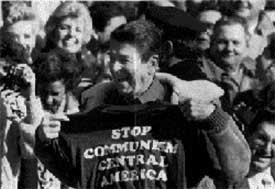
The
U.S. House of Representatives rejected President Ronald
Reagan's request for at least $36.25 million in aid to
the Nicaraguan Contras, an insurgent group trying violently
to overthrow the Sandinista government.
|
|
|
| President Bill
Clinton lifted the trade embargo against Vietnam, which had
been in place since the end of the Vietnam war. |
|
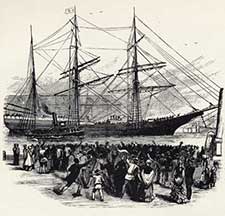 |
The
American Colonization Society established the first
settlement in what would become the west African state
of Liberia. The new arrivals to the island called Perseverance
were freeborn blacks from the U.S. who had emigrated
with the encouragement of influential white Americans
and funding from Congress. The colony was governed
by whites for twenty years.
|
| Read
more |
| American
Colonization Society ship leaving New York City bound for Liberia. |
|
Rosa
Louise McCauley was born in Tuskegee, Alabama.
She grew
up to become civil rights leader Rosa Parks.
|
 |
The
Neville Brothers music video says thank you in “Sister
Rosa”
|
| A
teenage Rosa Parks poses with friend Samson Smith |
|
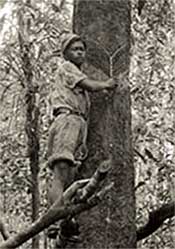
The
U.S. House of Representatives overrode President Ronald Reagan’s
(second) veto (401-26) of the Clean Water Act. The law provided
funds for communities to build waste treatment facilities
and to clean up waterways. Reagan described it as ''loaded
with waste and larded
with pork.'' |
|
|
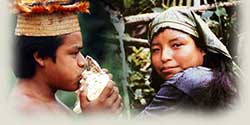
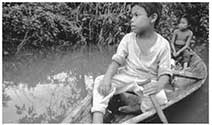
The
Colombian government recognized native rights to half
of its 69,000 square miles of forest in the Amazon River
basin, home to 55,000 indigenous people. In addition
to the official Spanish, as many as 200 languages or
dialects are spoken among Colombia’s peoples. |
|
 |
| U'wa
people |
Boys on the Amazon |
| More
on Colombia’s indigenous peoples |
|
| Start
of a week of marches for peace by thousands in Grozny,
the embattled capital of Chechnya.
|
|
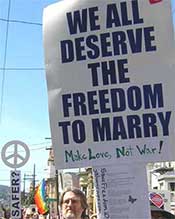 |
The
Massachusetts Supreme Court declared that gays were
entitled to nothing less than marriage under the equal
protection clause of the 14th Amendment to the Constitution.
They ruled that Vermont-style civil unions would not
suffice, declaring they created an "unconstitutional,
inferior, and discriminatory status for same-sex couples."
|
| In the news |
The actual text of the
decision in Goodridge vs. Department of Public Health |
|
|
America’s
first daily labor newspaper began publication in New
York City.
George Henry Evans, a 29-year-old journeyman
printer, was the publisher of "New York Daily
Sentinel."
|
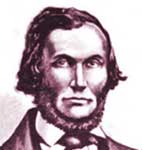 |
| George Henry Evans |
More about George Henry Evans |
|
|
49
German troops conscientiously objected to serving in
Turkey during the Gulf War. The German peace movement
actively supported U.S. soldiers stationed there by helping
them file for conscientious objector (CO) status. By
the end of the month, there were nearly 30,000 civilian
COs refusing to serve in the military.
|
|
|
|
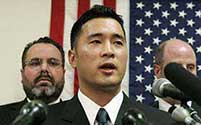
Lieutenant
Ehren Watada faced a court martial for refusing to deploy
to Iraq and for publicly criticizing the war, the first
officer since Vietnam to be so tried. A volunteer from
Hawaii who joined the U.S. Army prior to the invasion in
2003, he had refused to serve because:
"It
would be a violation of my oath because this war to me is illegal
in the sense that it was waged in deception, and it was also
in violation of international law.” |
| Lieutenant
Ehren Watada |
Initially
having served in South Korea, he learned more about the
Iraqi conflict and the bogus claims of Saddam Hussein’s
possession of weapons of mass destruction. He offered to
resign or serve in Afghanistan but was refused:
"Mistakes can happen but to think that it was
deliberate and that a careful deception was done on the American
people – you just had to question who you are as a serviceman,
as an American." |
|
| Spain agreed to abandon all claims of sovereignty
over Cuba, the cession of Puerto Rico and Guam, the cession
of the
Philippine Islands; and in exchange the U.S. agreed to
pay $20,000,000 in a treaty ratified by the U.S. Senate
on this day.
The previous July the U.S. took control of Gantanamo Bay,
blockaded Cuba’s other ports and destroyed the Spanish
fleet at Santiago Bay.
The U.S. Army, landed at Guanica,
near Ponce,
Puerto Rico, and shortly took possession of the island with
the exception of San Juan.
The Spanish Pacific fleet was destroyed
and the U.S. took control of Manila, the capital, and Luzon,
the main island of the Philippines a few weeks later.
|
|
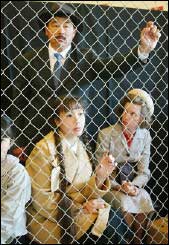
The U.S. government required the 110,000 disposessed Japanese
Americans forcibly held in concentration (internment) camps
to answer loyalty surveys. |
 |
|
Some
of the interned were U.S. citizens, and some volunteered
to serve in the armed forces during the war with Japan.
The Nisei, as they were known, were kept in the camps
until the end of World War II. |
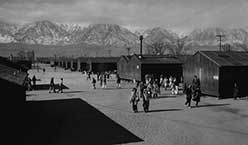 |
| The Manzanar Relocation
Center, a one of the concentration camps where Japanese-Americans
were forced to live throughout World War II. |
|
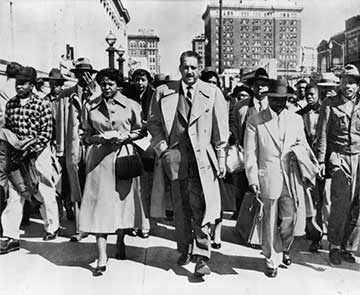
Autherine
Lucy was excluded from classes just three days after
becoming the first black person allowed to attend the
University of Alabama. Her suspension "for her
own safety" followed three days of riots over
her Supreme Court-ordered enrollment. |
|
Crowds of students,
townspeople and members of the Ku Klux Klan shouted, “Kill
her!” among other things. It is unclear why the
University did not suspend the students who were among
the rioters.
Lucy
had originally applied for graduate study in library science
in 1952, and had been accepted until the University realized
her race, and claimed state law prevented her admission.
|
| Autherine
J. Lucy and her attorney Thurgood Marshall |
| A
graduate of traditionally black Miles College, she was
only admitted with the help
of the National Association for Colored People Legal Defense
and Education Fund (NAACP-LDEF) and lawyers Thurgood Marshall
(later a Supreme Court justice), Constance Baker Motley (future
federal judge) and Arthur Shores (elected to Birmingham City
Council). |
| Read
more |
|
| The
United States successfully test-fired its first intercontinental
ballistic missile (ICBM), known as Titan, from Cape Canaveral.
It was a two-stage rocket designed to carry nuclear warheads. |
Titans were also capable of boosting satellites and spacecraft
into orbit. Before the last was produced in 2002, they launched
several two-man Gemini missions in the 1960s and launched
the first spacecraft to land on Mars.
|
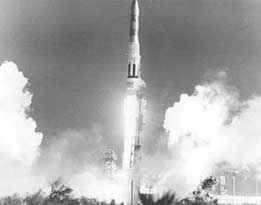 |
First
test launch of Titan booster rocket from
Cape Canaveral,
Florida. |
|
|
The civil
rights jail-in movement began when ten negro students in
Rock Hill, South Carolina, were arrested for requesting
service at a segregated lunch counter. They refused to
post bail and demanded jail time rather than paying fines,
refusing to acknowledge any legitimacy of the laws under
which they were arrested. |
| Charles Sherrod |
More about Charles Sherrod |
Reverend Martin Luther King, Jr. wrote to Charles Sherrod, Diane
Nash
and the others in jail:
‘‘You have inspired all of us by such demonstrative courage
and faith. It is good to know that there still remains a
creative minority who would rather lose in a cause that will
ultimately win than to win in a cause that will ultimately
lose.’’ |
|
The Molesworth
Common Peace Camp, just outside the Royal Air Force Base
there, was evicted by the British Army. The 300 inhabitants
and their many supporters had been nonviolently protesting
the siting of nuclear-tipped U.S. cruise missiles at the
base. Peace camps were established at several locations
in Europe in the early 1980s to protest the destabilizing
nuclear weapons buildup. |
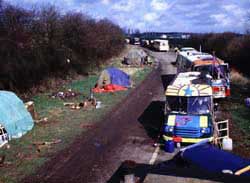 Molesworth
Common peace camp Molesworth
Common peace camp
|
|
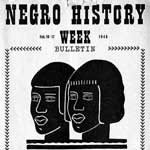
"Negro
History Week" was observed for the first time, conceived
by Dr. Carter G. Woodson as an opportunity to study the
history and accomplishments of African Americans. Dr.
Woodson was the founder, in 1915 Chicago, of the Association
for the Study of Negro Life and History. There he first published the Journal of Negro History,
currently known as The Journal of African American History (www.jaah.org).
|
Woodson was a graduate of the University of Chicago, the Sorbonne, and was the second black man ever to receive his doctorate from Harvard.
He chose February because it is the birth month of both Abraham Lincoln and Frederick Douglass; now it is designated Black History Month. |
 |
Top
L-R: Frederick Douglass, former slave and abolitionist
leader; Muhammad Ali, poet, World Champion, the greatest;
Maya Angelou, poet, novelist, voice of wisdom; Malcolm
X, strong and clear-eyed brother seeking freedom and honor
and dignity ; Harriet Tubman, liberator and conductor on
the Underground Railroad.
Below: Jimi Hendrix, prolific guitar genius, rock ‘n’ roll writer;
Nat “King” Cole, jazz composer, pianist and singer; Rev. Martin Luther
King, Jr., pastor, scholar and author, leader of a people, inspiration to peacemakers. |
|
 |
Women
in Switzerland were granted the right to vote in national
elections and to stand for parliament for the first time
in their nation's history. This happened through a national
referendum in which only men could vote, passing 621,403
to 323,596. A previous referendum in 1959 failed 2-1.
|
|
Haitian
self-appointed President-for-Life Jean-Claude “Baby
Doc” Duvalier fled his country after being ousted
by the military, ending 28 years of authoritarian family
rule. |
| Policies begun by his father, Francois “Papa
Doc” Duvalier, had forced many to flee Haiti (the
western portion of the island of Hispaniola), leaving it
the poorest and most illiterate nation in the hemisphere.
Deforestation (for cooking fuel and heat) eliminated forest
cover on 98% of the country, in turn leading to significant
annual loss of topsoil, often making agriculture unsustainable. |

|
| Jean-Claude
`Baby Doc' Duvalier with his father Francois `Papa
Doc' Duvailer. |
| Some Haitian history |
|
| The
Reverend Jean-Bertrand Aristide was sworn in as Haiti's
president after winning the country’s first-ever
democratic election. Haiti had achieved its independence
from France
in 1804 but had a long succession on unstable governments,
as well as significant U.S. control in the first half
of the 20th century, including military occupation
from 1915
to 1934. |
 |
| Jean-Bertrand
Aristide, in exile during the 1991-94 military junta. |
| Archive
of Haitian history |
|
More
than 20,000 attended a demonstration in Paris against the
Secret Army Organization (Organisation
de l'Armée Secrète or OAS), a group of European-Algerians
which used terrorist methods to keep Algeria a French colony.
They
set off bombs in Metropolitan France and made multiple
attempts on President Charles DeGaulle’s life. |
DeGaulle had chosen a referendum among Algerians to decide
their independence; Europeans were outnumbered 9:1 by
the native population of Sunni Muslim Arabs and Berbers.
The demonstration was held in violation of a declared state
of emergency (because of OAS actions) and, in the subsequent
rioting, at least eight people were killed and 240 injured
(half of them police officers).
|

|
| The terrorist crimes of the OAS |
|
|
The
Orangeburg Masssacre

|
|
Three
black students were killed and 50 wounded in a confrontation
with highway patrolmen at a South Carolina State rally
supporting arrested civil rights protesters. Orangeburg’s
only bowling alley, the All Star, was still segregated
years after the Civil Rights Act of 1964 had outlawed discrimination
based on race in such public accommodations.
On the previous two days, college students had entered the
bowling alley, refusing to leave after they were not allowed
to bowl. Fifteen of the second group were arrested.
|
The
Orangeburg Massacre
|
|
President Jimmy Carter
unveiled a plan to re-introduce
draft registration. |
|
Captain Paul Cuffe, his brother John, two free negroes,
and other residents of Massachusetts petitioned the state
legislature for the
right to vote. |
A few years earlier,
Cuffe and his brother had refused to pay local taxes,
reasoning that there was a connection between an obligation
to pay taxes to a government and the right to vote for
that government. |
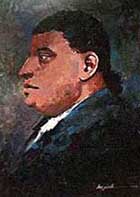 |
| Cuffe’s
memoir available |
| Captain
Paul Cuffee |
| Cuffe’s
career as ship captain, shipowner, African colonizer
and generous citizen |
|
United
States Senator Joseph P. McCarthy (R-Wisconsin) accused more
than 200 staff members in the State Department of being Communists,
launching his anti-red crusade.
He
made the allegation in a public speech in Wheeling, West
Virginia, saying that state was infested with communists,
and brandished a sheet of paper which he said contained
the alleged traitors' names. |

|
"I have here in my hand," he
said, "the names of 205 men that were known to the
Secretary of State [Dean Acheson] as being members of the
Communist party and who nevertheless are still working
and shaping the policy of the State Department." The
number changed repeatedly over the following months. Some
years later, he confided the paper was actually just a
laundry list.
|
| Anti-Communist
fear ran high in the U.S. at the time. Federal civil servant
and Soviet spy Alger Hiss had been recently convicted,
and a communist government had just come into power in
China. Those accused by McCarthy and others often lost
their jobs, regardless of the validity of the accusation
of their connection to the Communist Party. |
| McCarthy’s
career of irresponsible accusation |
|
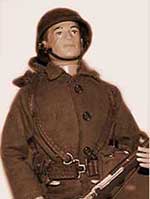 |
The
G.I. JOE action figure made its debut as an 11.5 inch "doll" for
boys with 21 moving parts, named after the movie, The Story
of G.I. JOE. |
Puts
you in the action!
|
|
| President
Lyndon Johnson ordered a U.S. Marine Corps Hawk air defense
missile battalion deployed to Da Nang, South Vietnam, to
provide protection for the key U.S. air base there. American
military advisers had been in country since the defeat and
withdrawal of the French in 1954, but this was the first
commitment of combat troops to South Vietnam. |
There
was considerable reaction around the world to this new level
of U.S. involvement. Both the People’s Republic of
China and the Soviet Union threatened to intervene if the
United States continued its military support of the South
Vietnamese government.
In Moscow, some 2,000 demonstrators,
led by Vietnamese and Chinese students and clearly supported
by the authorities, attacked the U.S. Embassy. Britain and
Australia supported the U.S. action, but France called for
negotiations. |
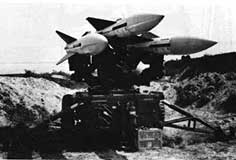 |
| A
Marine HAWK missile launcher is in position at the Danang
Airfield. |
|
| Ten
thousand, organized by Gush Shalom (peace bloc in Hebrew),
a coalition of Israeli
peace groups, marched in Tel Aviv against the Ariel Sharon
government's increasingly brutal attacks on Palestinian
civilians. The harsh tactics were part of Israel’s
continuing occupation of the West Bank (of the Jordan River)
and the Gaza Strip, territory beyond Israel’s internationally
recognized 1967 borders. |
|
| Six
weeks before the Iraq War began, Secretary of State Colin
Powell on ABC-TV's “This
Week” dismissed the need for U.N. weapons inspectors
to continue searching Iraq for weapons of mass destruction. |
 |
He
said the administration saw no further need for ''inspectors
to play detectives or Inspector Clouseau running all
over Iraq.'' Clouseau was the bumbling detective played
originally by Peter Sellers (and lately Steve Martin)
in the Pink Panther films.
|
 |
| Peter
Sellers as Inspector Clouseau |
| U.S.
Secretary of State Colin Powell presenting evidence at
the United Nations |
| U.N.
weapons inspectors, left, and Iraqi National Monitoring
Directorate members visit a Baghdad storage facility
in this photo taken Feb. 5, 2003, just hours before
U.S. Secretary of State Colin Powell appeared at the
U.N. Security Council to offer evidence of alleged
Iraqi attempts to hide banned weapons. |
 |
|

|
The
Voice of Nuclear Disarmament, a pirate radio station, began
operation offshore of Great Britain. It was run by John
Hasted, a physicist, a musician, and a radio expert in
World War II. He was active with mathematician and philosopher
Bertrand Russell in the Committee for Nuclear Disarmament,
a group that practiced Gandhian an nonviolent civil disobedience. |
| Pirate
radio ship |
|
 |
Bob
Dylan’s ''The Times
They Are A-Changin’'' was released. The album’s
title song captured the emerging, principally generational
gap in American culture concerning war and racism. |
Come
mothers and fathers
Throughout the land
And don't criticize
What you can't understand
Your sons and your daughters
Are beyond your command
Your old road is
Rapidly agin' |
watch video (1964) |
| the lyrics |
|
Iraq
acceded to U-2 surveillance flights over its territory,
meeting a key demand by U.N. inspectors searching for banned
weapons of mass destruction (WMD) there. |
The 60 weapons
inspectors in Baghdad and Mosul were under the U.N. Monitoring,
Verification and Inspection Commission (UNMOVIC), led by
Hans Blix, and the International Atomic Energy Agency under
Mohamed El Baradei.
The
U.N. had destroyed all of Iraq’s banned weapons
by 1994, as well as production and development facilities
later, though Saddam
Hussein expelled the U.N. representatives in 1998. |
 |
| U-2
spy plane. |
|

|
The
economic and trade embargo during the inter-war period
prevented resumption of the weapons programs. CIA and other
intelligence estimates, however, insisted upon the existence
of WMDs in Iraq. None have ever been
found. |
| Hans
Blix gives his report at the UN as Mohamed El Baradei listens. |
|
 |
The Pennsylvania Society
for Promoting the Abolition of Slavery, composed mostly
of Quakers and Mennonites, petitioned Congress for emancipation
of all slaves. Benjamin Franklin had become vocal as
an abolitionist and in 1787 began to serve as President
of the Society which not only advocated the abolition
of slavery, but made efforts to integrate freed slaves
into American society.
The proposed resolution was immediately denounced by pro-slavery
congressmen and sparked a heated debate in both the House
and the Senate. |
| More
on early Abolitionist and Anti-Slavery Movements |
|
Emma
Goldman was arrested for lecturing on birth control, presumed
a violation of the 1873 Comstock Law which prohibited distribution
of literature on birth control, considered obscene under
the act.
Goldman considered such knowledge essential to women's reproductive
and economic freedom; she had worked as a nurse and midwife
among poor immigrant workers on New York’s Lower East
Side in the 1890s. She also organized for womens’ suffrage,
later opposed U.S. involvement in World War I, and was imprisoned
for allegedly obstructing military conscription. |

|
“.
. . those like myself who are disseminating knowledge [of
birth control] are not doing so because of personal gain
or because we consider it obscene or lewd. We do it because
we know the desperate condition among the masses of workers
and even professional people, when they cannot meet the
demands of numerous children.”
|
| – Goldman
letter to the press following her arrest |
Emma
Goldman speaking on Birth Control -Union
Square, New York City May 20, 1916
|
Emma
Goldman’s courageous efforts
|
 |
|
Forty-eight
thousand General Motors workers won their 44-day sit-down
strike in Flint, Michigan. On December 30 workers at
Fisher Plants 1 & 2 sat down and refused to leave,
forcing workers around them to stop work and preventing
the next shift from starting.
|
 |
The
sit-down strike ended when the company agreed to recognize
the United Automobile Workers union as the representative
bargaining agent for the striking hourly employees.
Other automakers gradually accepted the legitimacy
of the union. The success of the sit-down was an inspiration
to workers in other industries to organize their own
unions.
|
Nearly
100 images on the Flint sit-down from
Detroit’s Wayne State University Walter Reuther
Archive |
|
| Native Americans began
The Longest Walk, a march from Alcatraz Island in San Francisco
Bay to Washington, D.C. |
 |
Native American Activism:
1960s to Present
A Brief History
of the
American Indian Movement
|

photo Ilka
Hartmann for
larger image click
|
| The Walk was intended
to be a reminder of the forced removal of American Indians
from their homelands across the continent, and drew attention
to the continuing problems plaguing the Indian community,
particularly joblessness, lack of health care, education
and adequate housing. |
|
|
Poet
John Trudell, a former national chairman of the American
Indian Movement (AIM), burned an upside-down flag and
spoke from the steps of the FBI building in Washington,
D.C. during a vigil for Leonard Peltier. Peltier, also
a leader of AIM, was imprisoned (and is still today after
30 years), and is considered a political prisoner by
Amnesty International.
Twelve hours later Trudell’s wife Tina, her mother,
and their three children died in an arsonist's attack of
their home on the Duck Valley Reservation in Nevada. The
FBI did not investigate even though the crime fell under
its jurisdiction.
|
|

|
Nelson
Mandela was freed after 27 years in a South African prison
following months of secret negotiations with South African
President F.W. (Frederik Willem) de Klerk.
In 1952, Mandela became deputy national president of the
African National Congress (ANC), the oldest black political
organization in South Africa, having joined as a young lawyer
in 1944.
|
He advocated nonviolent resistance to apartheid – South
Africa's institutionalized system of white supremacy, black
disenfranchisement and rigid racial segregation. |
However,
after the massacre of peaceful black demonstrators at Sharpeville
in 1960, Mandela helped organize a paramilitary branch
of the ANC to engage in guerrilla warfare against the white
minority government.
|
 |
He and de Klerk were jointly awarded the Nobel Peace prize
in 1993 "for their work for the peaceful termination
of the apartheid regime, and for laying the foundations for
a new democratic South Africa.” |
| Read
more |
|
 |
Charles
Robert Darwin, who first described the process of evolution
of species in the plant and animal kingdoms through natural
selection, was born.
It is now celebrated as Darwin Day,
when the common language of science, bridging language and
culture, is recognized and appreciated. |
 |
| Darwin
Day ideas |
|
| The National Association
for the Advancement of Colored People (NAACP) was founded by
sixty Americans, both black and white, in a call to safeguard
civil, legal, economic, human, and political rights of black
Americans. |
 |
The
call was partly in reaction to a race riot in 1908 in
Springfield, Illinois, home of Abraham Lincoln. The call
was issued on the centennial of his birth, and principally
written by Oswald Garrison Villard, president of the
N.Y. Evening Post Company: "If Mr. Lincoln could
revisit this country in the flesh, he would be disheartened
and discouraged.”
|
 |
| Oswald
Garrison Villard |
| NAACP’s
beginnings: |
|
 |
An
estimated 400-500 veterans and conscientious objectors
from World
Wars I and II burned their draft cards during two demonstrations,
in front of the White House and at New York City’s
Labor Temple, in protest of a proposed universal conscription
law.
This was the first peacetime draft-card burning. |
|
About
5,000 demonstrators marched on Atlanta's State Capitol to
protest the Georgia state flag (on left) because its principal
element was the Confederate battle flag. That flag was adopted
in 1956 by the state legislature in reaction to the Supreme
Court decision of Brown v. Board of Education ordering the
racial integration of public schools. Several newspaper editorials
opposed the flag as well as 18 local patriotic organizations,
including the United Daughters of the Confederacy, stating
the flag "would cause strife."
|
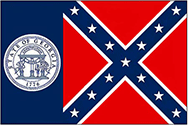 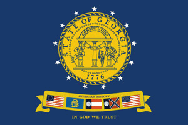 |
| In 2001 the Georgia state flag was redesigned, shown above. |
|
 |
In "Prince
of Peace Plowshares," six activists poured blood
and symbolically disarmed U.S.S. The Sullivans, a nuclear-capable
Arleigh Burke-class destroyer, at the Bath Iron Works
in Bath, Maine. All were eventually convicted of destruction
of government property and conspiracy. |
| Read
more about this action |
|
| Labor
leader Mary Harris "Mother" Jones was placed under
house arrest at Pratt (Kanawha Co.), West Virginia, for inciting
to riot. An
organizer for the United Mine Workers, she had come to
the Paint Creek and Cabin Creek mines where a long and nasty
struggle had escalated. |
 |
Jones was known for her fiery (and
often obscene) verbal attacks on coal operators and politicians.
A native of Ireland, she had been organizing for more than
15 years. |
The
coal operators had hired mine guards to intimidate the
workers and discourage formation of a union. Besides asking
to be paid what other area miners were making, the union
demanded
• the right to organize
• recognition of their rights to free speech and assembly
• an end to blacklisting of union organizers
• alternatives to company stores
• an end to the practice of using mine guards
• prohibition of cribbing
• installation of scales at all mines for accurately weighing coal
unions be allowed to hire their own checkweighmen to make sure the companies'
checkweighmen were not cheating the miners who were not paid hourly, but by the
ton.
68 years old (though claiming to be over 80) and suffering from pneumonia, Jones
was never charged with a crime (martial law had been declared). A few weeks later,
the new governor, Henry Hatfield, was sworn in and examined Mother Jones (he
was also a doctor) but refused to release her from house arrest for two months. |
| Mother Jones biography |
Mother Jones magazine |
|
France
became the world’s fourth nuclear power, conducting
its first plutonium bomb test at the Reggane base in
the Sahara Desert in what was then French Algeria. "Gerboise
Bleue" was detonated from a 330-foot tower and had
a yield of 60-70 kilotons (equivalent to nearly 70,000
tons of TNT). |
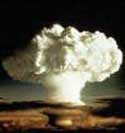
|
|
|
Carrying huge photos of Vietnamese children who had been victims of Napalm (a flammable defoliant used extensively in the war there), 2,500 members of the group Women Strike for Peace stormed the Pentagon, demanding to see "the generals who send our sons to Vietnam." When Pentagon guards locked the main entrance doors, the women took off their shoes and banged on the doors with their heels.
|

|
|

|
They
were eventually allowed inside, but Defense Secretary
Robert McNamara would not meet with them.
Senator Jacob Javits (R-New York) agreed to meet a few hundred
of the women, but he was booed by the women when he denied
the U.S. was using toxic gas in Vietnam.
|
|
| Five
soldiers were arrested at a pray-in for peace in Vietnam
at Fort Jackson, South Carolina. Two were court-martialed
for refusing to stop praying. The pray-in was repeated
a year later. |
|
| Two
precision-guided missiles destroyed the Amiriyah subterranean
bunker in Baghdad while
being used as an air-raid shelter by 408 Iraqi civilians
during the first Gulf War. The resulting deaths of all inside
made it the single most lethal incident for non-combatants
in modern air warfare.
The
U.S. had detected signals coming from the bunker and considered
it a military command
and control center. |
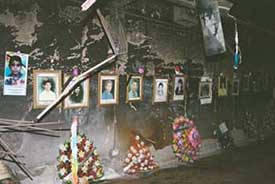 |
| There
was an antenna atop the bunker but it was connected by
cable to the actual command center
300 yards away, which was not hit by the 2000 lb. bombs which
landed precisely on their intended target, penetrating ten
feet of hardened concrete. Only 3% of the 250,000 bombs and
missiles fired during that conflict were considered such “smart
bombs.” |
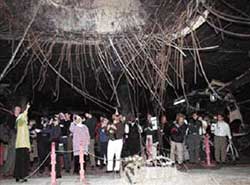 |
Visitors tour
the Amiriyah Bunker.
The Iraqi government has preserved
the bunker as a public memorial. |
|
The organization that would shortly
be called the Southern Christian Leadership Conference (SCLC)
chose its leadership at a meeting
in New Orleans. |
 |
Reverend
Martin Luther King, Jr. and Reverend Ralph David Abernathy
led the group which sought to coordinate civil rights protests
throughout the South.
Organizers of bus boycotts, inspired by the one in Montgomery,
Alabama, had met in Atlanta a month earlier. Duringthat meeting
Dr. Abernathy’s home and church were bombed. |
|
| Reverend
Ralph David Abernathy and Rev. Martin Luther King, Jr. |
|
|
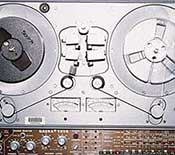
President
Richard Nixon ordered a secret taping system to be installed
for his offices in the White House.
Listen
in on the presidents
|
|
|
At a meeting of the presidents of Nicaragua, Honduras, Guatemala, Costa Rica, and El Salvador, the Sandinista government of Nicaragua agreed to release a number of political prisoners and hold free elections within a year. In return, Honduras promised to close bases established by the U.S. for and used by the anti-Sandinista Contra rebels.
Just over one year later, elections were held (with international observers including former President Jimmy Carter) though the nation was threatened with a continuing U.S. economic boycott, and was experiencing ongoing Contra violence. The Sandanista Front candidate was defeated 55% to 41%. |
|
The
man-of-war (battleship) USS Maine was sunk in Cuba’s Havana Harbor
as the result of an explosion, 260 American naval personnel
dying as a result, another 58 wounded. An insurrection against
Spanish colonial rule in Cuba had persisted for years, and
brutal Spanish tactics had engendered strong American reaction.
That is why Consul General Fitzhugh Lee had asked President William
McKinley to send the Maine “for the moral effect it might
have.”
Spain’s Governor-General Weyler had forced 300,000 Cubans
into towns and cities to insulate them from the insurgents
but had made no preparations for their food, housing or health
care. Half of the reconcentrados, as they were called,
died as a result. Pres. McKinley had tried since coming into
office
to reach a settlement through negotiation but Spain rejected
his efforts. Following the sinking of the Maine, popular opinion
in the U.S. moved toward war with Spain, partially in response
to inflammatory press coverage. Congress then voted McKinley
$50,000,000 to be used for the national defense at his discretion,
and provided for a contingent increase of the army to 100,000
men.
The cause of the explosion ??? |
|
About
2,000 people – including a tractor convoy consisting
of over 100 farmers – staged a demonstration in the
north German town of Ahaus in protest against the planned
shipment of nuclear waste to a storage facility in the town.
A consignment of full CASTOR (Casks for Storage and Transport
of Radioactive Material) containers was expected at the Ahaus
interim nuclear storage site within the next two weeks. |
|
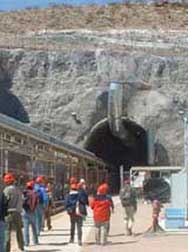
President George W. Bush approved
Nevada's Yucca Mountain as the site for long-term disposal
of 70,000 metric tons (77,000 tons) of highly radioactive nuclear
power plant waste.
12
years and $6.8 billion worth of study and construction
had gone into the site 90 miles from Las Vegas. |
 |
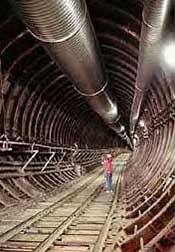
It
is officially estimated that, by the time it is completed
in 2017, the total construction cost will be $23 billion.
2000 additional metric tons of such waste are generated
by U.S. nuclear power plants each year, leading to concerns
that the facility would be full shortly after its opening.
All such waste is currently stored onsite at individual
nuclear power plants. |
 |
Problems with the Yucca Mountain
site
|
What
are the alternatives |
FAQs
on Yucca Mountain |
|
|
The
world said NO to war...
|
In
the single largest day of protest in world history, millions
on 6 continents demonstrated against the U.S./U.K. plans
to invade Iraq. Reported totals included 1 to 2 million
in London and Rome; 1.3 million in Barcelona, Spain (a
city of 1.5 million); 500,000 each in Berlin, Paris, Madrid,
and New York. Smaller demonstrations were held in over
600 cities and towns across the U.S., including tens of
thousands in several cities, and 150,000 the following
day in San Francisco.
Total participation is estimated at 25 million in more than
100 countries.
|
 |
|
| A
coalition known as the Popular Front (Frente Popular), comprised
of socialists, communists, republicans, and labor groups,
narrowly won a majority in the Cortes, Spain’s parliament,
defeating the National Front. |
|
Fidel
Castro was sworn in as Cuba’s youngest prime minister
after leading a years-long guerrilla campaign that forced
right-wing dictator Fulgencio Batista into exile. |
|
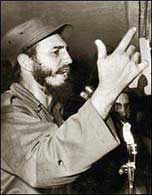 Fidel
Castro Fidel
Castro
|
Castro,
who had become commander-in-chief of Cuba's armed forces
after Batista was ousted on January 1, replaced the more
moderate Jose Miro Cardona as head of the country's new
provisional government.
|
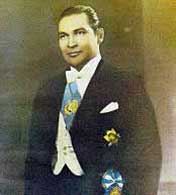 Fulgencio
Batista Fulgencio
Batista |
| More background
on Fidel |
| As
reported at the time, including a filmed interview with Castro
in English |
|
| Citizens’ Action
for Safe Energy (CASE) succeeded in stopping construction
of Black Fox Nuclear Power Plant near Inola, Oklahoma.
Public Service of Oklahoma announced the cancellation,
the first of its kind solely due to citizen protest. |
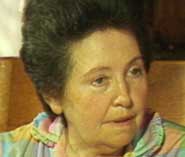 |
CASE’s
founder, Carrie Barefoot Dickerson, known as Aunt Carrie,
and her husband, Robert, spent nearly a decade and all
their financial assets organizing folks around Tulsa and
the state. The Dickersons’ principal concern was
the potential damage to health near the plant, and elsewhere
through uranium mining and processing. |
| Aunt
Carrie, her allies and their success |
watch video (2011) |
|
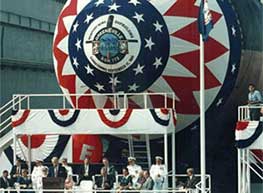
Seven
activists were arrested for blocking the road to the
ceremony commissioning the nuclear submarine U.S.S.
Greeneville at the Norfolk (Virginia) Naval Base.
|
|
|
| The
Zapatista National Liberation Army (EZLN), representing Mexico’s
southern indigenous peoples, and the Mexican federal government
signed the San Andrés Accords. |
Begun in 1994 in Chiapas
state, the EZLN had pushed the government for
• Basic respect for the diversity of the indigenous population
of Chiapas;
• The conservation of the the natural resources within the territories
used and occupied by indigenous peoples;
|
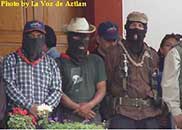 |
| Subcommandate Marcos, leader of the Zapatistas,
and two of his officers |
• A greater participation of indigenous communities in the decisions
and control of public expenditures;
• The
participation of indigenous communities in determining their
own development plans, as well as having control over their
own administrative and judicial affairs;
• The autonomy of indigenous communities and their right of free
determination in the framework of the State. |
|
| The
Kyoto Protocol went into effect after countries responsible
for 55% of the world’s
greenhouse gas (GHG) emissions had ratified the treaty, following
Russia’s agreement to its terms. The agreement’s
purpose was to reduce such gases to 12% below their levels
in 1990 by 2012 and, thus, slow global warming. |
|

|
180
countries had agreed (except for the United States and
Australia, two of the world’s top emitters of GHG
per capita) to rules for implementing the Kyoto Protocol
on July 29, 2001, in Bonn, Germany. President George W. Bush
withdrew the U.S. from the process shortly after he took
office that same year. His reasoning was that, since
India and China had not signed on, they would gain a
competitive advantage. The U.S. is now responsible for 15.6%
of the earth’s GHG (with 5% of its population).
|
History, background on the Kyoto Protocol |
|
|
The
first meeting of Britain's Campaign for Nuclear Disarmament
(CND) was held. CND developed the peace symbol which
became its logo. |
 |
| CND history |
|
Several hundred residents
of Wyhl, Germany, occupied the site of a nuclear power plant
with the intent of halting construction. The contractor had
begun building despite a court order to suspend doing so. Police
responded to the protesters with dogs, water cannon
and arrests. |
By
the following week, however, over 25,000 had joined the
occupation, and police withdrew for eight months.
This is believed to have been the first such nuclear plant
site takeover in the world. The occupation was nonviolent,
and a sort of village sprang up with a “Friendship House” and
a “popular university.” Local farmers supported
the occupiers with food.
|
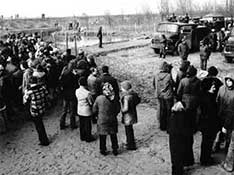 |
Stand-off
between anti-nuclear
activists and
police at Wyhl, Germany |
| Following the negotiated withdrawal of the occupiers, a panel
of judges permanently banned construction of the plant, and
the land is now a nature preserve. |
|
|
Francis
Daniel Pastorius and three other Pennsylvania Quakers
(members of the Society of Friends) made the first formal
protest against slavery in the new world. At the Thones
Kunders House in Germantown (now part of Philadelphia)
they signed a proclamation denouncing the importation,
sale, and ownership of slaves: ". . . we shall doe
[sic] to all men like as we will be done ourselves; making
no difference of what generation, descent or colour they
are."
|
More on Germantown
Society of Friends |
|
|
|
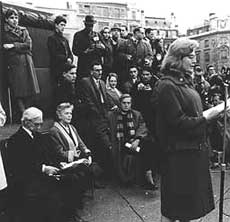
In
London, Sir Bertrand Russell, 88, led a march of 20,000
and sit-down of 5,000 in an anti-nuke rally outside the
U.K. Defense Ministry, and was jailed for seven days.
It was the first public demonstration organized by the
Committee of 100, the direct action wing of the Committee
for Nuclear Disarmament. |
|
| The
CND today |
| above:
Bertrand Russell and Edith Russell watching the actress Vanessa
Redgrave
address
the Committee of 100 meeting in Trafalgar Square, which preceded
the anti-Polaris "sit-in" outside the Ministry of
Defence on February 18, 1961. |
Early
CND demonstrator |
|
| Five
of the "Chicago Seven" (Rennie Davis, David Dellinger,
Tom Hayden, Abbie Hoffman, and Jerry Rubin) were found guilty
of crossing state lines to incite a riot during the 1968
Democratic convention. |
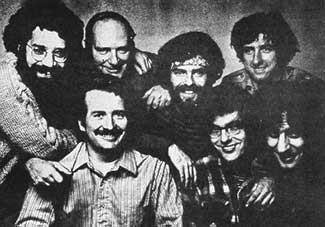 The
Chicago Seven The
Chicago Seven
|
John
Froines and Lee Weiner had both been charged with making
incendiary devices (stink bombs) but were found not
guilty of all charges. None of the seven were found
guilty of conspiracy. Attorneys William Kunstler and
Leonard Weinglass and defendants Weiner and Dellinger
were sentenced for contempt of court, except for Weiner
for more than a year. All appealed. |
| More on the group |
Summary
of the legal issues |
|
| A
Pan-African Congress was organized by W.E.B. DuBois in Paris, France, to coincide with the Versailles Peace
Conference after World War I. DuBois, sociologist, historian,
novelist, playwright, and cultural critic, served as special
representative of the NAACP (National Association for the
Advancement of Colored People), and was assisted by Blaise
Diagne, a member of the French Parliament from the West
African colony of Senegal. |
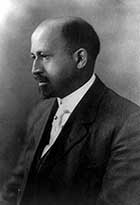 |
W.E.B.
DuBois, founder of the NAACP and convener
for the Pan-African Congress in Paris. |
| The
Congress’s aim was to call the issue of “international
protection
of the natives of Africa” to the attention of the United States and the
European colonial powers who were making momentous decisions on the nature of
the post-war world. |
| DuBois was a moving
spirit behind the growing struggle for self-determination among
Africans, both on the continent and in the diaspora, and the
Pan-African Congresses helped to bring the issues of this struggle
to world attention. The Pan-African Congress was re-convened
in 1921, 1923, 1927, and 1945. |
 Attendees
at the Pan-African Congress. Attendees
at the Pan-African Congress. |
| More about W.E.B. DuBois |
More
depth on the Pan-African Congresses |
|
| President
Franklin D. Roosevelt, ten weeks after the Japanese attack
on Pearl Harbor, issued a
directive ordering all Japanese Americans (Nisei) evacuated from
the West Coast of the U.S., and forcing them to live in concentration
camps. Executive Order 9066 authorized the Secretary of War and
military commanders “to prescribe military areas . . .
from which any or all persons may be excluded.” |
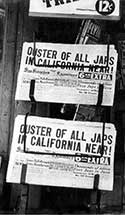 |
San
Francisco Chronicle February 27, 1942
Photo by Dorothea Lange |
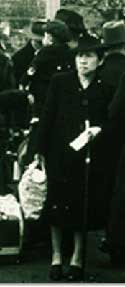
|
There
was strong support from California Attorney General Earl
Warren (later U.S. Supreme Court Chief Justice),
liberal journalist Walter Lippmann and Time magazine—which
referred to California as "Japan's Sudetenland" |
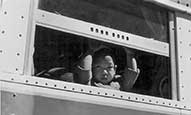 |
| Japanese-American
child on bus to concentration camp. photo: Dorothea Lange |
| 112,000
citizens of Japanese ancestry were relocated, losing their
businesses, homes, and belongings to the white residents
of their former neighborhoods.This
day is referred to as the "Day of Remembrance.” It
has been commemorated every year for 67 years to remind
Americans of that miscarriage of justice, and to ensure
such things do not happen again. |
| Japanese American residents board the bus for
Camp Harmony, 1942. |
| Children of the camps |
Note:
In the entire course of the war, 10 people were convicted
of spying for Japan,all of whom were Caucasian |
| Day of Rememberance |
"Not Enough People Know About Day of Rememberance" |
|
| Paul
McCartney's song, "Give Ireland Back to the Irish," was
immediately banned from airplay by the BBC. |
Opening of the song:
Give Ireland back to the Irish
Don’t make them have to take it away
Give Ireland back to the irish
Make Ireland Irish today
Great Britain you are tremendous
And nobody knows like me
But really what are you doin’
In the land across the sea
Tell me how would you like it
If on your way to work
You were stopped by Irish soldiers
Would you lie down do nothing
Would you give in, or go berserk? |
|
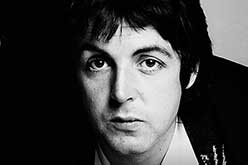 |
|
| Paul
McCartney and "Wings" rehearse the song |
|
| The vast majority of teachers in German-occupied Norway refused to comply with the forced Nazification of the school system. The government had ordered display of the portrait of German-installed Minister President Vidkun Quisling (formerly head of Nasjonal Samling, the Norwegian fascist party) in all classrooms, revision of the curriculum and textbooks to reflect Nazi ideology, and teaching of German to replace English as their second language. |
The
teachers organized and 12,000 of 14,000 nationwide wrote
the same letter on this day to the education department
refusing membership in the newly formed Nazi teachers’ association.
Two days later clergy throughout the country read a manifesto
against Nazi control of the schools. |
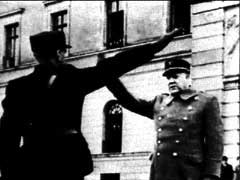
|
| How the teachers pushed back |
Vidkun
Quisling (on right), Germany’s puppet leader in
Norway,
allowed Germany to invade his country and declared himself Prime Minister.
In
Norway his name has become synonymous with traitor. |
|
| The U.S. rejected a Soviet proposal to ban nuclear weapons tests and deployment. The U.S. continued atmospheric nuclear testing in the South Pacific and Nevada until 1963. |
|
Nearly 40,000 pro-Democracy Moroccans demonstrated peacefully in
57 towns and cities across the country. Though there was sporadic
violence later that night, Interior minister Taeib Cherqaoui called the earlier efforts “the healthy practice of the freedom of expression.” |
|
| “The
Communist Manifesto,” written by 29-year-old Karl
Marx with the assistance of Friedrich Engels, was published
in London (in German) by a group of German-born revolutionary
socialists known as the Communist League. |
|

| Friedrich
Engels |
Karl
Marx |
|
The political
pamphlet — arguably one of the most influential
in history — proclaimed that "the history
of all hitherto existing society is the history of class
struggles," and that the inevitable victory of the
proletariat, or working class, would put an end to class
society forever.
|
| Read
the Manifesto |
|
Malcolm X, an African-American nationalist and religious leader, was shot and killed in New York City by Black Muslims with whom he had broken the year before, as he began to address his Organization of Afro-American Unity at the Audubon Ballroom in New York City’s Washington Heights. His home had been firebombed just a few days earlier. He was 39. |
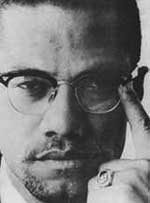
|
Radio story on the late Manning Marable’s biography,
Malcolm X: A Life of Reinventiion |
More
on on Malcolm's assassination |
MalcolmX.com |
“In
1964, after his break with Nation of Islam leader Elijah
Muhammad, and following his trips to Africa and
to Mecca, Malcolm was seriously questioning black nationalism.
He was also beginning to recognize that MLK’s non-violent
methods, far from being passive, were actually creating
more change than the separatism of the Nation of Islam.
In this same period MLK was beginning to recognize that Malcolm was advocating
self-defense, not violence.
In March Malcolm and Martin encountered one another by chance at a news
conference in Washington, D.C. Subsequently Malcolm spoke at several
rallies in support of the civil rights movement, and in February 1965,
two weeks before his assassination, he went to Selma to meet with King." –Grace
Lee Boggs
|
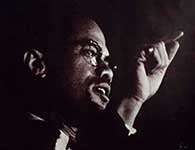 |
" You
can’t separate peace from freedom because no
one can be at peace unless he has his freedom."
--"Prospects
for Freedom in 1965," speech, January 7 1965.
|
|
The
trial began for Father Philip Berrigan and six other
activists (the "Harrisburg
Seven") in Pennsylvania. They were charged with conspiring
in an alleged plot to kidnap Secretary of State Henry Kissinger.
Proceedings later ended in a mistrial. |
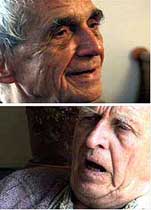
|
| Remembering Fr.
Philip Berrigan |
| Daniel
Berrigan, above, and his brother Philip in the documentary, "Investigation
of a Flame." The film focuses on the Catonsville action. |
|
| Former
Attorney General John N. Mitchell, Mitchell aide Robert
Mardian, and former White House aides
H.R. Haldeman and John D. Ehrlichman were sentenced to 21⁄2
to 8 years in prison for their roles in the Watergate cover-up.
They were variously convicted of conspiracy, obstruction
of justice, fraud, and perjury. |
See the new film, Frost/Nixon, for perspective
on some of
the issues behind Watergate
|
|
| Charlie
Rose interview with
Peter Morgan, the screenwriter (and author of what was originally
a play) and Michael Sheen and Frank Langella, the lead actors |
|
|
Two Libyan Air Force fighter pilots defected to the Mediterranean island of Malta rather than carry out orders they had received to bomb civilian countrymen. Two helicopters with seven others landed in Malta to escape the violence. Colonel Muammar Qadaffi had ordered the attacks in attempt to quell the growing protests against his 42-year dictatorship.
Libya’s ambassadors to China, India, Indonesia and Poland, as well as Libya's representative to the Arab League and most, if not all, of its mission at the United Nations resigned the same day. |
|
Sophie
Scholl, a 22-year-old White Rose (Weisse Rose) activist
at Munich University, was executed after being convicted
of urging students to rise up and overthrow the Nazi
government. |
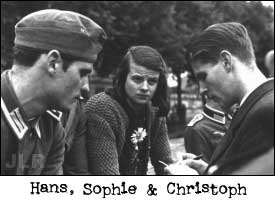
|
There are many memorials in Bavaria and Germany to Sophie and
her group, the White Rose, but little is known outside of Germany.
They were medical students who organized nonviolent resistance
to Hitler, and were arrested for printing and distributing
anti-Nazi flyers.
|
| Sophie,
her brother Hans, a former member of Hitler Youth who
started White Rose, and Christof Probst, the three young
people in the photo, were executed. Few White Rose members
survived the war which is why the story is not well known. |
|
| Indonesian
President Sukarno (born Kusno Sosrodihardjo) surrendered
all executive authority to military chief-of-staff General
Suharto, remaining president in title only. Sukarno had begun
the movement for Indonesian independence from Dutch colonial
control in 1927. They were supplanted by the Japanese during
World War II, but independence was realized following Japan’s
defeat. Sukarno was elected president but had declared himself
president for life in 1963. |
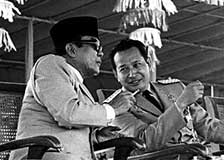
Suharto (right) with predecessor Sukarno |
Following a failed communist-led coup within the military, Suharto
launched a purge of Indonesian communists that resulted
in hundreds of thousands of deaths. In 1967 he assumed
full power, and in 1968 was elected president and remained
in power for 32 years. He was also responsible for Indonesia's
1975 invasion of East Timor, which left an estimated
100,000 Timorese dead from famine, disease and warfare.
|
| See The
Year of Living Dangerously for an excellent
dramatic re-creation of the time.(trailer) |
| More on Suharto |
And
more on Sukarno |
|
|
Farmer Sam Lovejoy toppled the weather tower for a proposed nuclear power plant in Montague, Massachusetts. This was the first act of civil disobedience against the dangers of nuclear power in the U.S. Lovejoy turned himself in to the police, was tried but not convicted.
|
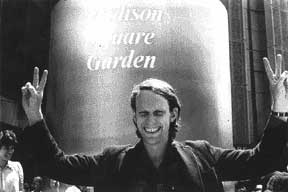 Sam
Lovejoy Sam
Lovejoy |
| The full
story of Sam Lovejoy’s
action |
Ballad of Sam Lovejoy by Rob Skelton |
|
| Nearly
35,000 marched in Paris against a new anti-immigration
bill. Many of the demonstrators
chanted "First, second or third generation, we are all
children of immigrants." Another 5,000 movie directors,
writers, painters, actors, translators, journalists and teachers
signed petitions pledging civil disobedience. |
|
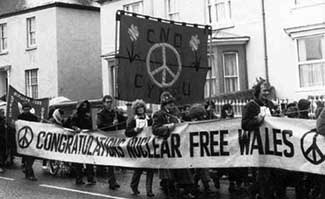
|
Wales declared itself a nuclear weapons-free zone.
Its last nuclear power plant, Wylfa at Anglesey with two reactors, was shut down completely in 2015. |
| Nuclear-free zones |
|
Benghazi, Libya’s second largest city, fell to rebels after three days of violent clashes with the forces of brutal dictator Colonel Muammar Qaddafi.
“He is gone. A dragon has been slain,” cried Ahmed Al-Fatuuir outside the secret police headquarters. “Now he has to explain where all the bodies are. |
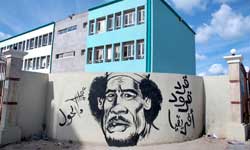 |
Graffiti showing a caricature of Gaddafi reading,
'The Monkey of Monkeys of Africa', a reference to his self-declared title 'The King of Kings of Africa'. |
|
|
José Martí,
a Cuban revolutionary, poet, journalist and teacher,
began the liberation struggle against Spanish control.
He had been forced out of Cuba repeatedly (to Spain)
for his opposition to colonial rule, and spent 15 years
in the U.S. organizing the revolution just before returning
home.
|
 José Martí José Martí
|
I
Cultivate a White Rose
By José Martí
I cultivate a white rose
In July as in January
For the sincere friend
Who gives me his hand frankly.
And for the cruel person who tears out
the heart with which I live,
I cultivate neither nettles nor thorns:
I cultivate a white rose. |
read about José Martí |
|
 |
District
1199 of the health care workers’ union (now Service
Employees International Union) in New York City became the
first U.S. labor union to officially
oppose the war in Vietnam. |
|
 |
Barry
Bondhus, classified 1-A (fully eligible) for the draft
during the Vietnam War, dumped two buckets of manure in
file drawers at the Elk River, Minnesota, draft board.
A farmer’s son (one of ten brothers) from Big Lake
who acted with the full support of his parents, he was
charged with destruction of government property. |
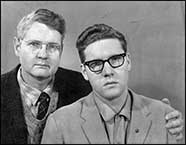
Father
and son, Tom and Barry Bondhus, united in their opposition
to the draft.
Photo:
Pete Hohn, Minneapolis Tribune |
His
father, Tom, wrote a declaration of war on the government
over their insistence on forcing his boys into the army.
He said he was prepared to die to protect his sons but
eager to negotiate.“My opinion is that since our
constitution guarantees: Life, Liberty, and The Pursuit
of Happiness; and because the army denies all three; the
draft is not lawful.”
Barry, sometimes referred to as “the Big Lake One,” who listed his
race as “human” on the draft forms, served 14 months in jail and
prison for his action. |
Perspective
on the case and the Bondhus family more than 50 years later |
|
| Daniel
Berrigan (one of the "Catonsville 9") was
released after 18 months of a three-year term. He went to Harrisburg,
Pennsylvania, where his brother Phil Berrigan was on trial,
also for anti-Vietnam War activities [see February 21, 1972]. |
|
| A
congressional commission released a report condemning the
internment of Japanese-Americans
during World War II, calling it a "grave injustice." |
Read more |
|
| Syndicated talk-radio host Rush Limbaugh began a three-broadcast-day-long campaign attacking Georgetown Law School student Sandra Fluke (rhymes with book) for her testimony before the House Democratic Steering and Policy Committee. |
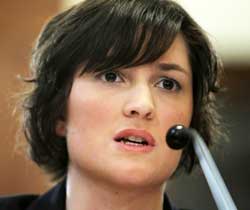 |
The previous week she had been invited to testify on the subject of federal requirements for contraceptive coverage in health insurance policies before the Republican-controlled House Oversight and Government Reform Committee. Instead, Committee Chair Darrell Issa (R-CA) declared her testimony inappropriate (she is past president of Georgetown Law Students for Reproductive Justice), instead hearing from five men. Committee member Congresswoman Carolyn Maloney asked, “Where are the women?” |
Fluke talked about the high cost of contraception and the non-pregnancy-related importance of such medications for some women.
Limbaugh spent six hours on air demeaning her personally and derided her as a “slut” and a “prostitute.” |
Watch Sandra Fluke’s testimony: |
|
A general strike was called in Amsterdam to protest Nazi persecution of Jews under the German Nazi occupation. The previous weekend 425 Jewish men and boys had been imprisoned (only two survived the war). Truck drivers, dock and metal workers, civil servants and factory employees — Christians, Liberals, Social Democrats and Communists — answered the call and brought the city to a standstill. The work stoppages spread to Zaanstreek, Kennemerland and Utrecht.
Two days later the strike was called off: nine people were dead, 50 injured and another 200 arrested, some of whom were to die in the concentration camps. |
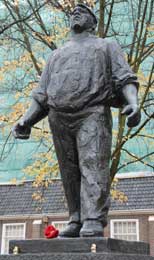 |
| The Dokwerker” is a statue by sculptor Mari Andriessen in Amsterdam’s Jonas Daniel Meyer Square commemorating the February 1941 strike. It is frequestly the rallying point for demonstrations against racism. |
Read more download
pdf |
|
Discussing
the war capacity of North Vietnam, a country that had been
fighting for its independence for 23 years and had just staged
the massive, successful Tet Offensive, U.S. General William
C. Westmoreland stated, "I do not believe Hanoi can hold
up under a long war."
He was replaced as commander in
Vietnam less than four months later. |
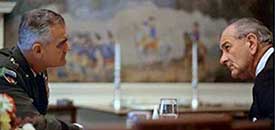 Vietnam commander
General William Westmoreland meeting with President Lyndon Johnson Vietnam commander
General William Westmoreland meeting with President Lyndon Johnson |
| Westmoreland’s
life and career |
|
Legislation
was introduced in both houses of Congress to forbid U.S. military
support of any South Vietnamese invasion of North Vietnam without
prior congressional approval. This bill was a result of the
controversy that arose following the invasion of Laos by South
Vietnamese forces.
On February 8, the Army of the Republic of Vietnam had launched
a major cross-border operation into Laos to interdict activity
along the Ho Chi Minh Trail and destroy the North Vietnamese
supply dumps in the area. The Ho Chi Minh Trail, named for
the leader of North Vietnam, was an informal network of jungle
trails down which supplies came from the north, supplying insurgents
and troops in the south. |
|
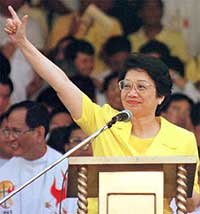
| The
newly elected Philippine president, Corazón Aquino,
was sworn in, bringing to an end years of dictatorship under
Ferdinand Marcos. In the face of massive demonstrations against
his rule, President Ferdinand Marcos and his entourage had
been airlifted from the presidential palace in Manila by U.S.
helicopters. |
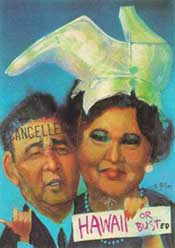 |
The
newly elected Philippine president, Corazón Aquino,
was sworn in, bringing to an end years of dictatorship
under Ferdinand Marcos. In the face of massive demonstrations
against his rule, President Ferdinand Marcos and his entourage
had been airlifted from the presidential palace in Manila
by U.S. helicopters. |
 |
| Ferdinand & Imelda
Marcos |
|
Corazon
Aquino |
|
| A Day of Rage saw demonstrations across the Middle East. Protesters in Iraq, Yemen, Egypt, Tunisia, Jordan, and Bahrain showed their support variously for an end to corruption and income inequality, political reform and better public services, and the replacement of long-running dictatorships with democratic regimes. |
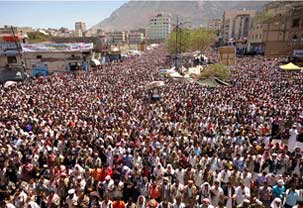 |
| Day of Rage in Taiz, Yemen |
| Reports from throughout the region |
|
|
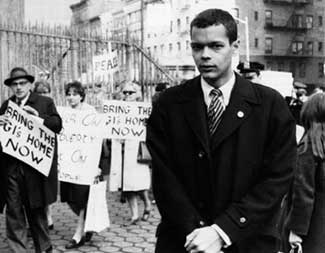
Four
thousand picketed outside New York's Waldorf-Astoria Hotel
as President Lyndon Johnson received
the National Freedom Award. As Johnson began his speech in
defense of his Vietnam policies, James Peck of the War Resisters
League jumped to his feet and shouted, "Mr. President,
peace in Vietnam!"
|
| Julian Bond in 1966 |
On the streets, meanwhile, activist A.J. Muste presented the
crowd's own "Freedom Award" to Julian Bond, who had
been denied his seat in the Georgia legislature for refusing
to disavow his opposition to the war, and for his support of
the Student Non-Violent Coordinating Committee. |
|
| The last of the 1400 peacekeeping troops President Ronald Reagan had sent to the Lebanese capital of Beirut were evacuated. The troops were part of an international force sent to deal with the Lebanese civil war. The president withdrew almost all American troops following the deaths of 241 Marines and 58 French paratroopers in a suicide truck bombing carried out four months earlier by the combined forces of Islamic Jihad and Hizbollah. France withdrew its troops as well. |
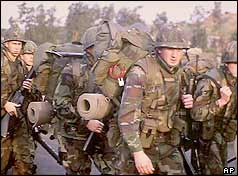 |
Three weeks earlier, Reagan had told the Wall Street Journal, “As long as there is a chance for peace, the mission remains the same. If we get out, that means the end of Lebanon.” In a barb directed at House Speaker Thomas P. “Tip” O'Neill Jr. (D-Massachusetts), Reagan had said, “He may be ready to surrender, but I'm not. |
| The
Beirut barracks bombing remembered |
News
of the withdrawal of peacekeeping troops |
|
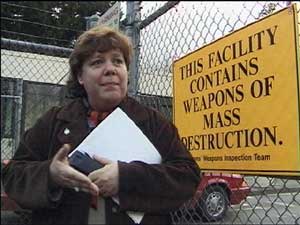 Libby
Davies Libby
Davies |
An international Citizens' Weapons Inspection Team, led by Canadian Member of Parliament Libby Davies (NDP-Vancouver East), was denied entry to determine the presence or absence of weapons of mass destruction at Naval Base Kitsap-Bangor, Washington, nuclear submarine base, just 12 km (7 miles) from Seattle and less than 60 km (37 miles) from Canada.
|
|
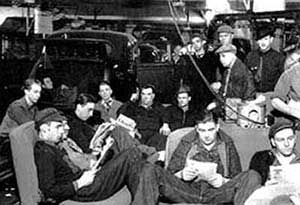 Flint
sit-down strikers, 1937 Flint
sit-down strikers, 1937 |
The Supreme Court outlawed sit-down strikes in its decision NLRB v. Fansteel Metallurgical Corp. Such strikes had become a very effective strategy employed by workers to organize unions. The 1937 Flint sit-down strike of autoworkers against General Motors forced GM to recognize the United Auto Workers as the representative of its hourly employees, and negotiate wages and working conditions. |
| The text of the Supreme Court’s decision: |
|
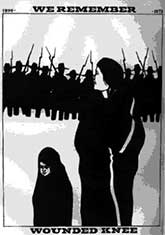
| Hundreds
of Oglala Lakota Sioux and members of the American Indian
Movement (AIM) occupied the village of Wounded Knee, South
Dakota. |
| Angered over a long history of violated
treaties, mistreatment, family dismemberment, cultural destruction,
discrimination, and impoverishment through confiscation of
resources, they particularly demanded the U.S. live up to the
terms of the 1868 Fort Laramie Treaty. That treaty recognized
the Sioux as an independent nation in the western half of South
Dakota. Additionally, there had been a recent campaign of harassment
and violence by tribal and FBI officials. Wounded Knee was
chosen because of the 1890 massacre there of several hundred
men, women and children by U.S. troops. The occupation lasted
until May.
|
 |
|
 Gandhi, 1919 Gandhi, 1919 |
Mohandas Gandhi launched his campaign of non-cooperation with Imperial British control of India. He called his overall method of nonviolent action Satyagraha, formed from satya (truth) and agraha, used to describe an effort or endeavor. This translates roughly as "Truth-force." A fuller rendering, though, would be "the force that is generated through adherence to Truth."
|
More on Satyagraha (civil disobedience) |
Excerpt from The Core of Gandhi's Philosophy
by Unto Tahtinen on the concept of Satyagraha
|
|
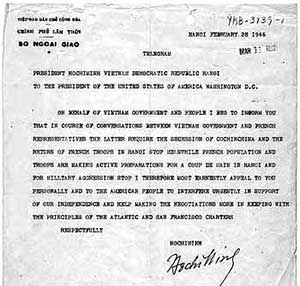 |
Ho Chi Minh, the leader of the newly formed Democratic Republic
of Vietnam, facing re-imposition of French colonial rule
over his country, sent a telegram to President Harry Truman: “.
. . I most earnestly appeal to you personally and to
the American people to interfere urgently in support
of our independence and help making the negotiations
more in keeping with the principles of the Atlantic and
San Francisco charters [founding documents of the League
of Nations and United Nations].” |
|
 |
The
U.S. detonated its largest thermonuclear blast ever, in
a test of a new hydrogen (fusion) weapon design in the
atmosphere at Bikini Atoll, part of the Marshall Islands.
Castle Bravo had an explosive yield of 15 megatons (equivalent
to 15,000,000 tons of TNT), it was double the maximum
possible expected by the Atomic Energy Commission.
|
| Carried
out in spite of adverse weapon conditions (the monitoring
station was downwind at the time of detonation), the unexpected
yield created a radioactive fallout plume that contaminated
three other atolls of the 29 in the Marshall chain. Though
too late to avoid their contamination, hundreds of Marshallese
and U.S. servicemen were evacuated. |
| To
avoid another such radiological disaster, future tests required
an exclusion zone 1370 km in diameter
(850 miles), an area equal to about 1% of the earth’s
surface. Because Bikini had been essentially destroyed, subsequent
test weapons were detonated from barges. |
| All about
Castle Bravo |
|
 |
The
Campaign for Nuclear Disarmament (CND) was founded in London
by philosopher Sir Bertrand Russell, then 86 years old,
and the Reverend Canon (Lewis) John Collins of St. Paul’s
Cathedral.
The peace
symbol was originally developed for CND. |
| History of the CND |
The
CND today |
|
| The
Nevada-Semipalatinsk Movement to Stop All Nuclear Testing
was founded in the USSR (Union of Soviet Socialist Republics).
Olzhas Suleimenov, a popular Kazakh poet, was chosen to lead
this first anti-nuclear non-governmental organization in
Kazakhstan, formerly part of the USSR. Nevada-Semipalatinsk
ended nuclear arms tests at the Semipalatinsk Polygon. Organizers
had been inspired by the large Nevada Test Site anti-nuclear
demonstrations and encampments outside Las Vegas in the mid-to-late
1980s. |
 |
Read more |
 |
| a
Semipalatinsk test > |
| <
demo at Semipalatinsk, 1990 |
|
| The
National Advisory Commission on Civil Disorders (Kerner Commission)
warned that racism was causing America to move "toward
two societies, one black, one white – separate and
unequal." Former Illinois Governor Otto Kerner and his commission
were charged by President Lyndon Johnson to look into the causes
of the many riots that had taken place in recent years. |
| The 1968 Kerner Commission Got It Right, But Nobody Listened |
|
U.S.
District Judge Miles W. Lord held the officers of A.H.
Robins Company personally liable for the injuries caused
by the intrauterine contraceptive device they had produced
and sold, the Dalkon Shield. Eighteen women had died, and
more than 300,000 ultimately
claimed injury.
The
top three executives had to pay $4.6 million personally,
and the company paid out $220 million in compensatory and
$13 million in punitive damages to thousands of women.
|
 |
| Judge Miles
W. Lord |
Judge Lord: “The whole cost-benefit analysis is warped.
They say, well you can kill so many people if the benefits
are great enough . . .
Once they put a price on human life,
all is lost. Life is sacred.
Life is priceless.”
He also criticized Robins’s legal strategy of requiring witnesses to discuss
their sex lives: ”You exposed these women, and ruined families and reputations
and careers, in order to intimidate those who would raise their voices against
you,” he said. “You introduced issues that had no relationship whatsoever
to the fact that you implanted in the bodies of these women instruments of death,
mutilation and of disease.”
Judge Lord was called before a review panel for his professional and judicial
conduct in the case but the charges were dismissed and he continued to serve
until retirement. |
| Read about the case |
|
February
1 2 3
4 5 6
7 8 9
10 11 12
13 14 15
16 17 18
19 20 21
22 23 24
25 26 27
28 29
visit
another month
Jan
• Feb
• March • April
• May • June
• July
• Aug • Sept
• Oct • Nov
• Dec
|
See what happened in the history of
Peace and Social Justice
|
 |
Subscribe to our FREE! e-newsletter
 |
| also announcements of new buttons and other cool stuff |
|
We make custom buttons
your design or ours
email your idea and info |
|
|
Please
support this newsletter visit
peacebuttons.info
|
Because of your support peacebuttons has been able to donate to
several peace and justice organizations.
see list
Thank you ! |
|
|
|
|