| |
The
International Peace Bureau was launched in Rome, Italy, “. . .
to coordinate the activities of the various peace societies
and promote the concept of peaceful settlement of international
disputes.” The organization won the Nobel Peace Prize
in 1910
for its work, and is headquartered in Bern, Switzerland.
|
 |
|
| Following
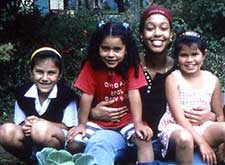
a brief but bloody civil war in 1948, Costa Rican President
Jose Figueres helped draft a constitution that abolished
the military and guaranteed free election with universal
suffrage (all adult citizens can vote). |
 |
Money
not spent on a military allowed the country to adequately
fund health care and education, yielding
one of the highest literacy rates on the continent, ninety-six
percent. This is judged to be a factor in the nation’s
never having fallen prey to corruption, dictatorships,
or the bloodshed that has marred the history of much of
the region.
|
Costa Rica stands apart  |
|
| Rosa Parks, a black seamstress active
in the local NAACP, was arrested by police in Montgomery, Alabama,
after refusing to give up her seat on the bus to a white man.
Mrs. Parks faced a fine for breaking the segregation laws which
said blacks had to vacate their seats if there were white passengers
left standing. The same bus driver had thrown her off his bus
twelve years prior for refusing to enter through the rear door. |
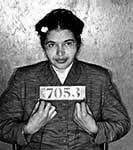 |
| Rosa
Parks |
Mrs.
Parks had not been the first to defy the Jim Crow (the
system of legalized or de jure segregation) law but her
arrest sparked the year-long Montgomery Bus Boycott, organized
by a young Baptist minister named Martin Luther King, Jr.
The Montgomery bus company couldn’t survive without
the revenue from its black passengers who, for the next
year, created car pools and other means to avoid using
the city busses.
|
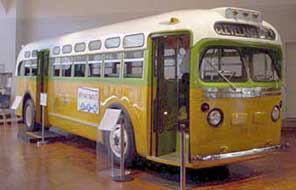 The
bus restored in Henry Ford Museum The
bus restored in Henry Ford Museum |
The boycott was successful and Mrs. Parks
became known as the "mother of the civil rights movement." |
| The
story of the bus |
|
 |
Rosa Parks pin |
| 1" diameter - satin finish |
| Union printed - made in Detroit. |
 |
|
|
| Representatives
of 12 countries, including the United States and the Soviet
Union, signed a treaty in Washington setting
aside Antarctica as a scientific preserve, free from military
activity. President Eisenhower said the treaty and its guarantees "constitute
a significant advance toward the goal of a peaceful world with
justice." |
|
|
|
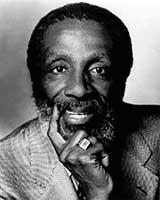
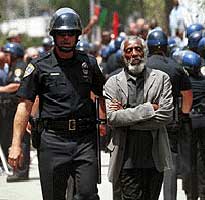
Comedian
Dick Gregory was convicted in Olympia, Washington for
his participation in a Nisqually Native American fishing
rights protest.
Interview with
Dick Gregory
|
 |
|
A
lottery was held to determine which young men would be
drafted into the armed services
for the ongoing Vietnam War. A large glass container held
366 blue plastic balls each marked with a birth date. The
drawing determined the order of induction for draft-eligible
men between 18 and 26 years old, and was broadcast live nationally. The
first draft lottery was held in 1942.
|
|
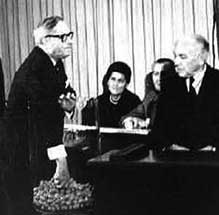
Rep. Alexander Pirnie, R-NY, draws the first capsule in the
draft lottery held on December 1, 1969.
The capsule contained the date, September 14. |
|
| A silent march of women in Khartoum, Sudan, protesting conscription,
was met by a police attack and the arrest of 37 women. |
|
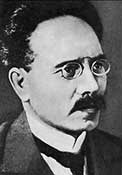 |
Karl Liebknecht was the
only member of German Parliament to vote against war with
France and Britain. He was arrested shortly thereafter
and conscripted into the German Army. Refusing to fight,
Liebknecht served on the Eastern Front burying the dead.
|
| Karl
Liebnecht |
More about Karl Liebnecht |
|
| Enrico Fermi, the Italian-born Nobel Prize-winning physicist,
directed and controlled the first self-sustaining fission reaction
in his laboratory beneath the bleachers of Stagg Field at the
University of Chicago. |
|
The
result of this experiment made the atomic bomb possible
and ushered in the nuclear age. Upon successful completion
of the experiment, a coded message was transmitted to
President Roosevelt: "The Italian navigator has
landed in the new world."
|
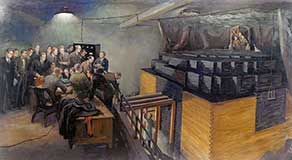 |
More
on Fermi and the bomb |
|
The
U.S. Senate voted 65 to 22 to censure Senator Joseph
R. McCarthy
(R-Wisconsin) for "conduct that tends to bring the
Senate into dishonor and disrepute."
|
The
condemnation, with all the Democrats and about half the
Republicans voting against him, was related to McCarthy's
controversial, abusive and indiscriminate investigation
of suspected communists in the U.S. government, military,
and civilian society. The House of Representatives and
many states continued their own investigations.
|
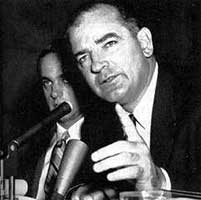 |
| Senator Joseph P. McCarthy
with chief counsel Roy Cohn (L) |
See a video clip of McCarthy reacting
to the censure |
|
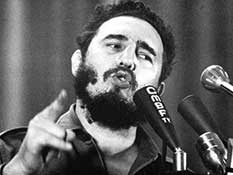 |
Following
a year of severely strained relations with the United
States and his country, Cuban leader Fidel Castro openly
declared that he was a Marxist-Leninist. |
| Fidel
Castro |
|
|
Thousands
who were part of the Berkeley Free Speech Movement gathered
on the steps of Sproul Hall, the administration building
at that University of California campus, to protest four
students being disciplined for distributing political literature;
Joan Baez performed in support. The next day, police arrested
773 who began a sit-in at Sproul Hall. 10,000 more students
then went on strike and shut down the school.
|
 |
|
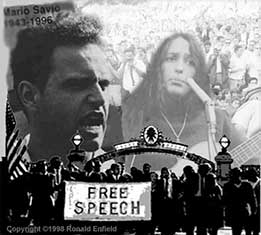 photo: © Ron Enfield photo: © Ron Enfield
|
The
Free Speech Movement had begun in October, when three thousand
students surrounded a police
car for 36 hours. Inside the car was a civil rights worker,
Jack Weinberg, who had been arrested for distributing political
literature on the UC-Berkeley campus. |
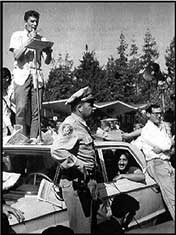
Jack
Weinberg
in
police car.
|
What
was the Free Speech Movement? |
|
A
demonstration erupted outside a South African court after
a magistrate ruled that security police were to be exonerated
in the death of black consciousness leader Steve Biko,
who died while in their custody.
The
demonstrators chanted, "They have killed Steve Biko.
What have we done? Our sin is that we are black?" |

Biko's
funeral
|
His funeral had been attended by more than 15,000 mourners, not including
the thousands who were turned away by the police. He had been arrested
for writing inflammatory pamphlets and "inciting unrest" among
the black community.
|
 Steve
Biko Steve
Biko
|
The
news story
|
Review
of a Biko biography |
| Learn
more about Steve Biko: |
|
|
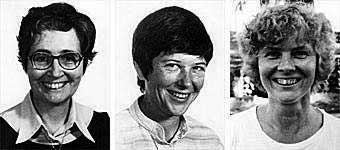
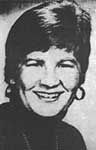
| Maryknoll
Sisters Ita Ford and Maura Clarke, Ursuline Sr. Dorothy
Kazel, and lay missionary Jean Marie Donovan were raped,
murdered, buried outside San Salvador, and unearthed shortly
thereafter. |
|
| American
Nuns Maura Clarke, Ita Ford, Dorothy Kazel and Jean Marie
Donovan- killed in El Salvador in 1980. |
U.S.-trained
and -supported Salvadoran national guardsmen, widely known
to act as death squads, were suspected. |
| The
Reagan administration, taking office seven weeks later,
and relying in part on the Salvadoran military to rid Central
America of communism, denied the National Guard’s
involvement. General Alexander Haig, the president’s
secretary of state, explained the churchwomen's deaths
to Congress as an accident caused by nervous soldiers who "misread
the mere traveling down the road (of the nuns' van) as
an effort to run a roadblock." The FBI and CIA later
reported this as a total fabrication, and five national
guardsmen were later convicted of murder. |
| More about the Maryknoll Sisters |
|
| Oberlin College
was founded in Ohio. It as the first college to enroll men
and women on equal terms, and to accept African-American men
and women on equal terms with white students. |
|
An
all-white jury in Alabama convicted three Ku Klux Klansmen
for the murder of white civil rights activist Viola Liuzzo. |

Viola
Liuzzo |
The mother of five from Detroit was shot and killed while
driving a young black activist, Leroy Moton, back
to the town of Selma following a protest march
to the state capital in Montgomery. It was later
learned that another Klansmen in the car, Gary
Thomas Rowe, was an FBI informant. |
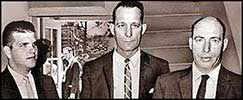
Klansmen
Collie Wilkins, Eugene Thomas and William Eaton at their trial |
| A
serious blogger considers a book about the FBI’s
involvement |
|
|
Files were destroyed at eight New
York City draft boards in protest
of the Vietnam War. |
|
| In
the early morning hours, one of the worst industrial disasters
in history began when American-owned Union Carbide’s
pesticide plant located near the densely populated city
of Bhopal in central India leaked a highly toxic cloud
of methyl isocyanate into the air. |
| 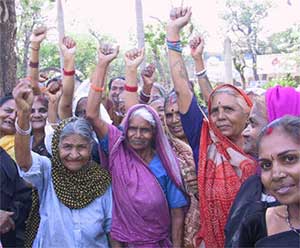 Bhopal
survivors still demanding justice 2004 Bhopal
survivors still demanding justice 2004
|
Estimates of the fatalities vary widely, but of the approximately
one million people living in Bhopal at the time,
2,000 were killed immediately, at least another 8,000
within a short time, and hundreds of thousands were
injured, many still suffering today.
The U.S. blocked extradition of Union Carbide officials facing
criminal prosecution in India. Union Carbide has since been
purchased by Dow Chemical which continues to refuse responsibility
for the incident or its victims, and has yet to clean up
the site.
|
| Contemporary news report on the incident |
bhopal.org |
|
The
International Day of Disabled Persons was declared by
the United Nations. “The
annual observance of the International Day of Disabled
Persons ... aims to promote an understanding of disability
issues and mobilize support for the dignity, rights and
well-being of persons with disabilities . . . .” |
2020 Theme:
Building Back Better: toward a disability-inclusive, accessible and sustainable post COVID-19 World. |
 more info more info |
|
| 
|
An international treaty
banning land mines was signed by 122 countries. It comprehensively
prohibits the use, production, trade or stockpiling of antipersonnel
mines. Buried landmines kill about 15,000 people every year
worldwide. The dangerous and time-consuming process of removal
would take centuries at the current rate of landmine clearance. |
| The
United States and approximately forty other countries have
yet to sign the treaty, and fifteen countries continue
to produce land mines. The Pentagon requested $1.3 billion
for research on and production of two new landmine systems—Spider
and Intelligent Munitions System—between fiscal years
2005 and 2011, but Congress has resisted funding the programs
under pressure from nearly
500 U.S.-based organizations
opposing the weapons. |
|
Comprehensive
information from the International Campaign to Ban Landmines
|
|
|
Recent
U.S. policy on land mines: |
|
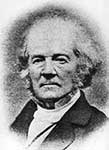
| The American Anti-Slavery Society
was formed by Arthur Tappan in Philadelphia. He and his brother
Lewis had been active abolitionists throughout their lives,
including providing legal defense for the Africans who mutinied
on the slave ship Amistad. |
 |
|
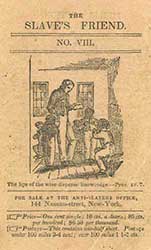
The Anti-Slavery Society produced
The Slave's Friend, a monthly
pamphlet of Christian and abolitionist poems, songs,
and stories for children. In its pages, young readers
were encouraged to collect money for the anti-slavery
cause. |
| Arthur
Tappan |
|
| Five
members of a women's suffrage group unrolled a banner from
the visitor's gallery during President Wilson's annual
message (state of the union) to Congress, asking, "Mr.
President, What will you do for woman suffrage?" There
was no mention of the issue in his speech. |
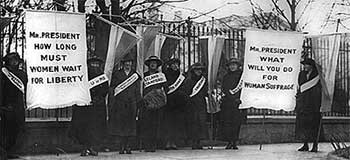 |
Wilson
and suffrage |
|
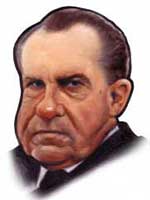 |
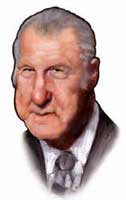
President Richard Nixon, Vice-President Spiro T. Agnew and 40 U.S.
governors embarked on a fact-finding mission to discover
the causes of the generation gap. They viewed films
of "simulated acid trips" and listened to
hours of "anti-establishment rock music." |
 |
| President
Richard Nixon |
|
Vice-President
Spiro T. Agnew |
|
|
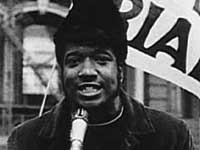
Black Panther
party leaders Fred Hampton and Mark Clark were assassinated
by Chicago Police officers with cooperation from the FBI.
Hampton had founded the Illinois chapter of the Black Panther
Party at the age of 20. He led in establishing the Breakfast
for Children program and a free health clinic on the west side
of the City. A main purpose of the Panthers was to resist police
violence. |
| Fred Hampton |
| One
of Hampton's achievements was to persuade Chicago's most
powerful street gangs to agree
on a non-aggression pact. FBI Director J. Edgar Hoover, however,
considered the Panthers as "the greatest threat to the
internal security of the country." The Panther party
headquarters had been raided three times with over 100 members
arrested. |
| The
Senate Intelligence Committee, led by Frank Church (D-Idaho),
revealed in 1976 that William O'Neal, Hampton's bodyguard,
was an FBI informant who had delivered an apartment floor-plan
to the Bureau with an "X" marking the bed where
Hampton died. About 100 shots were fired by the police, just
one from the building. The survivors, including Deborah Johnson,
Hampton's pregnant girlfriend, were arrested and charged
with attempting to murder the police. |
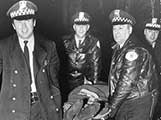 |
| Chicago
police remove the body of Fred Hampton, slain by police
on Chicago's west side, Dec 4, 1969 |
| “You
can kill a revolutionary, but you can’t kill a
revolution!” – Fred
Hampton |
| Remembrance
by someone who worked with Deputy Chairman Fred Hampton |
|
| Cesar
Chavez was sentenced to 20 days in jail for refusing
to call off the United
Farm Workers’ consumer boycott of Bud Antle, Inc.,
the country’s second largest lettuce grower. Antle
had signed a contract with Teamsters Local 890 though only
5% of the workers voted to ratify it. Nor had there ever
been an election for the workers to choose a union to represent
them. The boycott had been called to pressure Antle to
negotiate with the Farm Workers.
|
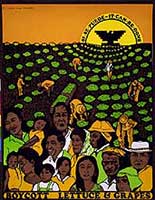 |
| |
Lettuce & Grape
boycott poster |
|
|
Five
days after Rosa Parks was arrested for refusing to give
up her bus seat to a white man, the African-American
community of Montgomery, Alabama, launched a boycott
of the city's bus system.
The Montgomery Improvement Association (MIA) was formed to
coordinate the boycott with Dr. Martin Luther King, Jr.,
elected as its president. |
Out
of Montgomery’s 50,000 black residents, 30,000-40,000
participated. They walked or bicycled or car-pooled,
depriving the bus company of a substantial portion
of its revenue.
The boycott lasted (54 weeks) until
it was agreed the buses
would be integrated. |
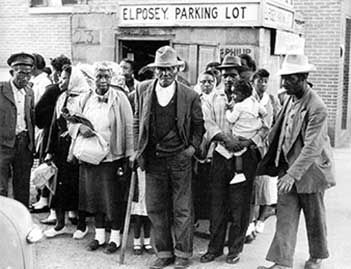
|
| Waiting at a transportation pickup point during the Montgomery bus boycott - 1955-1956 |
< What
was the Montgomery Bus Boycott? > |
|
|
| The American Federation of
Labor, which had historically focused on organizing craft
unions, merged with the Congress of Industrial Organizations,
an organization of unions largely representing industrial
workers, to form the AFL-CIO with a combined membership
of nearly 15 million.
George Meany was elected its first
president. |
 |
| AFL-CIO history |
|
| New
York became the first city to legislate against racial
or religious discrimination in housing (Fair Housing
Practices Law). |
|
| 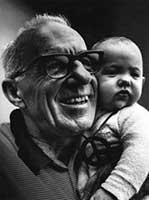 Dr.
Benjamin Spock Dr.
Benjamin Spock
|
264 were arrested at a military induction
center in New York City during a Stop the Draft Week Committee
action. Dr. Benjamin Spock and poet Allen Ginsberg were
among those arrested for blocking (though symbolically)
the steps at 39 Whitehall Street where the draft board
met. 2500 had shown up at 5:00 in the morning to show their
opposition to the draft and the Vietnam War.
|
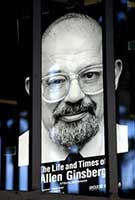 Allen
Ginsberg Allen
Ginsberg |
|
The United Nations adopted the charter for the University
for Peace in Costa Rica. Its purpose would be “promoting
among all human beings the spirit of understanding,
tolerance and peaceful coexistence, to stimulate
cooperation among peoples and to help lessen obstacles
and threats to world peace and progress . . . .”
|

|
| The
monument sculpted by Cuban artist Thelvia Marín
in 1987, is the world's largest peace monument. |
 |
It
also established short-wave Radio for Peace International
(RFPI)which was shut down by the University in 2004
when RFPI exposed a plan between the University for
Peace and the U.S. to hold anti-terrorist combat training
on campus.
|
| Interview
with James Latham, CEO of RFPI when it was under siege |
| RFPI continues
on the web |
|
|
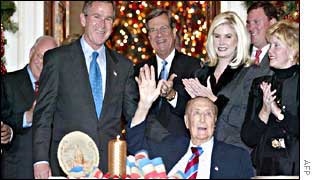
At
the 100th birthday celebration for Senator Strom Thurmond
(R-South Carolina), Senate Republican leader Trent Lott
(R-Mississippi) praised Thurmond's Dixiecrat Party 1948
presidential campaign (official slogan: “Segregation
Forever!”). |
| President
George W. Bush with Sen. Lott and Sen. Thurmond |
| “I
want to say this about my state. When Strom Thurmond ran
for president, we voted for him. We're proud of him. And
if the rest of the country had followed our lead, we wouldn't
have had all these problems over all these years, either.”
The
reaction to this sentiment led to Lott's resignation as
Senate majority leader. |
|
| Harriet Tubman, a slave
in Maryland, escaped her owners. |
More about
Harriet Tubman |
|
The
state of Georgia provided the final vote needed for the
13th Amendment to become part of the U.S. Constitution,
abolishing slavery.
|
|  slave
auction slave
auction
|
“Neither slavery nor involuntary servitude, except
as a punishment for crime whereof the party shall have been
duly convicted, shall exist within the United States, or
any place subject to their jurisdiction.” |
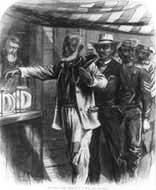 first
vote first
vote |
| Two
days before, Mississippi’s
legislature had voted to reject ratification; Mississippi
didn’t ratify the anti-slavery amendment until 1995. |
More on the ratification |
|
| The
voters of Spain approved a new constitution in a popular
referendum by nearly 8-1. It proclaimed Spain to be a parliamentary
monarchy and guaranteed its citizens equality before the
law and a full range of individual liberties, including
religious freedom. While recognizing the autonomy of seventeen
regions, it stressed the indivisibility of the Spanish
state.
|
|
|
|
| 
|
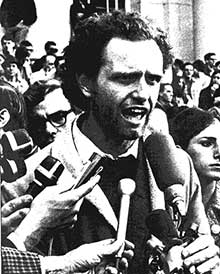
A leader of the Berkeley Free Speech Movement, Mario Savio,
was arrested. One-third of the 27,000 students
at the University of California campus, along with
faculty, were on strike to protect their first
amendment right to distribute political literature
and to organize on campus. A faculty resolution
passed 824-115, supporting the rapidly growing
Free Speech Movement. |
| "There
is a time when the operation of the machine becomes so
odious, makes you so sick at heart, that you can't take
part; and you've got to put your bodies upon the gears
and upon the wheels, upon the levers, upon all the apparatus
and you've got to make it stop." - Mario Savio |
Mario Savio as remembered
by journalist Robert Scheer |
|
| 
|
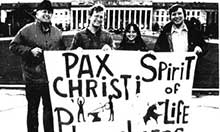
Four
Plowshares activists were arrested for disarming an F-15E
Strike Eagle fighter jet at Seymour Johnson Air Force Base
in North Carolina. |
| Pax Christi-Spirit of Life Plowshares
newspaper article |
The arrested: Phil Berrigan, John Dear, Lynn Fredriksson,
and Bruce Friedrich |
|
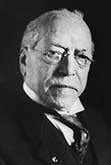 |
The
American Federation of Labor (AFL) was founded at a convention
of union leaders in Columbus, Ohio. It was an alliance
of autonomous unions, each typically made up of workers
within a particular craft.
Samuel Gompers, a leader in the Cigarmakers’ union, was a key person in
creating the AFL, was elected its first president, and served as such virtually
continuously for nearly 40 years. |
| Samuel Gompers, a founder and leader of the American Federation
of Labor |
|
Samuel
Gompers
|
On Samuel Gompers from the AFL-CIO |
|
| Jeanette
Rankin (R-Montana), the first woman elected to the U.S.
Congress in 1916, cast the only vote (she was among eight
women in the Congress at the time) opposing declaration
of war against Japan, despite their attack on Pearl Harbor
the previous day . She had also voted against the U.S.
entering World War I (at the time called the war to end
all wars). Rankin served served just two single terms in
the House. She spent her early career working for women’s
suffrage, later very active in several peace and justice
organizations. |
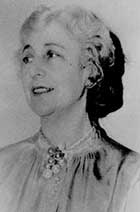 |
| Jeannette Rankin in 1940 |
Jeanette Rankin timeline |
Chronology
and oral history transcript of interview of Jeanette Rankin |
|
U.S. President Dwight Eisenhower addressed the United Nations General Assembly, proposing the creation of a new U.N. atomic energy agency which would receive contributions of uranium from the United States, the Soviet Union, and other countries "principally concerned," and would put this material to peaceful use. |
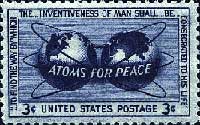 |
The speech, known later as Atoms for Peace, included: “My country wants to be constructive, not destructive. It wants agreement, not wars, among nations. It wants itself to live in freedom, and in the confidence that the people of every other nation enjoy equally the right of choosing their own way of life.” |
|
|
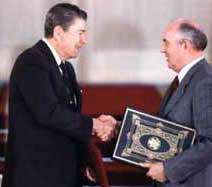
U.S. President Ronald Reagan and Soviet
leader Mikhail Gorbachev signed the first treaty to reduce
the nuclear arsenals of the two superpowers. The Intermediate
Nuclear Forces (INF) Treaty eliminated and banned all ground-launched
ballistic and cruise missiles with a range of 500-5,500 kilometers
(300-3,400 miles). By May 1991, all intermediate- and shorter-range
missiles, launchers, and related support had been physically
dismantled. |
|
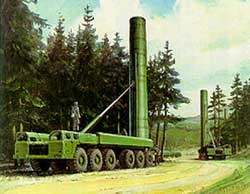 Intermediate
Nuclear Force vehicle
Intermediate
Nuclear Force vehicle |
On
the first anniversary of the INF (Intermediate Nuclear
Force) Treaty, twelve Dutch peace activists, calling themselves "INF
Ploughshares," cut through fences to enter the Woensdrecht
Air Force base in The Netherlands.
They made their way
to cruise missile bunkers where they hammered on the missiles,
carrying out the first disarmament action in Holland.
|
|
British
troops, known as the Egyptian Expeditionary Force and under
the command of General Edmund Allenby, entered Jerusalem, ending
700 years of Muslim rule of the city, 400 under the Ottoman
Turks.
The Turkish army withdrew, the city surrendered without
a battle.
Thus began 30 years of British control over Palestine. |
|
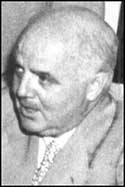
U.S.
Representative John Parnell Thomas, former chairman of the
House Un-American Activities Committee (HUAC), was sentenced
to 6 to 18 months in federal prison for "padding" Congressional
payrolls and using the money himself (embezzlement).
He had
pled no contest to the charges, and was pardoned by President
Harry Truman shortly before the end of his presidency.
|
|
| John
Parnell Thomas |
|
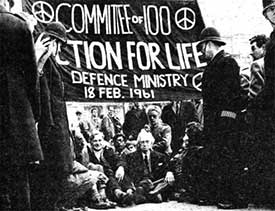
| Members
of the National Committee of 100, a movement of non-violent
resistance to nuclear war and to the manufacture and use
of all weapons of mass extermination, joined with the Campaign
for Nuclear Disarmament (CND) and held demonstrations at
various U.S. air and nuclear bases in Britain. |
|
|
Members of the Committee of 100, including Bertrand Russell,
considered civil disobedience a legitimate means in
their struggle. The CND avoided all illegal activities. |
| The
CND is still active today |
Bertrand
Russell and the "Committee of 100"
at
an earlier action in 1961. |
|
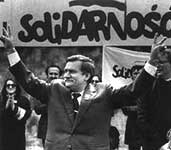
| Solidarity
trade union founder and leader Lech Walesa won Poland's
presidential runoff election in a 3-1 landslide. He thus
became the first directly elected Polish leader. Poland
only became an independent country at the end of World
War I.
|
 |
| About Lech
Walesa |
|
| The
General Assembly of the United Nations adopted and proclaimed
the Universal Declaration of Human Rights. Following this
historic act the Assembly called upon all Member countries
to publicize the text of the Declaration and "to cause
it to be disseminated, displayed, read and expounded principally
in schools and other educational institutions, without
distinction based on the political status of countries
or territories."
Since 1950 the anniversary of the declaration has been known
as Human Rights Day. |
 |
| Human
Rights Day |
|
| 
|
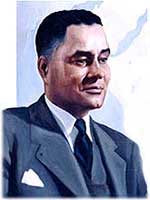
Detroit-born
U.N. diplomat Ralph J. Bunche became the first Black American
to win the Nobel Peace Prize. The award was in recognition
of his peace mediation during the first Arab-Israeli war
in 1948. |
| Ralph
Bunche the Peacemaker |
From
his acceptance speech in Oslo, Norway.
“There are some in the world who are prematurely resigned
to the inevitability of war. Among them are the advocates of
the so-called "preventive war," who, in their resignation
to war, wish merely to select their own time for initiating
it. To suggest that war can prevent war is a base play on words
and a despicable form of warmongering. The objective of any
who sincerely believe in peace clearly must be to exhaust every
honorable recourse in the effort to save the peace. The world
has had ample evidence that war begets only conditions which
beget further war.” |
|
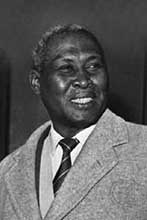
| Chief
Albert Luthuli, President-General of the banned African National
Congress, appealed for racial equality in racially separatist
apartheid South Africa after accepting the Nobel peace prize
for 1960 in Oslo, Norway. |
| 
|
Mr.
Luthuli said he considered the award "a recognition
of the sacrifices made by the peoples of all races [in
South Africa], particularly the African people who have
endured and suffered so much for so long.”
“It
may well be that South Africa's social system is a monument
to racialism and race oppression, but its people are the living
testimony to the unconquerable spirit of mankind. Down the
years, against seemingly overwhelming odds, they have sought
the goal of fuller life and liberty, striving with incredible
determination and fortitude for the right to live as men -
free men.”
Albert Luthuli
|
| Watch
and listen to Chief Luthuli’s speech |
|
| Reverend
Martin Luther King, Jr. was awarded Nobel Peace Prize.
From his speech in Oslo: “After
contemplation, I conclude that this award which I receive
on behalf of that
[civil
rights]
movement is profound recognition that nonviolence is the
answer to the crucial political and moral question of our
time --
the need for man to overcome oppression and violence without
resorting to violence and oppression. Civilization and violence
are antithetical concepts.” |
| King’s
Nobel acceptance speech: |
|
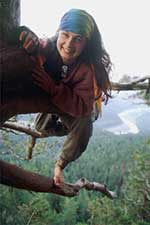
| Julia
Butterfly Hill, age 23, climbed "Luna," a 1,000-year-old
California redwood, to protect it from loggers. She stayed
up in the
tree for more than two years. |
 |
Julia's web site |
Julia
Butterfly Hill atop Luna |
|
 Shirin
Ebadi Shirin
Ebadi |
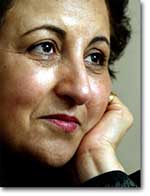
Iranian
democracy activist Shirin Ebadi, the first Muslim woman
(first Iranian and only the third Muslim) to win the Nobel
Peace Prize, accepted the award in Oslo, Norway "for
her efforts for democracy and human rights. She has focused
especially on the struggle for the rights of women and
children." |
| More about Shirin Ebadi |
|

|
The
General Assembly of the United Nations voted to establish
the United Nations International Children's Emergency
Fund (UNICEF) to provide health and rehabilitation to
children living in countries devastated by World War
II. |
What
does UNICEF do today? |
|
The
United Nations General Assembly unanimously passed Resolution
95 affirming the principles of international law recognized
by the charter and judgment of the Nuremberg Tribunal. These
Principles of International Law were formulated and published
by the International Law Commission on July 29, 1950:
|
These
Principles of International Law were formulated and published
by the
International Law Commission on July 29, 1950:
|
| Read
the UN Resolution 95 (pdf) |
|
| Two
U.S. Army air cavalry helicopter companies arrived in Vietnam,
including 33 Shawnee H-21C helicopters and 425 ground and
flight crewmen. They were to be used to airlift South Vietnamese Army troops
into combat, the first direct military combat involvement
of U.S. military personnel. |
|
President Kennedy had
sent them to bolster the U.S. advisors, in the country
since the 1950s, in light of the inability of the
Government of Vietnam’s armed forces to resist
the Viet Cong insurgency movement and the Army of
the Republic of [North] Vietnam.
|
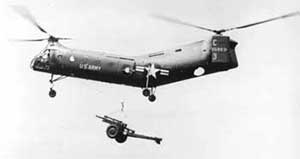
Shawnee
helicopter
|
|
A U.S. Supreme
Court decision outlawed the use of disorderly conduct statutes
as grounds for arresting African Americans sitting-in at segregated
public facilities to obtain equal service.
The case began in Baton Rouge, Louisiana, where a group of
negro Southern University students bought some items then sat
at the lunch counter of Kress Department Store. Their polite
requests to order food were ignored because the lunch counter
was only for the use of whites, and police arrived to arrest
them. Convicted of "disturbing the peace,” they
were expelled from Southern University and barred from all
public colleges and universities in the state of Louisiana.
The Court overturned their convictions because there was no
evidence indicating a breach of the peace. |
| The
decision in Garner v. Louisiana |
|
| New
Zealand Prime Minister Norman Kirk (Labour Party) announced
withdrawal of his
country’s troops from Vietnam and a phase-out of
his country’s draft just three days after taking
office. |
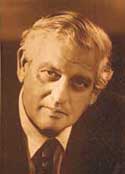 |
| Prime
Minister Norman Kirk |
| 
Anti-War
demo Parliament Buildings in Wellington, 1969 |
3,890 New Zealand military personnel had served there, suffering
37 dead and 187 wounded. This had given rise to a
large and vocal anti-war movement. |
| History of the
anti-war movement in New Zealand |
|
| President Carter signed a law creating
a $1.6 billion environmental Superfund to pay for cleanup of
chemical spills and toxic waste dumps. |
|
More than
20,000 women turned out for an anti-nuclear demonstration
at Greenham Common Air Base in England, where U.S. nuclear-armed
cruise missiles were deployed. Some tried to rip down the
fence surrounding the base. |
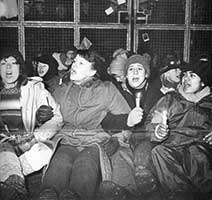
|
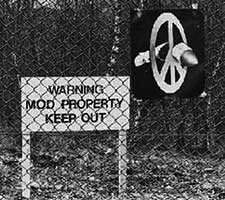
A
Greenham Peace Camp scrapbook
Poster
of Broken Missile taped to the fence of Greenham Common by
a protester, 1982.
Greenham
Women |
 |
|
| The
three major U.S. television networks (ABC, CBS, NBC) agreed
on joint standards to limit entertainment violence by the
start of the following season. |
Violence
in the Media - Psychologists Help Protect Children from Harmful
Effects |
|
| In
the largest Russian military offensive since its 1979 invasion
of Afghanistan,
thousands of troops and hundreds of tanks crossed the border
into the Muslim republic of Chechnya. Just two weeks prior,
a Russian covert operation to undermine the government in
Grozny, the capital, had been foiled and Dzhokhar Dudaev,
Chechnya’s first elected president, had threatened
to have the perpetrators executed. |
The
Chechens had declared their independence from the Commonwealth
of Independent States, comprised of Russia and most of
the countries previously part of the Soviet Union. Chechnya
had been a Russian colony since 1859, and in 1943 Josef
Stalin deported the population en masse, their return to
their homeland not allowed until 1957.
|
 |
|
Russian President Boris Yeltsin, who ordered the invasion,
would not deal with Dudaev, and had raised him to the rank
of chief enemy, ignoring Chechen-Russian history. The
main attack was halted by the deputy commander of Russian ground
forces, Colonel-General Eduard Vorobyov, who resigned in protest,
stating that he would not attack fellow Russians. Yeltsin's
advisor on nationality affairs, Emil Pain, and Russia's Deputy
Minister of Defense, Colonel-General Boris Gromov (esteemed
hero of the Soviet-Afghan War), also resigned in protest of
the invasion, as did Major-General Borys Poliakov. More than
800 professional soldiers and officers refused to take part
in the operation. Of these, 83 were convicted by military courts,
and the rest were discharged. |
|
 |
Joseph H. Rainey (R-South Carolina)
took his seat in the U.S. House of Representatives, becoming
the first African-American Member of Congress. |
More about Rainey |
|
| Dr.
Ben Reitman was arrested in Cleveland for organizing volunteers
to distribute birth control information at an Emma Goldman
lecture on birth control. He was sentenced to six months
in jail and a $1,000 fine plus court costs.
|
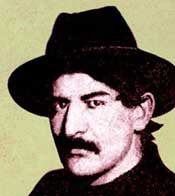 |
Review of a novel by Reitman, Sister of
the Road |
| Dr.
Ben Reitman |
|
| The
United Mine Workers union withdrew from the American Federation
of Labor over
the AFL’s failure to organize workers in mass production
industries such as textiles, automobiles, steel and rubber. |
|
| The
Philippine Civic Action Group, a 1350-man contingent
from the Army of the Philippines,
left South Vietnam. The contingent had been part of the
Free World Military Forces, an effort by President Lyndon Johnson
to enlist allies for the United States and South Vietnam,
similar to President George Bush’s “Coalition
of the Willing,” the multi-national force in Iraq.
|
|
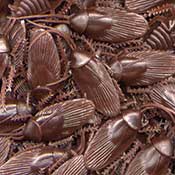
| Seventy
people were arrested in Boston outside a hotel where
a "New Trends in Missiles" trade conference
was being held.
Inside the hotel, over 1,000 cockroaches
were released to symbolize the likely survivors of
nuclear
war. |
 |
|
|
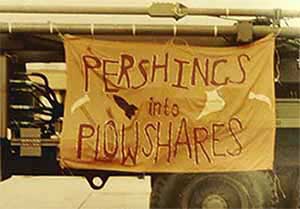
Plowshares
activists disarmed a Pershing missile launcher in West
Germany. In a statement of intent the four said, "With
awareness of our responsibility we understand that we are
the ones who make the arms race possible by not trying
to stop it."
|
| |
| From
a pershing plowshares action 1984 |
Details of their action
in Pershing to Plowshares |
|
|
|
| Nazi
propaganda minister Joseph Goebbels recorded in his journal
his contempt for the Italians' treatment of Jews in Italian-occupied
territories. "The Italians are extremely lax in their
treatment of Jews. They protect Italian Jews both in Tunis
and in occupied France and won't permit their being drafted
for work or compelled to wear the Star of David."
|
|
| Poland's
new military leaders issued a decree of martial law, drastically
restricting civil rights and suspending the operations
of the Solidarinosc (Solidarity) trade union. The union's
activists reacted with an appeal for an immediate general
strike to protest.
|
|
In-depth history
of U.S. and the Solidarity movement |
|
| At the United Nations Second Special
Session on Disarmament, the two resolutions for a nuclear freeze
(a verifiable end to all testing, production and deployment
of nuclear weapons by the Soviet Union and the United States)
passed 119-17 and 122-16. The socialist and developing countries
voted solidly for a freeze, while the U.S. and member countries
of the NATO alliance voted against it. |
|
| 
|
In
Belgium, 80,000 labor and anti-globalization activists began
several days of protests at a European Union summit conference
in Brussels.
Despite a massive police presence, unlike other similar meetings,
events remained peaceful. |
|
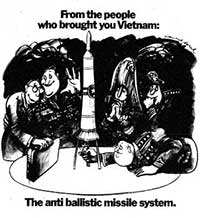
| President
George W. Bush served formal notice that the United States
was withdrawing
from the 1972 Anti-Ballistic Missile Treaty with Russia (then
the Soviet Union). “I have concluded the ABM treaty
hinders our government's ability to develop ways to protect
our people from future terrorist or rogue state missile attacks.”
The anti-ballistic missile system, known during the Reagan
administration as the Strategic Defense Initiative (SDI) or,
commonly, Star Wars, are referred to as National Missile Defense
(NMD). To date, research, testing and limited deployment have
cost approximately 500 billion dollars.
|
 |
|
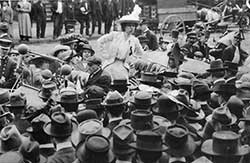
| U.S.
peace activist and suffragist Kate Richards O'Hare was
sentenced to five years’ imprisonment for a speech
denouncing World War I. |
 |
Occupying
a neighboring jail cell was Emma Goldman, the well-known
anarchist
organizer, feminist, writer and anti-war critic was
imprisoned for obstructing the draft. O'Hare was one
of a number of prisoners Socialist Party leader Eugene
Debs cited in his "Canton Speech" for which
he in turn was imprisoned.
|
| Kate Richards O'Hare addressing a crowd in
downtown St. Louis on National Suffrage Day,1916. |
| More about activist Kate Richards O'Hare |
Read
the speech |
|
|
In a public exchange of letters with South Vietnamese President
Ngo Dinh Diem, U.S. President John F. Kennedy formally
announced the United States would increase aid to
South Vietnam, including the expansion of the U.S.
troop commitment. Kennedy, concerned with recent
advances made by the communist insurgency movement
in South Vietnam, wrote: "We shall promptly
increase our assistance to your defense effort."
|
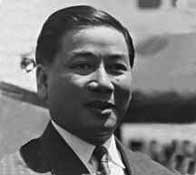
President
Ngo Dinh Diem |

President
Kennedy and Secretary of Defense McNamara |
Kennedy - Diem
letter exchange |
|
|
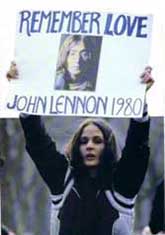
At Yoko Ono's request, John
Lennon fans around the world mourned him with 10 minutes
of silent prayer. In New York over 100,000 people converged
on Central Park in tribute, and in Liverpool, England, his
hometown, a crowd of 30,000 gathered outside of St. George's
Hall on Lime Street. |
| johnlennon.com > |
 |
"You may say I'm a dreamer.
But I'm not the only one." |
Time capsules to mark John Lennon's legacy |
|
|
| Wilma
Mankiller became the first woman to lead a major American
Indian tribe when she took office as principal chief of
the Cherokee Nation of Oklahoma. |
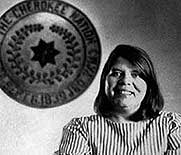 |
Wilma Mankiller on the day in 1985 when
her election as chief of the Cherokee Nation was announced |
|
|
After eight years of negotiations, the United States finally
agreed to honor New Zealand's ban on nuclear weapons
in its territory.
U.S. Navy ships armed with nuclear
weapons no longer visited New Zealand’s ports. |
|
Leaders of the states that were parts of
the former Yugoslavia signed the Bosnia peace treaty, formally
ending four years of bloody and vicious ethnic/religious conflict.
The Dayton Accords, as they are known, committed the Balkan
states of Serbia, Croatia, Bosnia-Herzegovina to accept a division
of territory, a process to deal with the more than 2 million
refugees, and the introduction of 60,000 NATO peacekeeping
forces.
The negotiations were led by U.S. Assistant Secretary of State Richard
Holbrooke, and held principally at Wright-Patterson Air Force
Base near Dayton, Ohio. |
| The Dayton Accords |
|
The Bill of Rights became law when Virginia ratified the first
10 amendments to the United States Constitution. |
| Read The
Bill of Rights |
The
Bill of Rights Defense Committee |
|
 |
Albert Einstein urged militant pacifism and the creation
of an international war resistance fund. Einstein
stated in New York that if two percent of those called
for military service were to refuse to fight, and
were to urge peaceful means of settling international
conflicts, then governments would become powerless
since they could not imprison that many people.
|
| Albert Einstein, 1930 |
He struggled against compulsory military service and urged
international protection of conscientious objectors. He concluded
that peace, freedom for individuals, and security for societies
depended on disarmament; otherwise, "slavery of the
individual and the annihilation of civilization threaten
us." |
Einstein
on Peace and World Government |
|
|
| Vietnamese
leader Ho Chi Minh sent a note to French Premier Leon Blum congratulating
him for his selection as French Premier and asking for peace
talks. France had exercised colonial power over the Vietnamese
as part of French Indochina, formed in October 1887 from the
provinces of Annam, Tonkin, Cochin China, and the Kingdom of
Cambodia; Laos was added in 1893. Vietnamese nationalists, however,
had demanded independence for the three provinces at the end
of World War II. |
|
| 
|
The
American Psychiatric Association reversed its long-standing
position and declared that homosexuality is not a mental illness
and
"...deplores all public and private discrimination in
such areas as employment, housing, public accommodation..." |
| Read the APA on homosexuality |
|
| The
Chernobyl nuclear power plant was shut down 14 years after
becoming the site of the world's worst nuclear accident ever.
Nearly nine tons of radioactive material – dozens of
times as much as the Hiroshima and Nagasaki bombs –
were released in the explosion.
The radioactive fallout affected
23% of Belarus, with 4.8% of Ukrainian territory and 0.5%
of Russia. The Belarussian government spends 30% of its annual
budget dealing with the aftermath of Chernobyl.
|
|
| Heinrich
Himmler, head of the German Gestapo, made public an order
that Gypsies, or Roma, and those of mixed Roma blood already
in labor camps be deported to Auschwitz-Birkenau." |
| Himmler
was determined to prosecute Nazi racial policies, which
dictated the elimination from Germany and German-controlled
territories of all races deemed "inferior," as
well as "asocial" types, (hardcore criminals,
homosexuals, Communists, Slavs, Catholic priests). Gypsies
fell into both categories according to Nazi ideology and
had been executed widely in Croatia, Poland and the Soviet
Union. |
 |
| 
|
The
Porajmos (also Porrajmos) — literally Devouring — is
a term coined by the Romani to describe attempts by the
Nazi regime to exterminate most of their people in Europe. |
| Read
more |
video |
| Gypsy
arrivals to the Belzec death camp. |
|
| President
Truman proclaimed a national state of emergency in order
to fight "Communist
imperialism." This followed major Chinese intervention
in the Korean War, launching a counter-offensive with 300,000
men against Republic of Korea, United States and United Nations
troops. |
| The
U.N. command, under General Douglas MacArthur, had attacked
the North Korean Army at Inchon three months earlier,
liberating Seoul, destroying three divisions and forcing
a retreat by the North Korean People’s Army. |
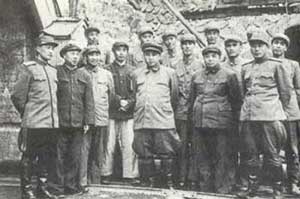 |
North
Korean Leader Kim Il Sung (second from L)
with
the Korean-Chinese joint military command |
|
| The U.N. passed a series
of 4 resolutions attacking apartheid in South Africa: To
organize an international conference of trade unions on sanctions
against South Africa (approved 129 to 2); To encourage various
international actions against South Africa (126 to 2); Support
of sanctions and other measures against South Africa including
international sporting events (139 to 1); Cessation of further
foreign investments and loans for South Africa (138 to 1).
The U.S. was the only country to have voted against all 4
resolutions (joined only by the United Kingdom on two). |
|
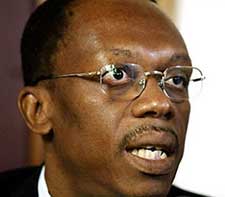 |
Jean-Bertrand Aristide, a radical Roman Catholic priest and opponent of the dictatorship of Jean-Claude Duvalier who had been deposed in 1986, was elected president in the first free election in Haiti's history. He was overthrown in 1991 in a military coup led by Brigadier-General Raoul Cedra. |
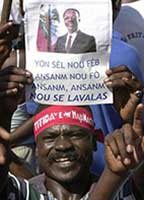 |
| Jean-Bertrand Aristide |
More about Jean-Bertrand Aristide |
Jean-Bertrand Aristide Fast Facts |
|
In Tunesia jobless graduate Mohmad Bouazizi starts selling vegetables. When police seize his cart, he sets fire to himself and later dies.
This event believed to be the ignition of Arab Spring. |
A UK Guardian interactive timeline |
|
| Following its ratification by the requisite three-quarters of the states
earlier in the month, the 13th Amendment was formally adopted into
the U.S. Constitution, ensuring that "neither slavery nor involuntary
servitude... shall exist within the United States, or any place subject
to their jurisdiction." |
 |
"Selling females by the pound" |
|
Julia
Butterfly Hill descended from her tiny platform 180 feet
up in a giant redwood tree (sequoia sempervivens) named "Luna," after
perching there for 738 days to protect it from loggers. Luna
survived a chainsaw attack in 2001 but still stands. |

|
 |
"The
question is not 'Can you make a difference?' You already
do make a difference.
It's
just a matter of what kind of difference you want to make
during your life on this planet."
–
Julia Butterfly Hill |
More about Julia Butterfly Hill and Luna |
Luna TodayEarth Medicine |
|
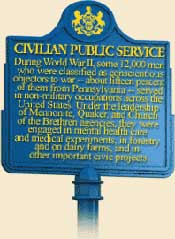
Civilian
Public Service (CPS) camps were established for conscientious
objectors following the
institution of the first peacetime draft (a year before the
attack on Pearl Harbor).
It was the first
time members of peace-oriented religious groups (e.g., Quakers,
Mennonites, Church of the Brethren) could legally avoid military
conscription. |
|
 Fire
fighting. CPS 30, Walhalla, Michigan (Brethren) Fire
fighting. CPS 30, Walhalla, Michigan (Brethren)
|
Though they worked nine-hour days except Sundays,
they had to pay their own room-and-board, and were not released
from the camps until 1947.
|
 |
| Civilian
Public Service |
|
| 
|
Juan
Bosch Gaviño
was elected President of the Dominican Republic in its first
free elections in 38 years. The election of journalist and
writer Bosch followed shortly after the end of 31 years of
military dictator Rafael Trujillo who had been assassinated
the previous year. Bosch was overthrown by a U.S.-backed
coup just seven months later.
|
| Bosch’s
brief political career |
Juan
Bosch Gaviño |
|
Police in a provincial city in Tunisia used tear gas late on Saturday to disperse hundreds of youths who smashed shop windows and damaged cars, witnesses told Reuters. The beginning of Arab Spring.
|
 |
| Read more (Reuters) |
|
The
morning after Viet Minh forces under Ho Chi Minh launched
a nighttime revolt in the Vietnamese capital of Hanoi,
French colonial troops cracked down on the communist rebels. Ho and his soldiers immediately fled the city to regroup
in the countryside.
That evening, the communist leader
issued a proclamation that read: |

Ho
Chi Minh, Paris 1946 |
"All the Vietnamese
must stand up to fight the French colonials to save the
fatherland. Those who have rifles will use their rifles;
those who have swords will use their swords; those who
have no swords will use spades, hoes, or sticks. Everyone
must endeavor
to oppose the colonialists and save his country.
Even if we have to endure hardship in the resistance war,
with the determination to make sacrifices, victory will
surely be ours." The first Indochina War thus began.
|
|
North Vietnam announced the formation of the National Front
for the Liberation of the South (usually known as
the National Liberation Front or NLF), designed to
replicate the success of the Viet Minh, the umbrella
nationalist organization that successfully liberated
Vietnam from French colonial rule. |
 National
Liberation Front flag National
Liberation Front flag |
Ho
Chi Minh biography |
|
| 
|
Kansas reservist
Dr. Yolanda Huet-Vaughn refused orders to serve in the
first Gulf War (Desert Storm) and was later sentenced to
prison. The Kansas medical board withdrew her hospital
privileges. |
| "The
issue was not whether I belonged in the military but whether
the military belonged in the Middle
East waging war. I did not want to focus on the personal
decision.
I was trying to focus on the decision for which each and
every American would have to be responsible." — Yolanda
Huet-Vaughn |
What
if they gave a war and nobody came? |
|
|
100,000
Chechnyan civilians linked hands in a 65 km-long human chain
(40 miles) to protest the Russian invasion of their country
and attack on their capital, Grozny. |
Read more |
|
The Vermont Supreme Court rulled in Baker v. State of Vermont that homosexual couples were
entitled to the same benefits and protections as
wedded couples of the opposite sex. |
History of the Freedom to Marry |
|
|
Amidst a strike for union recognition by 395,000 steelworkers,
the "Red Scare" was launched with the
deportation of Alexander Berkman, Emma Goldman,
and some 250 other radicals. They were deported
to Russia aboard the S. S. Buford ("The Soviet
Ark").
|

|
| Emma
Goldman and Alexander Berkman also organized against World
War I |
J. Edgar Hoover, heading
the Justice Department's General Intelligence Division,
advanced his career by implementing to the fullest extent
possible the government's plan to deport all foreign-born
radicals. |
|
The
Montgomery, Alabama, public buses were officially integrated.
This happened following a successful boycott of city buses led by Reverend
Martin Luther King, Jr., and initiated by Rosa Parks’s refusal to
move to the back of the bus. |
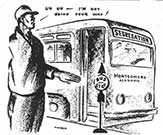 |
"UH
UH, I'm not going your way!"
|
| Bus
Boycott cartoon by Laura Gray from 1956 |
|
American
political activists Tom Hayden, Staughton Lynd, and Herbert
Aptheker began a visit to Hanoi, the capital of
North Vietnam. Invited by the North Vietnamese, they went despite
the U.S. travel ban.
Lynd and Hayden wrote “The Other
Side” following their trip,
explaining the Vietnamese
perspective. |
Read
more |
|
| Hundreds of supporters visited jailed Vietnam War resisters
at Allenwood Federal Penitentiary in Pennsylvania, organized
by the Fellowship of Reconciliation. |
|
| President
Ronald Reagan signed, after Congress had passed it unanimously,
the first Boland Amendment. Representative Edward Boland’s
(D-Massachusetts) legislation prohibited the use of U.S.
funds for either overt or covert efforts by its intelligence
agencies to overthrow the Nicaraguan government. |
|
Vice
President Dan Quayle sent out 30,000 Christmas cards with
the word beacon misspelled "beakon."
|
 |
"May our nation continue to be the beakon
of hope to the world."
-- The Quayles' 1989 Christmas card. |
| More
Quayle quotes |
|
| Eleven
former Soviet republics and Russia peaceably declared an
end to the Soviet Union and formed the
Commonwealth of
Independent States. Azerbaijan, Armenia, Belarus, Georgia,
Kazakhstan, Kyrgyzstan, Moldova, Tajikistan, Turkmenistan, Uzbekistan
and Ukraine agreed to cooperate on the basis on sovereign
equality. |
|
| African-American women during World War II had difficulty volunteering to serve in the war effort. Negro enlistment in the Women's Army Corps (WAC) was limited to 10% of enlistees (reflecting the black proportion of the U.S. population and known as "ten-percenters"). Only the officers were trained in integrated units but all served in racially segregated units, and lived and ate in "colored only" facilities. During the war, 6,520 black women served as WACs. |
Black women were completely banned from the WAVES (Women Accepted for Volunteer Emergency Service) until the last year of the war. Through the efforts of Director Mildred McAfee and Dr. Mary McLeod Bethune, Secretary of the Navy (and later the first Secretary of Defense) James Forrestal pushed through their admittance. The first two black WAVES officers, Lieutenant Harriet Ida Pikens and Ensign Frances Wills,
were sworn in this day.
Of 80,000 WAVES, only 72 black women served. |
 |
|
The
original Radio Free Alcatraz, a pirate radio station, broadcasted
for the first time through Berkeley, California’s
Pacifica radio station, KPFA. The voice of Alcatraz was
Johnny Trudell, an ally of the American Indians who had
occupied Alcatraz Island, the site of the former prison
in
San Francisco Bay. |
 |
John
Trudell speaks with news media representatives regarding
negotiations with the federal government
for title to Alcatraz
Island. Trudell, known as "the
voice of Alcatraz," |
|
Operation “Toys
for Guns" was begun in New York City through the efforts
(and $10,000) of I.M. Rainmaker, CEO of an electronics
company. Conceived in cooperation with local police concerned
about crime fed by too many guns and the glorification
of violence, the program offered a $100 voucher redeemable
at Toys ‘R’ Us
for a firearm turned in to the
police. |
| How
it happened |
|
| Paramilitaries
associated with the ruling PRI party in Mexico massacred
45 peasants in the village of Acteal in the state of Chiapas.
The federal government then occupied the territory with over
70,000 troops and expelled the humanitarian observers who
were stationed in the area to monitor the treatment of the
indigenous people who lived there. |
|
A 135-day strike
by 23 conscientious objectors (COs) ended dining hall segregation
at Danbury Federal Penitentiary in Connecticut.
The number
of conscientious objectors had increased from 15 in early 1941
to 200 by the time of the strike. |
|
General Dwight Eisenhower endorsed
the finding of a court-martial in the case of Eddie Slovik,
who was tried for desertion, and authorized his execution.
It was the first such sentence against a U.S. Army soldier
since the Civil War, and Slovik was the only man so punished
during World War II.
He made no secret of his unwillingness to enter combat, but
his pleas to be reassigned to noncombat status were rejected.
Eisenhower ordered that Slovik's execution be carried out to
avoid further desertions in the late stages of the war. |
 Eddie
Slovik Eddie
Slovik |
Read more |
|
University
of Tennessee refused to play Duquesne University, because
they might have used a black player, Chuck Cooper,
in the basketball game [see July 14, 1887].
Cooper went on
to be drafted (the first black player ever) by the Boston
Celtics, playing his first NBA game on the same day as the
debut of head coach Red Auerbach, guard Bob Cousy, and center “Easy” Ed
Macauley. |
 |
| Chuck Cooper, graduate of Duquesne University |
|
 |
James
Davis of Livingston, Tennessee, was killed by the Viet Cong,
the insurgents in South Vietnam, and became the first of
some 58,000 U.S. soldiers killed during the Vietnam War.
Lyndon Johnson later referred to him as “the first American
to fall in defense of our freedom in Vietnam.”
Over two
million Vietnamese would die before the end of the war. |
James
Davis
|
|
Months
after the fall of the Confederacy and the end of slavery,
several veterans of the Confederate Army formed a private
social club in Pulaski, Tennessee, called the Ku Klux Klan
(KKK). Its first priority, declared in its creed, was "to
protect the weak, the innocent, and the defenseless from
the indignities, wrongs, and outrages of the lawless, the
violent, and the brutal.”
In fact, the Klan terrorized
and killed former slaves, sympathetic whites and immigrants. |
 |
| Three
Ku Klux Klan members, September 1871. |
| The
building where it happened still stands with a bronze plaque
reading, "Ku Klux Klan organized in this, the law
office of Judge Thomas M. Jones, Dec. 24, 1865.” When
the building was purchased in 1990, the new owner, Don
Massey, instead of
removing the plaque, simply reversed it, showing the smooth
back side. |
More
on the Klan |
|
 |
Costa Rica indicated its intention to withdraw from The League
of Nations to protest lack of progress on regional issues,
particularly U.S. dominance of the hemisphere.
The Monroe
Doctrine, declared by President James Monroe in 1823, established
the U.S. sphere of influence encompassed the entirety
of North and South America, as well as the Caribbean
island nations. |
| Read more |
|
| President
Truman pardoned 1,523 of the 15,805 World War II draft resisters
who had been convicted and served time in prison for their
offense. Five years later on the same day, shortly before
leaving office, he granted full pardon and restoration of
civil and political rights to former convicts who had served
in the peacetime army or who had not been covered by his
earlier pardon, as well as all convicted peacetime deserters. |
| Read more |
|
| Parents of reservists
from Grocka protested at Army headquarters in Belgrade, Yugoslavia,
worried their sons would be caught up in the war threatened
by Serbian nationalist expansionism. |
|
| President
George Herbert Walker Bush pardoned six Reagan administration
appointees in the Iran-Contra case, among them former Secretary
of Defense Casper Weinberger, and Robert McFarlane, the President’s
former national security advisor. |
He
did so with less than one month to go in his presidency,
and one week before Weinberger’s trial on four felony
charges was to begin.
These people and others were responsible for selling arms
to the revolutionary government of Iran in hope of the release
of hostages held in Lebanon, despite then-President Ronald Reagan’s
repeated pledge not to negotiate with hostage-takers. |
The Iran-Contra Boys
 Otto
Reich /Elliott Abrams /John Poindexter/Edwin Meese George
H.W. Bush/Casper
Weinberger/Oliver North/Robert McFarlane Otto
Reich /Elliott Abrams /John Poindexter/Edwin Meese George
H.W. Bush/Casper
Weinberger/Oliver North/Robert McFarlane |
The money raised
through the arms sales was used to fund the Contra insurgents
in Nicaragua, who were violently trying to overthrow the
government. This support was in violation of an explicit
legal ban on such activities under the Boland Amendment [see December
21, 1982]. |
| Text of Bush’s
Grant of Executive Clemency |
| U.S. presidential pardon history: |
More
about presidential pardons: |
|
 |
Just
after midnight on Christmas morning, German troops at the
front in World War I ceased firing their guns and artillery,
and began to sing Christmas carols. At the first light of
dawn, many of the German soldiers emerged from their trenches
and approached the Allied lines across no man's land, calling
out "Merry Christmas" in their enemies' native
tongues. |
| German
officer in the trenches with British soldier |
| At first the Allied soldiers suspected it to be a trick, but
they soon climbed out of their trenches and shook hands
with the German soldiers. The men exchanged presents
of cigarettes and plum puddings; the fighting didn’t
resume in earnest for several days, and then only at
the insistence of the generals. |
 German
and British soldiers fraternize German
and British soldiers fraternize |
| What
happened that night |
| a
film | Joyeux Noel: The Christmas Truce Of 1914 |
watch & listen |
|
President
Harding announced the release of Socialist Party leader Eugene
V. Debs
from prison, unconditionally commuting his 10-year sentence
to time served. Debs’s full rights as a citizen, however,
were not restored. He had been imprisoned for his vocal opposition
to U.S. participation in World War I.
Following a meeting with the president and attorney general,
Debs commented,
". . . a convict for his principles is always a citizen in good standing. He is a citizen by his own inherent, God-given integrity. The only man who loses his citizenship is the man who renounces his principles and abdicates his manhood." |
|
| The first Christmas demonstration
at the White House was held by those seeking amnesty for conscientious
objectors convicted of refusing to fight in World War II. |
|
The
special prosecutor responsible for investigating crimes committed
in the Iran-Contra
Affair, Lawrence E. Walsh, denounced the pardons granted the
day before by President George H.W. Bush. Mr. Walsh charged
that "the Iran-contra cover-up, which has continued for
more than six years, has now been completed."
Walsh said, "evidence of a conspiracy among the highest
ranking Reagan Administration officials to lie to Congress
and the American public" was central to his case against
Weinberger. President Bush had been vice president at the time
of the arms sales to Iran for hostages, and illegal aid to
the insurgent Contras in Nicaragua.
Those Bush pardoned: Caspar Weinberger, former Secretary of
Defense, soon to go on trial for lying to Congress; Clair E.
George, the former head of the Central Intelligence Agency's
clandestine services, who had been convicted twice of perjury;
two other CIA officials, Duane Clarridge and Alan D. Fiers
Jr.; Robert C. McFarlane, the former national security adviser,
and Elliott Abrams, the former assistant Secretary of State
for Central America, both of whom had pled guilty to withholding
information from Congress. |
|
38
members of the Santee Sioux tribe were hanged in a public
mass execution in Minnesota. 300 members of the band had
been convicted of participating the the Minnesota Uprising
and ordered to hang. However, all sentences except the
38 had been commuted by President Abraham Lincoln.
For
decades white settlers had been encroaching on Santee Sioux
territory, and they had been victimized by corrupt federal
Indian agents on the reservations. |
| In July agents and contractors
had withheld food when their demands for kickbacks had
been refused. The Indians eventually struck back, killing
Anglo settlers and taking some hostages. In two battles
with the U.S. Army, they killed or wounded dozens of soldiers,
but ultimately lost and were put on trial. |
 |
| America’s
only legal mass execution |
|
| The
first Kwanzaa was celebrated in Los Angeles, California.
It was conceived and organized in the wake of the Watts
riots by Dr. Maulana (Ron) Karenga, a professor and chairman
of Black Studies at California State University at Long
Beach. Kwanzaa is a non-religious African-American holiday
focusing on family, community, and culture. |
| The
name Kwanzaa is derived from the phrase "matunda ya
kwanza," which means "first fruits" in Swahili.
The celebrations are expressed through song, dance, drumming,
storytelling, poetry and the lighting of candles in a Kinara,
all followed by a large traditional meal. The holiday is observed
for seven days, each representing a different principle: |

a
Kwanzaa Kinara |
• Umoja (oo-MO-jah) Unity
• Kujichagulia (koo-gee-cha-goo-LEE-yah) Self-Determination
• Ujima (oo-GEE-mah) Collective Work and Responsibility
• Ujamaa (oo-JAH-mah) Cooperative economics
• Nia (NEE-yah) Purpose
• Kuumba (koo-OOM-bah) Creativity
• Imani (ee-MAH-nee) Faith |
 |
Ron Karenga lighting
the Kinara |
|
History, Principles, and Symbols of Kwanzaa |
|
 |
Two
dozen members of Vietnam Veterans Against the War "liberated" the
Statue of Liberty with a sit-in to protest resumed U.S. aerial
bombings in Vietnam. They flew an inverted U.S. flag from the
crown as a signal of distress. |
|
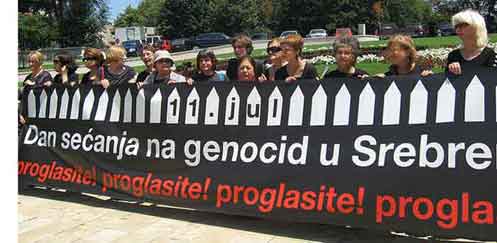 photo: Simran Sachdev Belgrade, 7.2009 photo: Simran Sachdev Belgrade, 7.2009 |
Women In Black began campaign against
rape during war, Belgrade, Serbia. |
 |
| WIB website |
Women
in Black is a world-wide network of women committed to
peace with justice and actively opposed to injustice,
war, militarism and
other
forms of violence. |
|
| Alfonso Portillo
Cabrera scored a resounding victory (nearly 70% of the vote
in the second round) in Guatemala's first peacetime presidential
elections following a 36-year civil war. |
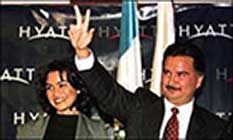
Alfonso
Portillo Cabrera after his election |
| Some
perspective |
|
| The International
Fellowship of Reconciliation (IFOR), an inter-religious peace
group, was founded in Cambridge, England. |
 |
“The International Fellowship
of Reconciliation (IFOR) is an international spiritually based
movement composed of people who commit themselves to active
nonviolence as a way of life and as a means of transformation – personal,
social, economic and political." |
 |
"Your
goal is, in my opinion, the only reasonable one and to
make it prevail is of vital importance."
--Albert Einstein, in a letter to the FOR |
| Read
more |
|
| Vietnam Veterans Against the War
staged a peace protest at historic Betsy Ross House, Philadelphia. |
|
| North Korea ordered
U.N. nuclear inspectors to leave the country and said it would
restart the Yongbyon plutonium Plant to
meet the fuel needs of its nuclear power reactor. The plant
had been shut down and sealed by the U.N. in 1994 in exchange
for shipments of fuel oil. When it was discovered that the
North Korean had been pursuing a uranium-based weapons program,
the U.S. and Japan, South Korea and the European Union suspended
the fuel shipments. |
|
| 1500
people gathered in Tel Aviv, Israel, the protest the Israeli
military occupation of land beyond the 1948 borders of
the country. With the slogans “End the Occupation” and “No
to Racism,” and dressed mostly in black, they used
a variety of means – drumming, singing, art installations,
giving away olives and olive oil – to express their
frustration and anger over the ongoing occupation. |
 |
| Alternative Ten commandments
at demonstration in Tel Aviv, Israel |
| The
Coalition of Women for Peace also showed a movie, Jenin,
Jenin, which had been banned for public showing, in defiance
of police orders to stop the projector. Shown on a large outdoor
screen, it was a narrative about the actions of the Israeli
army the previous Spring in the occupied West Bank town of
Jenin. |
|
| The
(Noble and Holy Order of the) Knights of Labor, a labor union
formed by
tailors in Philadelphia, held the first Labor
Day ceremonies in American history. Led by Uriah S. Stephens,
they advocated and end to child and convict labor, equal
pay for women, a progressive income tax and cooperative ownership
of mines and factories by management and workers. They organized
among the growing mass of industrial workers, their motto, “An
Injury to One Is the Concern of All.” |
|
| An
anti-draft conference launched a "Don't Register" campaign
to resist Australia’s conscription system. |
|
 |
Aleksandr
Solzhenitsyn's “The Gulag Archipelago, 1918-1956,” was
published in Paris in the original Russian. The book is a
brutal and uncompromising first-hand description of political
repression and terror in the Soviet Union and its forced-labor
prison camp system, where the author spent eight years. He
dedicated it "to all those who did not live to tell
it.”
Solzhenitsyn was again arrested and forced into
exile within two months of publication. |
Read more about the Soviet
gulags |
|
| A peace camp was
set up at the Molesworth Royal Air Force base in Cambridgeshire
in the United Kingdom. Led by men and women from the Fellowship
of Reconciliation, and inspired by the encampment at Greenham
Common, it was set up to protest the siting of 64 U.S. ground-launched
nuclear-armed cruise missiles at the base. |
| Their songs |
|
| Three
were arrested at the Capitol Hill Post Office in Seattle
for refusing to leave after attempting to mail humanitarian
supplies to Iraq in defiance of the U.S.-led embargo. |
| Read more about sanctions
against Iraq |
|
The
U.S. Army killed approximately 300 Miniconju Sioux (another of the Teton Sioux tribes). They had fled after the murder of Sitting Bull and sought refuge on the Oglala reservation of Pine Ridge at Wounded
Knee, in the new state of South Dakota.
The 7th Cavalry (Custer's
old command) fired their artillery amidst mostly unarmed
women, children, and fleeing men. The Wounded Knee Massacre
was the final major military battle in the genocide against
Native Americans. 18 soldiers received Congressional Medals
of Honor for their "bravery.”
Encroaching white settlement after gold was found in 1874 on
Sioux lands led to conflicts. |
 |
The Great Sioux Agreement of
1889 established reservations for the native inhabitants and
encouraged further white settlement on Indian land. |
|
Other perspectives and sad, disturbing
photos |
|
|
| War-weary guerrilla
and government leaders in Guatemala signed an accord ending
36 years of civil conflict. |
What
was the conflict all about? |
|
|

|
The
worst year in the 20th century for lynching in the U.S.
ended with a total of 130 victims (105 blacks, 25 whites).
Ida Wells-Barnett had been a teacher and newspaper editor in Memphis, Tennessee,
where she wrote against the evils of lynching in her columns in The Free
Speech and Headlight. Forced from the South by threat of violence, she
continued her efforts in Chicago. |
| Ida
Wells-Barnett |
From
a letter to President William McKinley from Barnett, published
in the Cleveland Gazette April 9, 1898:
Mr.
President, the colored citizens of this country in general,
and Chicago in particular, desire to respectfully urge that
some action be taken by you as chief magistrate of this great
nation, first for the apprehension and punishment of the lynchers
of Postmaster Baker, of Lake City, S.C.; second, we ask indemnity
for the widow and children, both for the murder of the husband
and father, and for injuries sustained by themselves; third,
we most earnestly desire that national legislation be enacted
for the suppression of the national crime of lynching.
For nearly twenty years lynching crimes, which stand side by side with
Armenian and Cuban outrages, have been committed and permitted by this
Christian nation. Nowhere in the civilized world save the United States
of America do men, possessing all civil and political power, go out in
bands of 50 and 5,000 to hunt down, shoot, hang or burn to death a single
individual, unarmed and absolutely powerless. Statistics show that nearly
10,000 American citizens have been lynched in the past 20 years. To our
appeals for justice the stereotyped reply has been that the government
could not interfere in a state matter. Postmaster Baker’s case was
a federal matter, pure and simple. He died at his post of duty in defense
of his country’s honor, as truly as did ever a soldier on the field
of battle. We refuse to believe this country, so powerful to defend its
citizens abroad, is unable to protect its citizens at home. Italy and China
have been indemnified by this government for the lynching of their citizens.
We ask that the government do as much for its own. |
|

 |
Members
of the United Automobile Workers sat down at a General
Motors
plant in Flint, Michigan. GM, the world’s largest corporation
at the time, had refused to recognize or negotiate with the
union, despite passage of the National Labor Relations Act
(Wagner Act) in 1935 which promised unions the right to organize.
The local’s membership adopted a tactic developed by
French workers. Instead of picketing outside a factory only
to be ignored or forcibly cleared away, the sit-down strike
enabled workers to halt production and seize the plant "from
the inside." The strike began just days after the end
of a successful sit-down at Ford supplier Kelsey-Hayes. |
| |
above:
Workers sit down at GM
below: Supporters pass in food to sitdown strikers |
“Master
Hands,” a corporate documentary about the Flint plant
shot shortly before the strike |
|
| Daniel
Ellsberg, a Defense Department analyst, and his colleague
Anthony Russo were indicted by a federal grand jury for releasing
the Pentagon Papers to the news media. The papers were part
of a 7000-page, top-secret government history of the United
States’ political and military involvement in the Vietnam
War from 1945 to 1971, and described air strikes over Laos,
raids along the coast of North Vietnam, and offensive actions
taken by U.S. Marines well before the American public had
been told that such actions had occurred. |
|
|
| President
Richard Nixon ordered an end to U.S. bombing of North Vietnam.
The
most recent air strikes had been retaliation
for North Vietnam’s walking out of the peace negotiations
in Paris and pressure to force it to submit to U.S. terms.
Bombing of strategic targets and Hanoi (the North’s
capital) and Haiphong lasted for eight days with a 36-hour
break for Christmas. The 20,000 tons (18.1 million kg) of
bombs killed just over 1600 North Vietnamese, and a dozen
B-52s were lost. North Vietnam agreed to return to the bargaining
table. |
|
| The state of Israel
and the Vatican under Pope John Paul II agreed to extend diplomatic
recognition to one another. |
|
The
U.S. branch of the International Fellowship of Reconciliation
(FOR) was founded.
FOR’s
Mission Statement
The Fellowship of Reconciliation seeks to replace
violence, war, racism and economic injustice with nonviolence, peace
and justice. We are an interfaith organization committed to active nonviolence as a transforming way of life
and as a means of radical change. We educate, train, build
coalitions, and engage in nonviolent and compassionate actions
locally, nationally, and globally. |
FOR’s website |
|
| The U.S. Congress
repealed the Gulf of Tonkin resolution, which in 1964 authorized
an increase in U.S. military involvement in Vietnam as a
response to a reported attack on U.S. naval forces patrolling
close to the North Vietnamese border. The reports of the
attacks were later revealed to be fictitious. The resolution
was used as the basis for the entire war which lasted until
1974 and took the lives of millions of Vietnamese and over
58,000 Americans.
|
 |
| What
really happened in the Gulf of Tonkin |
|
December 1 2 3 4 5 6 7 8 9 10 11 12 13 14 15 16 17 18 19 20 21 22 23 24 25 26 27 28 29 30 31
visit
another month
Jan • Feb • March • April • May • June • July • Aug • Sept • Oct • Nov • Dec |
See what happened in the history of
Peace and Social Justice
|
 |
Subscribe to our FREE! e-newsletter
 |
| also announcements of new buttons and other cool stuff |
|
We make custom buttons
your design or ours
email your idea and info |
|
|
|
|
|


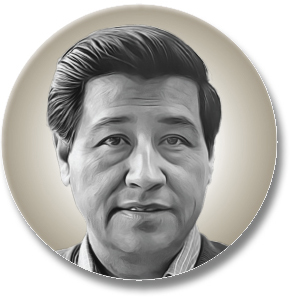
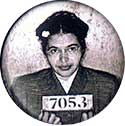


 S.S.
Buford
S.S.
Buford
