| |
|
8000
anti-war marchers demonstrated in Boston. Their banners
read:
“IS THIS A POPULAR WAR, WHY CONSCRIPTION?
WHO STOLE PANAMA? WHO CRUSHED HAITI?
WE DEMAND PEACE.”
The parade was attacked by soldiers and sailors,
on orders from their
officers.
|
|
A massive general strike and nonviolent protest in Guatemala led to the resignation of dictator Jorge Ubico who had harshly ruled Guatemala for over a decade.
|

Juan
José Arévalo Bermejo
|
On March 15 of the following year, Dr. Juan José Arévalo Bermejo took office as the first popularly elected president of Guatemala, and promptly called for democratic reforms establishing the nation’s social security and health systems, land reform (redistribution of farmland not under cultivation to the landless with compensation to the owners), and a government bureau to look after native Mayan concerns.
|
 Jorge
Ubico Jorge
Ubico |
A decade of peaceful democratic rule followed, until a CIA-backed coup in 1954 ushered in a new, even more brutal era of dictatorial and genocidal regimes. [see June 27, 1954] |
|
| The United States exploded a 20-kiloton atomic bomb near Bikini Atoll, part of the Marshall Islands in the Pacific Ocean.he
United States exploded a 20-kiloton atomic bomb near Bikini
Atoll, part of the Marshall Islands in the Pacific Ocean. |
|
|
Sixty-one nations, including the United States, Britain and the Soviet Union, signed the Treaty on the Non-Proliferation of Nuclear Weapons (NPT) which set up systems to monitor use of nuclear technology and prevent more nations from acquiring nuclear weapons. 190 countries are now signatories; Israel, India and Pakistan remain outside the Treaty. North Korea joined the NPT in 1985, but in January 2003 announced its intention to withdraw from the Treaty.
|
Text
of the Treaty  |
|
 |
Publication of the first monthly issue of Ms. Magazine, founded by Gloria Steinem “The truth will set you free. But first, it will piss you off,”
Letty Cottin Pogrebin “Housework is the only activity at which men are allowed to be consistently inept because they are thought to be so competent at everything else,” and others. |
The
first issue |
Ms. Magazine today |
|
 |
Vermont's civil unions law went into effect, granting gay couples most of the rights, benefits, protections and responsibilities of marriage under state law.
In the first five years, 1,142 Vermont couples,
and 6,424 from elsewhere,
had chosen
a Vermont civil union. |
|
| New Jersey became the first British colony in America to grant partial women's suffrage. The new constitution (temporary if there were a reconciliation with Great Britain) granted the vote to all those “of full age, who are worth fifty pounds proclamation money,” including non-whites and widows; married women were not able to own property under common law. |
|
| Vermont became the first of the United States to abolish slavery. |
|
|
Alarmed by the growing encroachment of whites squatting on Native American lands, the Shawnee Chief Tecumseh called on all Indians to unite and resist. By 1810, he had organized the Ohio Valley Confederacy, which united Indians from the Shawnee, Potawatomi, Kickapoo, Winnebago, Menominee, Ottawa, and Wyandotte nations.
For several years, Tecumseh's Indian Confederacy successfully delayed further white settlement
in the region.
|
 Chief
Tecumseh Chief
Tecumseh |
Tecumseh’s efforts |
|
|

Slave
ship
|
Early in the morning, captive Africans on the Cuban slave ship Amistad, led by Joseph Cinquè (a Mende from what is now Sierra Leone), mutinied against their captors, killing the captain and the cook, and seized control of the schooner. Jose Ruiz, a Spaniard and planter from Puerto Principe, Cuba, had bought the 49 adult males on the ship, paying $450 each, as slaves for his sugar plantation.
|
More about Amistad
|
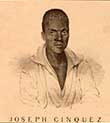 |
| Joseph
Cinquè |
|

Jobs
and Freedom march April 28, 1963
Washington DC |
U.S. President Lyndon B. Johnson signed the Civil Rights Act of 1964 into law, thus barring discrimination in public accommodations (restaurants, stores, theatres, etc.), employment, and voting. |
The law had survived an 83-day filibuster in the U.S. Senate by 21 members from southern states. |
 |
"I think we just delivered the South to the Republican party for a long time to come," said President Johnson to his press secretary,
Bill Moyers later that day.
He anticipated a shift in white southern voting from the Democratic to the Republican party in response to the law. |
| Massive demonstrations a year earlier ensured passage of the Act. |
|
| President George H.W. Bush (the elder) announced that the United States had completed the worldwide withdrawals of all its ground- and sea-launched tactical nuclear weapons [see September
27, 1991]. |
|
Children employed in the silk mills at Paterson, New Jersey, went on strike for an eleven-hour workday and a six-day workweek rather than 12-14 hour days. With the help of adults, they won a compromise settlement of a 69-hour week. |
More on the Baby Strikers |
|
4000 Britons chanting, “Hands off Vietnam,” demonstrated in London against escalation of the Vietnam War. U.S. warplanes had recently bombed the North Vietnamese capital of Hanoi as well as the port city of Haiphong. Police moved in after scuffles broke out at the demonstration outside the U.S. Embassy in Grosvenor Square; 31 were arrested. |
 Actress
Vanessa Redgrave joins 25,000 two years later at Anti-Vietnam
war protest, Grosvenor Square. Actress
Vanessa Redgrave joins 25,000 two years later at Anti-Vietnam
war protest, Grosvenor Square.
|
| Read
more |
|
At the Moscow Summit talks between President Richard Nixon and President Leonid Brezhnev, the United States and the Soviet Union agreed to hold bilateral talks on the prohibition of chemical weapons. |
|
|

|
The United States declared its independence from King George III and Great Britain, thus beginning the first successful anti-imperial revolution in world history. Signed in Philadelphia by 56 British subjects who lived and owned property in thirteen of the American colonies, the document asserted the right of a people to create its own form of government. The signers of the Declaration of Independence were members of the 2nd Continental Congress which had voted two days earlier to separate from the British crown.
Read
the Declaration
|
|
| Slavery was outlawed in New York State as the result of the Gradual Emancipation law passed ten years earlier. This freedom applied only to those who had been 18 at the time of its passage. Enslaved children born during the subsequent ten-year period were not be freed until they reached the age of 21. |
 |
At the urging of Reverend William Hamilton, a freedman and carpenter, and others, the end of slavery was celebrated in churches. The Fourth of July had in the past been marred by young white men attacking black Americans. |
| More
on William Hamilton and others |
|
Speaking at Boston’s Park Street Church, newspaper editor and abolitionist William Lloyd Garrison gave a seminal speech on “Dangers to the Nation.” Though Massachusetts had banned slavery in 1781 and there was strong anti-slavery sentiment, most understood that a national ban of slavery would threaten the union of the states. Compensation to slaveholders and return of the enslaved to Africa was considered the best solution.
Garrison, on the other hand, called attention to the hypocrisy of celebrating the the day the document was signed declaring, “All men are created equal” while two million were in bondage. He proposed four propositions that day to guide the abolitionist movement:
|
1. Above all others, slaves in America deserve “the prayers, and sympathies, and charities of the American people.”
2. Non-slave-holding states are “constitutionally involved in the guilt of slavery,” and are obligated “to assist in its overthrow.”
3. There is no valid legal or religious justification for the preservation of slavery.
4. The “colored population” of America should be freed, given an education, and accepted as equal citizens with whites. |
 |
| William Lloyd Garrison |
|
| The Republic of Hawaii was proclaimed with Sanford B. Dole as president. It was recognized immediately by the United States government under President Grover Cleveland. This was the result of the successful overthrow of the Hawaiian monarchy, then held by Queen Lydia Liliuokalani, and the support by white Americans involved in the sugar trade on the islands for annexation by the United States. Shortly after she had come to office, she had promulgated a new constitution which increased the power of the monarchy and that of native Hawaiians. |
|

|
The first of an annual picket in front of Philadelphia’s Independence Hall was held by gay and Lesbian Americans. Jack Nichols and Frank Kameny and members of the New York and Washington Mattachine Society and the Daughters of Bilitis had earlier demonstrated in Washington, and wished to change the general perception that homosexuals were perverted or sick. |
| Barabara Gittings at the Philadelphia picket |
“By those protesters coming out publicly, and placing themselves very strategically in front of the building that evoked the Declaration of Independence and the idea that all men are created equal, it suggested it [gay rights] was no longer a moral or national security or psychiatric issue ... it was a civil-rights issues,” David K. Johnson wrote in The Lavender Scare: The Cold War Persecution of Gays and Lesbians in the Federal Government. |
 |
|
| The Freedom of Information Act, P.L. 89-487, became law. It established the right of Americans to know what their government is doing by outlining procedures for getting access to internal documents. |
|
 |
“Give Peace a Chance” by the Plastic Ono Band was released in the United Kingdom.
The song was recorded May 31, 1969, during the “Bed-In” John Lennon and Yoko Ono staged at the Queen Elizabeth Hotel in Montreal as part of their honeymoon. John and Yoko stayed in bed for 8 days, beginning May 26, in an effort to promote world peace.
Some of the people in the hotel room who sang on this were Tommy Smothers, Timothy Leary, Allen Ginsberg, and Petula Clark. Smothers also played guitar. This event promoting peace received a great deal of media attention. |
|
|
A national anti-war conference in Cleveland, Ohio, mapped out activities against the Vietnam War and resulted in the founding of New Mobe (mobilization).
More about the Mobes
|
 |
reissued
click to buy |
|
| The Women's Encampment for a Future of Peace and Justice began an eight week stay on a farm just outside the Seneca Army Depot near Romulus, New York. The purpose of the gathering was for the women to learn about and together protest the escalation of militarism and the weapons build-up being led at the time by the Reagan administration. |
| visit PeaCe eNCaMPeNT HeRSToRy PRoJeCT |
|
| The first of several Peace Caravans (Caravanes de Paix) set out from South Kivu and traveled across Africa’s Great Lakes region, including the Democratic Republic of the Congo, Burundi and Rwanda. The Scout Associations of the countries in the violence-ridden area trained hundreds of young people in conflict resolution through their focus on education for peace. |

Members of the Caravan for Peace in Burundi |
| The classes and the caravans included hundreds of young people in Scouts and Girl Guides from many ethnic groups (often with a history of mutual hostility) who act as community mediators. |
Caravanes du Paix |
|
| The newly freed African-American population of New York, led by men on horseback, marched in an Emancipation Day Parade from the Battery at the foot of Manhattan to City Hall. |
Follow the route of the
parade |
|
Buildings erected for the 1892 Columbian Exposition in Chicago's Jackson Park were set ablaze, seven reduced to ashes. The fire was part of the chaos in reaction to President Grover Cleveland’s calling out federal troops to end the Pullman Strike.
The Pullman Palace Car Company produced the sleeping cars used by most of the railroads. The contingent of federal, state and local forces equalled the number of striking workers. |
The Pullman employees, who lived in company-owned housing in Pullman, Illinois, had suffered massive layoffs and pay cuts averaging 25%. The company refused to cut the rent on the housing its employees were required to occupy, nor would it bargain with workers’ representatives.
|
 |
| Federal troops guarding the Arcade Building
in Pullman, Illinois. |
| The Pullman workers’ cause had been taken up by Eugene V. Debs, the leader of the American Railway Union, who helped organize a nationwide boycott of any train that included a Pullman car. |
The Pullman Strikers’ Statement |
More on the Great Pullman Strike |
|
|

|
On “Bloody Thursday,” police armed with machine guns opened fire against striking longshoremen and their supporters, killing two, wounding 32 more by gunfire, and injuring 75 others at Rincon Hill in San Francisco. |
| Bloody Thursday, July 5, 1934, near Rincon Hill. |
|
The National Labor Relations or Wagner Act (named for New York’s Senator Robert Wagner) became law, recognizing workers' rights to organize and bargain collectively. It was signed into law by President Franklin D. Roosevelt. |
Read more about the act |
|

|
Former National Security Council aide Oliver North received a $150,000 fine and a suspended prison term for his part in the Iran-Contra scandal. The scandal was a secret arrangement directed from the Reagan White House that provided funds to the Nicaraguan Contra rebels
|
(despite specific congressional prohibition) from profits gained by selling arms to Iran (at war with Iraq at the time) in hopes of their releasing hostages, despite President Reagan’s claim that he would never negotiate with hostage-takers. |
North’s conviction was later overturned because evidence revealed in the congressional Iran-Contra hearings had compromised his right to a fair trial. |
The
real details on Ollie North’s activities |
|
|
In
one of the worst cases of violent union-busting, a fierce
battle broke out between
the striking employees (members of the Amalgamated Association
of Iron and Steel Workers) of Andrew Carnegie’s Homestead
Steel Company and a Pinkerton Detective Agency private
army brought on barges down the Monongahela River in the
dead of night. Twelve were killed.
Henry C. Frick, general manager of the plant in Homestead,
near Pittsburgh, Pennsylvania, had been given free rein by
Carnegie to quash the strike. At Frick's request, Pennsylvania
Governor Robert E. Pattison then sent 8,500 troops to intervene
on behalf of the company. |
Read
more |
|
 |
In
Nazi-occupied Holland, thirteen-year-old Jewish diarist
Anne Frank and her family were forced to take refuge in
a secret sealed-off area of an Amsterdam warehouse under
threat of arrest and deportation to a concentration camp
by the Einsatzgruppen (Task Force), a part of the German
Gestapo. |
| The Anne Frank Center for Mutual Respect |
|
|
|
| As many as 500 students in Berkeley,
California, attempted to block trains carrying troops destined
for Vietnam along the Santa Fe Railroad tracks; there were
no casualties. Organized by the Vietnam Day Committee, this
was the first civil disobedience at UC-Berkeley against the
Vietnam War. |
|
| The
first military draft was instituted in the U.S. to provide
troops for the Union army in the American Civil War. Once
called, a draftee had the opportunity to either pay a commutation
fee of $300 to be exempt from a particular battle, or to
hire a replacement that would exempt him from the entire
war. |
|
 |
Labor
organizer Mary Harris "Mother" Jones led the "March
of the Mill Children" over 100 miles from Philadelphia
to President Theodore Roosevelt's Long Island summer home in
Oyster Bay, New York, to publicize the harsh conditions
of child labor and to demand a 55-hour work week. It is
during this march, on about the 24th, she delivered her
famed "The Wail of the Children" speech.
Roosevelt
refused to see them. |
The
March of the Mill Children watch a video - highly recommended |
“Fifty
years ago there was a cry against slavery and men gave up
their lives to stop the selling of black children on the block.
Today the white child is sold for two dollars a week to the
manufacturers.”
from
Mother Jones’s autobiography
|
 |
| Read
more about Mother Jones |
|
| Convened
at the onset of the Cold War, a group of scientists held
their first peace conference in the village of Pugwash,
Nova Scotia, Canada. The mission of the Pugwash Conference
was to “. . . bring scientific insight and reason
to bear on threats to human security arising from science
and technology in general, and above all from the catastrophic
threat posed to humanity by nuclear and other weapons of
mass destruction . . . .” |
|

Bertrand
Russell
|
Wealthy
industrialist and Pugwash son Cyrus Eaton had invited the
world’s greatest minds to his family home in Nova
Scotia and address the emerging threat of nuclear war.
The Conference became the basis for an ongoing organization
that deals with issues of weapons of mass destruction.
The 1995 Nobel Peace Prize was awarded to Joseph Rotblat
(one of the original signatories of the Pugwash Manifesto)
and to the Pugwash Conferences on Science and World Affairs. |

Albert Einstein |
Pugwash
home |
Fifty
years later . . .
25 scientists, diplomats and former military officers from
15 countries gathered for a “Revitalizing Nuclear Disarmament” strategy
workshop. The meeting was held near the Thinkers’ Lodge,
the site of the first meeting in 1957.
“Fifty years ago from Pugwash, Nova Scotia, nuclear scientists
helped alert the world to the dangers of nuclear weapons, and
especially the newly developed hydrogen bomb,” said Paolo
Cotta-Ramusino, Secretary General, Pugwash Conferences on Science
and World Affairs. “Today, we are working with experts
from around the world for global action to revitalize nuclear
disarmament and the final elimination of nuclear weapons.”
Senator Roméo Dallaire, Honorary Patron of the Pugwash
Peace Exchange, said “It is appalling to observe the
increasing potential for many regional nuclear arms races,
shameless plans to modernize nuclear arsenals and bald-faced
threats of pre-emptive nuclear use,” said Senator Dallaire. “Only
by revitalizing discussion and implementation of disarmament
leading to abolition can we ensure that these genocidal devices
will never again be used.” |
|
The United States conducted its first test of the neutron bomb. The neutron
bomb was a tactical thermonuclear weapon designed to cause very little
physical damage through limited blast and heat but was designed to
kill troops through localized but intense levels of lethal radiation.
A
neutron bomb explosion at a test site |
 |
|
| 2,000
American Indian activists and anti-nuclear demonstrators
marched through the Black Hills of western South Dakota to
protest the development of uranium mines on sacred native lands. |
|
Vermont became the first
British colony in America to abolish slavery when adopting
its first constitution following its breaking away from
New York. |
Read more on slavery in Vermont |
More on slavery in the northern states |
|
The
Women's Peace Crusade organized a protest against the first
world war in Glasgow, Scotland. Processions from two sides
of the city, accompanied by bands and banners, wound their
way toward the Glasgow Green where they merged into one
demonstration of some 14,000 people. |
Read about the Women's Peace Crusade |
|

|
In an effort called "Omaha Action," by the Committee for Nonviolent Action (CNVA),
anti-nuclear activist Don Fortenberry was arrested after climbing a fence to protest against the building of ICBM sites in Nebraska.
Also arrested during this series of actions was
internationally known peace activist A. J. Muste. |
"Omaha Action" protestors march from Lincoln, Nebraska to the Mead ICBM construction site in 1959.
Source — NSHS. |
| More about Omaha Action |
|
|
Vietnamese
guerillas ambushed two U.S. advisors, Major Dale Buis
and Sgt. Chester Ovnand, are killed by Viet Minh guerrillas
at Bien Hoa, South Vietnam, making them the first U.S. casualties
in Vietnam
since 1946.
|
|
|
Roy
Wilkins became the executive director of NAACP, the National
Association for the Advancement
of Colored People. He had edited the organization’s
magazine, Crisis, for fifteen years, and was one of the
most articulate of civil rights leaders. |
 |
| Roy Wilkins |

the
Roy Wilkins Memorial in Minneapolis |
|
| The
International Court Of Justice declared that, in almost all
circumstances, use of nuclear weapons is illegal. |
|
|
During
World War I, Emma Goldman and Alexander Berkman, leaders
of the No-Conscription
League, spoke out against the war and the draft. Both were
found guilty in New York City of conspiracy against the
draft, fined $10,000 each and sentenced to two years’ imprisonment
with the possibility of deportation at the end of their
terms. |
 |
Emma
Goldman and Alexander Berkman in New York, 1917,
awaiting
trial on charges of opposing the draft during World War I. |
Emma Goldman's address to the Jury "History is a Weapon" |
|

|
Albert
Einstein, Bertrand Russell and nine other scientists warned
that the development of weapons of mass destruction had
created a choice between war and survival of the human
species. |

|
| Albert
Einstein |
Bertrand
Russell |
The Russell-Einstein Manifesto was published in
London and became the basis for the Pugwash Conference
of scientists two years later. |
“Here,
then, is the problem which we present to you, stark and dreadful
and inescapable: Shall we put an end to the human race; or
shall mankind renounce war? People will not face this alternative
because it is so difficult to abolish war.
The abolition of war will demand distasteful limitations
of national sovereignty....”
|
“We
have to learn to think in a new way. We have to learn to
ask ourselves ... what steps can be taken to prevent a
military contest of which the issue must be disastrous
to all parties?”
|
Text of
the manifesto |
|
Ku
Klux Klan (KKK) members near Georgetown, Illinois, gathered
for an ill-fated cross-burning. The meeting started an
hour late. When the Klansmen went to plant their cross,
it was too heavy to move. Three hours later, after the
cross was chopped down to a portable size, it was planted,
but would not light.
Finally, the Klan members gave up
and went home. |
 |
The
ugly history of the KKK |
|
 |
The
Greenpeace flagship, Rainbow Warrior (named after a North
American Indian legend), was blown up in Auckland Harbour,
New Zealand, killing one and sinking the ship.
|
| The Rainbow Warrior then |
The attack had been authorized by French President
François Mitterand because the environmental organization
had plans to protest France’s nuclear bomb tests in the
South Pacific.
The Rainbow Warrior today
|
 |
|
The
Niagara Movement, precursor of the National Association for
the Advancement of Colored
People (NAACP), was formed in Buffalo, New York. Meeting at
the home of Mary Burnett Talbert were W.E.B. DuBois, John Hope
and 30 others who rejected the accommodationist approach of
Booker T. Washington (“The wisest among my race understand
that the agitation of questions of social equality is the extremest
folly . . . .”)
|
 |
| Founders of The
Niagara Movement at Niagara Falls |
The Niagara Movement's manifesto was, in the words of DuBois, "We
want full manhood suffrage and we want it now . . . We are
men! We want to be treated as men. And we shall win." |
| The Niagara Movement and its founding principles |
|
The
American Indian Movement (AIM) was founded in Minneapolis,
Minnesota, by George Mitchell, Dennis Banks, Clyde Bellecourt
and 200 others.
They gathered to organize in order to deal
with widespread and persistent poverty among native Americans,
and unjust treatment from all levels of government. |
 |
American
Indian Movement background |
|
 |
The
federal appeals court in Boston reversed the convictions
of Dr. Benjamin Spock and Michael Ferber who had been found
guilty of conspiring to counsel evasion of the military
draft in 1968. The judges considered their activities opposing
the Vietnam War covered under the 1st Amendment right to
free speech.
|
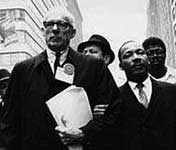 |
Dr.
Benjamin Spock and
Dr. Martin Luther King Jr. |
| Read
"A Call to Resist Illegitimate Authority" co-authored by
Dr. Spock (1967) |
|
John
Ehrlichman, former top aide to President Richard Nixon, and
three others were convicted of conspiring to violate a citizen’s
civil rights. Ehrlichman had approved a recommendation for
a covert investigation of Daniel Ellsberg in 1971 by writing
on a memo: "If done under your assurance that it is
not traceable." Looking for information to discredit Ellsberg, agents of President Nixon’s re-election campaign broke into the office
of his psychiatrist.
|
 |
| John Ehrlichman |
Ellsberg, a former Defense Department analyst,
had been responsible for public release of The Pentagon Papers,
a collection of documents outlining the U.S. history and strategy
in Vietnam, that had been classified as secret to avoid public
scrutiny. |
| The world's most famous filing cabinet |
|
| Massive New York City protests decrying the first-ever wartime draft lottery led to bloody rioting over five days as a mob of 50,000 burned buildings (including looting and torching the Colored Orphan Asylum on Fifth Avenue, though the 200+ children were unharmed), stores and draft offices, and attacked police. Some clubbed, lynched, and shot large numbers of blacks, whom they blamed for the war. |
|
By the time troops returning from the Battle of Gettysburg finally restored order, 1200 had died over five days.
New Yorkers, spurred on by the Democratic leadership of Tammany Hall and tired of the seemingly endless war, had been angered by President Abraham Lincoln’s recent call for 300,000 more troops.
|

New York City draft riot, 1863 |
They especially resented the legal provision allowing a cash payment ($300 commutation fee) as a way for those with the means to avoid military service in the Union Army. |
Read
more about the 1863 draft riots |
In the Shadow of Slavery: African Americans in New York City, 1626-1863 by Leslie M. Harris |
|
A Declaration of Principles was issued by the Niagara Movement (the precursor to the National Association for the Advancement of Colored People) following their conference in Buffalo, New York. Matters of concern included: realization of suffrage for all black men, as well as other civil liberties; economic opportunities for black Americans, especially in the South; access to education, especially high schools, trade and technical schools, and colleges; fair treatment in the courts and an end to the convict-lease system; fair treatment in employment wherein employers brought in black workers temporarily to keep down wages, and labor unions refused membership to blacks; an end to the color line, particularly in public transporation; fair treatment for black soldiers and access to military training schools; enforcement of the 13th, 14th and 15th amendments to the U.S. Constitution passed in the wake of the Civil War.
|
“The Negro race in America, stolen, ravished and degraded, struggling up through difficulties and oppression, needs sympathy and receives criticism; needs help and is given hindrance, needs protection and is given mob-violence, needs justice and is given charity, needs leadership and is given cowardice and apology, needs bread and is given a stone. This nation will never stand justified before God until these things are changed.” |
Additionally, they urged upon the African-American community:
The duty to vote.
The duty to respect the rights of others.
The duty to work.
The duty to obey the laws.
The duty to be clean and orderly.
The duty to send our children to school.
The duty to respect ourselves, even as we respect others. |
|
| The first Live Aid concert raised $75 million for agricultural and technical assistance to Africa, many times what was expected. Described as the Woodstock of the ‘80s, the world's biggest rock festival (in London, Philadelphia, Moscow and Sydney, Australia, simultaneously and linked by satellite) was organized by Boomtown Rats singer Bob Geldof to raise money for famine relief in Ethiopia. |
 |
 Bob
Geldof Bob
Geldof |
The Republic of Ireland (Éire) gave the most donations per capita, despite being in the throes of a serious economic depression at the time. The single largest donation (£1m) came from the ruling family of Dubai (Al Maktoum). |
| More
about Live Aid '85 |
Watch a video about the concert |
|
| Bastille Day in France: Parisian revolutionaries and mutinous troops stormed and dismantled the Bastille, a former royal fortress converted to a state prison, that had come to symbolize the tyranny of the Bourbon monarchy. This dramatic action was proof that power no longer resided in the King as God's representative, but in the people, and signaled the beginning of the French Revolution and the First Republic. |
 |
Bastille Day for kids |
|
A
mere 22 years after the Declaration of Independence, Congress
passed the Sedition Act, making it a federal crime to ".
. . unlawfully combine or conspire together, with intent
to oppose any measure or measures of the government of the
United States . . . or to excite any unlawful combinations
therein, for opposing or resisting any law of the United
States, or any act of the President of the United States
. . . ."
The Declaration: “...whenever any Form of Government
becomes destructive of these ends [life, liberty and the pursuit
of happiness], it is the Right of the People to alter or to
abolish it, and to institute new Government....” |
“An act for the punishment of certain crimes against the United States” |
|
Adrian C. “Cap” Anson, both manager and captain of the Chicago Whitestockings (National League), refused to let his baseball team take the field as long as the Newark Little Giants included their starting pitcher, George Stovey, an African-American, in the lineup. “Get that nigger off the field!” Anson was heard to say. Newark refused to allow Anson to dictate the use of their personnel, but the game was ruled a forfeit to Chicago. At the time there were only 20 black players in all of professional baseball.
The same day, the directors of the International League (which included Newark) barred any of their teams from hiring black players in the future. By the following year there were only six black players left on all the teams in four leagues. All-black teams were formed, but the last of them, the Acme Colored Giants from Celeron, New York, of the Iron and Oil (I&0) League, stopped playing in 1898. No African-American would play in white organized baseball again until Jackie Robinson nearly 50 years later. |
|
The Air Pollution Control Act of 1955 became law, the first in a series of laws that ultimately became the Clean Air Act in 1963.
This first law simply provided funding to the Public Health Service to conduct research.
|
 |
| History of the Clean Air Act |
|
 |
A
group of Iraqi army officers staged a coup in Iraq and
overthrew the monarchy of King Faisal II (who had ascended
to the throne at age four). The new government, led by
Abdul Karim el Qasim, was ousted in 1963 by a coup helped
by the CIA and led by the Arab Socialist Ba'ath Party—later
dominated by Saddam Hussein. |
| King
Faisal II |
Read
more |
|
| The Spanish Inquisition, a centuries-long brutal effort by
the Catholic Church to root out heresy, begun in 1481,
was officially abolished by King Bonaparte. Spain’s
King Ferdinand and Queen Isabella had chosen Catholicism
as their religion and asked the pope to help purify the
people of Spain. Many thousands were forced to convert,
were tortured to encourage confession, or burned at the
stake.
|
 |
| More
on the Inquisition |
Witch
burning during the Inquisition |
|
| Following
World War I, the U.S. War Department announced that it had
classified more than 337,000 American men as "draft
dodgers." |
| Read
a brief history of Conscientious Objection in America |
|
| The
Longest Walk, a peaceful transcontinental trek for Native
American justice, which had begun with a few hundred departing
Alcatraz Island, California, ended this day when they arrived
in Washington, D.C. accompanied by 30,000 marchers. |
 |
They
were calling attention to the ongoing problems plaguing
Indian communities
throughout the Americas: lack
of jobs, housing, health care, as well as dozens of pieces
of legislation before Congress
canceling treaty obligations of the U.S. government toward
various Indian tribes.
They
submitted petitions signed by one-and-a-half million Americans
to President Jimmy Carter. |
 |
|
 The
Sacking of Jerusalem The
Sacking of Jerusalem |
Soldiers from all over Catholic Europe, known as Crusaders, overtook the defenses of Jerusalem and slaughtered both the Jewish and Muslim populations. According to Fulk of Chartres in his contemporaneous account, “Many fled to the roof of the Temple of Solomon, and were shot with arrows, so that they fell to the ground dead. In this temple almost ten thousand were killed. Indeed, if you had been there you would have seen our feet colored to our ankles with the blood of the slain. But what more shall I relate? None of them were left alive; neither women nor children were spared.” |
Pope Urban II initiated this effort to wrest the Holy Land from the hands of the “Infidel” (the city had been under Islamic rule for 460 years) and assured those who joined the first crusade that God would absolve them from any sin associated with the venture. |
|
| Firemen and brakemen for the Pennsylvania and Baltimore & Ohio Railroads refused to work, and refused to let replacements take their jobs. They managed to halt all railroad traffic at the Camden Junction just outside of Baltimore. The railroad companies had cut wages and shortened the workweek. |
 |
A contemporary artist's rendering of the clash in Baltimore between workers
and the Maryland Sixth Regiment during the
Great Railroad Strike of 1877.
The governor had called out
the troops on behalf of the railroad company. |
| After a second pay cut in June, Pennsylvania RR announced that the same number of workers would be expected to service twice as many trains. The work stoppage spread west and eventually became the first nationwide strike |
| Background
and growth of the Strike |
|
The U.S. Army’s Manhattan Project succeeded as its first hand-made experimental atomic bomb, known as the “Gadget,” was successfully detonated at the top of a 30m (100 ft.) tower in the desert near Alamogordo, New Mexico (at the Trinity test site now part of the White Sands Missile Range). The original $6,000 budget for the intensive and secret weapons development program during World War II eventually ballooned to a total cost of nearly $2 billion (more than $25 billion in current dollars).
|
 "Gadget"
explodes "Gadget"
explodes |
 |
Assembled in the McDonald Ranch house nearby, the orange-sized plutonium core, weighing 6.1 kg (13.5 lbs.), yielded an explosive force of more than 20 kilotons (equivalent of 20,000 tons of TNT). |
| The "Gadget" just
before the Trinity test July 16, 1945. |
| Trinity Atomic Bomb |
What it’s like there today: “My Radioactive Vacation” |
|
The largest release of radioactive material in the U.S. occurred in the Navajo Nation. More than 1200 metric tons (1,100 tons) of uranium tailings (mining waste) and 378 million liters (100 million gallons) of radioactive water burst through a packed-mud dam near Church Rock, New Mexico. The river contaminated by the spill, the Rio Puerco, showed 7,000 times the allowable standard of radioactivity for drinking water downstream from the broken dam shortly after the breach was repaired.
|
 |
A month later, only 5% of the tailings had been cleaned out.
Warnings not to drink the contaminated water were issued by officials, but non-English-speaking Navajo never heard them, having no electrical power for TV or radio. Humans and livestock continued to drink the water. |
|
 |
Saddam Hussein became president of the Iraqi republic, secretary general of the Ba’ath Party Regional Command, chairman of the Revolutionary Command Council, and commander-in-chief of the armed forces. He had been the ambitious protegé of Ahmed Hassan al-Bakr, who resigned on this day. |
|
During
a time of increasing tension between the U.S. and the U.S.S.R.
(Union of Soviet Socialist Republics), and an escalating
nuclear arms race, 10,000 peace activists formed a human
chain linking the two superpowers’ embassies in London,
England.
The
same day, members of the Greenham Common Women's Peace
Camp painted the
U.S. spy plane, Blackbird, and composed
this song for their activities:
[to the tune of Count Basie’s “Bye, Bye, Blackbird”] |
|
"Here
I stand paint in hand
Speaking low, here I go
Bye bye blackbird
Just a dab of paint or two
Here I stand paint in hand
Speaking low, here I go
Bye bye blackbird
Just a dab of paint or two
Grounds
you for a week or two
Bye bye blackbird. |
|
No
one in the base could undermine you
Till we did some countersigning on you
Now you're just a silly joke
Invented by some macho bloke
Blackbird bye bye." |
|
|
|
In a significant early use of close air support, a U.S. Marine squadron of seven airplanes dive-bombed rebels and peasants surrounding Marines and Nicaraguan military (then under direct U.S. control) in Ocotal, Nicaragua, killing more than 100. The rebels were opposed the presence of U.S. forces, essentially continuously in their country since 1909.
|
|
| Why was the
U.S. in Nicaragua? |
|
 |
The Young Lords Party entered the Lincoln Hospital in the South Bronx, NYC. The hospital, located in a condemned and dilapidated building, was filled with pain, degradation, neglect, flies, and humiliation. The YLP set up care units in the Hospital, and drew attention to the abysmal conditions. |
| The direct-action takeover prompted a response by the government, and the building of a new Lincoln Hospital. |
| The Lincoln Hospital Offensive |
|
|
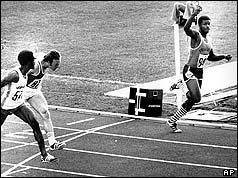
The opening ceremony of the 21st Olympic Games in Montreal was marked by the withdrawal of more than twenty African countries, Iraq and Guyana, and their 300 athletes. They had demanded that New Zealand be banned from participation because its national rugby team had toured South Africa, itself banned from the Olympics since 1964 for its refusal to end the racially separatist policy of apartheid.
|
| The Soweto Massacre, in which 150 children were killed by South African troops, had occurred just one month earlier. The apartheid government had been using international sport as a means to build respectability. The following year, however, in reaction to the Olympic boycott, the nations of the British Commonwealth (which includes New Zealand)adopted the Gleneagles Agreement, discouraging all sporting contacts with South Africa. |
| African countries boycott Olympics |
Gleneagles Agreement |
|
Fighters of the Sandinista National Liberation Front overthrew the U.S.-supported dictatorial regime of Anastasio Somoza in the Central American republic of Nicaragua and forced him to flee the country. The notorious and feared U.S.-trained National Guard crumbled and its surviving commanders negotiated a surrender, despite their superiority in armaments. |
| The Sandanista
Revolution |
 Anastasio
Somoza Anastasio
Somoza |
|
 |
Girls
born after the historic Sandinista victory.
Legal voting age
in Nicaragua is 16 years. |
The overthrow: Sandinista rebels take Nicaraguan capital
|
|
| Great Britain, under the leadership of William Gladstone, passed a law requiring voting by secret ballot. Previously, people had to mount a platform in public and announce their choice of candidate to the officer who then recorded it in the poll book. Secrecy served to prevent the possibility of coercion and retaliation for one’s vote. |
 |
| A
ballot box used in the 1872 election. |
|
|
 Mandela
photo gallery Mandela
photo gallery
|
Nelson Mandela was born. He was one of the leaders in the successful fight against apartheid in South Africa and became its first black president. In 1993 he was awarded the Nobel Peace Prize.
|
| |
 |
|
| Mandela at 19 |
A short bio of Nelson Mandela by the Nobel Committee |
|
| The first Women's Rights Convention in the U.S. was held at Seneca Falls, New York. Its “Declaration of Sentiments” launched the movement of women to be included in the constitution. |
The Declaration used as a model the U.S. Declaration of Independence, demanding that the rights of women as individuals be acknowledged and respected by society. It was signed by sixty-eight women
and thirty-two men.
The impetus came from Elizabeth Cady Stanton and Lucretia Mott, both of whom had been excluded, along with all the other female American delegates, from the World Anti-Slavery Convention (London, 1840) because of their sex.
|
 |
| Frederick Douglass, the former slave and abolitionist leader attended the convention and supported the resolution for women’s suffrage.When suffrage finally became a reality in 1920, seventy-two years after this first organized demand in 1848, only one signer of the Seneca Falls Declaration, Charlotte Woodward, then a young worker in a glove manufactory, had lived long enough to cast her first ballot. |
| The Seneca Falls Convention and the Early Suffrage Movement |
|
| Several black teenagers, members of the local NAACP chapter (National Association for the Advancement of Colored People), entered downtown Wichita’s Dockum Drug Store (then the largest drugstore chain in Kansas) and sat down at the lunch counter. |
 Wichita sit-in sculpture Wichita sit-in sculpture |
The store refused to serve them because of their race. They returned at least twice a week for the next several weeks. They sat quietly all afternoon, creating no disturbance, but refused to leave without being served. Though the police once chased them away, they were breaking no law, only asking to make a purchase, a violation of store policy. |
This was the first instance of a sit-in to protest segregationist policies. Less than a month later, a white man around 40 walked in and looked
at those sitting in for several minutes. Then he looked at the store manager, and said, “Serve them. I'm losing too much money.”
That man was the owner of the Dockum drug store chain.
That day the lawyer for the local NAACP branch called the store’s state offices, and was toldby the chain’s vice president that “he had instructed all of his managers, clerks, etc. (statewide), to serve all people without regard to race, creed or color.” |
|
| Martha Tranquill of Sacramento, California, was sentenced to nine months’ prison time for refusing to pay her federal taxes as a protest against the Vietnam War. |
|
President Bill Clinton announced regulations to implement his "Don't Ask, Don't Tell" policy regarding gays in the military, saying that the armed services should put an end to “witch hunts.” The policy was developed by General Colin Powell, then Chair of the Joint Chiefs of Staff, and eventually summarized as “don’t ask, don’t tell, don’t pursue, don’t harass.” |
|
A federal administrative law judge ordered white supremacist Ryan Wilson to pay $1.1 million in damages to fair housing advocate Bonnie Jouhari and her daughter, Dani. The decision stemmed from threats made against Jouhari by Wilson and his Philadelphia neo-Nazi group, ALPA HQ.
|

|
| Bonnie
and Dani Jouhari |
|
|

|
The first Black Power conference was held in Newark, New Jersey, calling on black people in the U.S. “to unite, to recognize their heritage and to build a sense of community.”
Read
more
|
|
The first labor contract in the history of the federal government was signed by postal worker unions and the newly re-organized U.S. Postal Service. This contract was made possible by the postal strike of March 1970, in which 200,000 postal workers walked off the job, defying federal law. |
|

|
Prior to that, postal worker salaries started at $6,200 a year, and many postal workers were eligible for food stamps. The strike was not organized by a national union; it started when rank-and-file workers walked off the job in New York City and it spread to other parts of the country.
The strike led to federal legislation that allowed postal unions to negotiate a contract with postal management (previously, postal salaries were set by Congress), with provisions for arbitration if no agreement were reached. |
Since that time, postal unions have successfully negotiated or arbitrated wages and benefits that provide a secure standard of living for their members. |
Read
about the history of the APWU
(American Postal Workers Union) |
|
|
Publication
of "Eight Hours," written by Reverend Jesse H. Jones
(music) and I.G. Blanchard (lyrics), the most popular labor
song until "Solidarity Forever" was published
by the IWW (Industrial Workers of the World) in 1915.
“Eight
hours for work,
Eight hours for rest;
Eight hours for what we will.”
All
the lyrics
|
 |
The
eight-hour was an established concept before the song.
Shown
is an 1856 banner from Melbourne, Australia. |
|
The so-called "Monkey Trial" ended in Dayton, Tennessee, with high school teacher John T. Scopes convicted of violating a state law against teaching Darwin's theory of evolution. It was considered illegal to contradict the Bible’s description of God’s seven-day creation of the world in Genesis.
The trial pitted two of America’s leading advocates as the opposing lawyers: William Jennings Bryan, thrice the Democratic presidential candidate (1896, 1900, 1908) and the state’s prosecutor; Clarence Darrow, a lawyer famous for representing the underdog, at the defense table. Referred to as “the trial of the century” even before it began, it was the first trial ever broadcast (on radio).
Bryan became ill and died shortly after the trial’s end; the conviction was later overturned by Tennessee’s Supreme Court. |
 |
|
 |
|
 |
The Defendant
John
T. Scopes
|
|
The Attorneys: Darrow & Bryan |
|
The
Verdict:
Thou Shall Not Think |
Interest
in the trial by the populace and the media (and the heat
in the courtroom) prompted Judge John T. Raulston to
move the trial outdoors to the courthouse lawn. Bryan
himself was called as a witness on the literal interpretation
of scripture.
Attorney General Thomas Stewart, in response to Darrow’s questioning, asked, "What
is the meaning of this harangue?" "To show up fundamentalism," shouted
Mr. Darrow, "to prevent bigots and ignoramuses from controlling the educational
system of the United States."
Mr. Bryan sprang to his feet, his face purple, and shook his fist in Darrow’s
face:
"To protect the word of God from the greatest atheist and agnostic
in the United States."
|
|
Major world powers, meeting in Geneva, Switzerland, reached agreement on the terms of a ceasefire for Indochina, ending nearly eight years of war. The war began in 1946 between nationalist forces of the Communist Viet Minh, under leader Ho Chi Minh, and France, the occupying colonial power after the Japanese lost control during World War II.
The Geneva conference included France, the United Kingdom, the U.S., the U.S.S.R., People’s Republic of China, Cambodia, Laos, and both Vietnamese governments (North and South).
|
 |
|
The peace treaty called for independence for Vietnam and a 1956 election to unify the country. However, only France and Ho Chi Minh's DRV (Democratic Republic of Vietnam (North)) signed the document.
The United States did not approve of the agreement. Instead, they backed Emperor Boa Dai and Prime Minister Ngo Dinh Diem’s government in South Vietnam and refused to allow the elections, knowing, in President Eisenhower’s words, that “Ho Chi Minh will win.” The result was the Second Indochina War, more commonly known as the Vietnam War. |
The
treaty is signed |
|

Plaza de Mayo mother
|
A military junta under General Jorge Rafael Videla took power in Argentina on March 24, disbanding parliament and taking over all labor unions. The military kidnapped hundreds of people from two villages of Jujuy province in northern Argentina, thirty of whom never returned from a clandestine detention center. Most of those disappeared worked for the Ledesma sugar refinery.
Since 1983, on the Thursday closest to July 21, Madres de Plaza de Mayo (an organization of mothers and wives of the missing) are joined by others, and walk the 7 km (4.3 miles) from Calilegua to San Martin, demanding answers about their loved ones. |
| Madres de Plaza de Mayo is supported by Amnesty International and the United Nations Human Rights Commission. |
| Read more |
|
|

|
The “The Friendly Association for gaining and preserving Peace with the Indians by Pacific Measures.” was founded in Philadelphia. It was comprised primarily of Quakers (members of the Society of Friends) who wished to pursue peaceful coexistence between the native peoples and the European immigrants to the Pennsylvania region.
|
| Quakers and Indians |
|
|
A general strike, part of the railroad strike that had paralyzed the country, was called in St. Louis, where workers briefly seized control of the city. Within a week after it began in Martinsburg, West Virginia, the railroad strike reached East St. Louis,Illinois, where 500 members of the St. Louis Workingmen's Party joined 1,000 railroad workers and residents.
|
 |
Strikers in St. Louis continued operation of non-freight trains themselves, collecting the fares, making it impossible for the railroads to blame the workers for loss of passenger rail service. |
More
about the 1877 general strike
|
|
Federal Judge Claude Clayton issued an injunction ordering the police of Grenada, Mississippi, to stop interfering with lawful protest, ordering them instead to protect demonstrations, and requiring certain rules to be set down for the conduct of marches.
This ruling followed weeks of arrests and beating of demonstrators who had been attempting to integrate all the businesses and other institutions in their town. |
|
| President Ronald Reagan signed into law the Stewart B. McKinney Homeless Assistance Act (named for a member of Congress from Connecticut) which provided emergency relief provisions for shelter, food, mobile health care, and transitional housing for homeless Americans. |
| More about the act |
|
|
Author
Henry David Thoreau was jailed for refusing to pay the
poll tax as a protest against the Mexican war, which
in turn led to his writing "Civil Disobedience." This
essay became a source of inspiration for Leo Tolstoy,
Mahatma Gandhi, and Martin Luther King, Jr.
From Thoreau’s essay:
“Unjust laws exist: shall we be content to obey them, or shall we endeavor to amend them, and obey them until we have succeeded, or shall we transgress them at once?” |
 |
| Daguerreotype of Henry David
Thoreau |
Out
of Thoreau's jailing grew a legend: The great Ameriacan
philosopher Ralph Waldo Emerson visited Thoreau in
jail. Emerson asked, "Henry,
why are you here?" Thoreau
replied, "Why are you not here? Under a government which imprisons unjustly, the true place for a just man is also a prison." |
Thoreau
was not alone in his opposition: Thomas Corwin of Ohio denounced
the war as merely the latest example of American injustice
to Mexico: “If I were a Mexican I would
tell you, ‘Have
you not room enough in your own country to bury your dead.’ ” Henry
Clay [former speaker of the House and presidential candidate]
declared, "This is no war of defense, but
one of unnecessary and offensive aggression."
Abraham
Lincoln also opposed the war, and lost his seat in Congress
as a result.
|
The
entire essay (in annotated form) |
|
| Detroiters angry at loss of jobs and, especially, at the abusive and virtually all-white police department, started rioting in what became known as the Detroit Rebellion. |
The intitiating incident was an early-morning raid on a blind pig (Detroit for after-hours drinking club) on 12th Street.
The violence spread elsewhere in the city, and led to President Lyndon Johnson’s calling out 8000 members of the National Guard. Order was not restored for six days.
|
 |
| In the end, there were 43 known dead, 347 injured, 3800 arrested, 1000 families homeless. Thirteen hundred buildings burned to the ground and twenty-seven hundred businesses were looted. |
| Online
documentary on all aspects of what happened, “Ashes
to Hope” |
| The Rebellion from a 40-year perspective” |
|
|
The United States Supreme Court (U.S. v. Nixon) unanimously ordered President Richard Nixon to surrender tape recordings of White House conversations regarding the Watergate affair. Speaking for the Supreme Court in front of a packed and hushed courtroom, Chief Justice Warren E. Burger (a Nixon appointee) rejected President Nixon's claims of executive privilege (virtually total confidentiality for the White House) because the need for fair administration of criminal justice must prevail.
|
 |

|
The White House feared review of the recordings by a U.S. district judge would reveal, among other crimes, impeachable offenses.
Listen to the tapes online
|
|
|
Canadians and Americans spanned the international border at Thousand Islands Bridge, linking New York and Ontario, to protest nuclear weapons and border harassment of peace activists. |
 |
| Thousand
Islands Bridge |
|
|
Women tagged a U.S. warplane with anti-nuclear graffiti at Greenham Common, an air base in England. The Greenham Common Women's Peace Camp had been set up just outside the perimeter of the base in 1981 to get U.S. Cruise missiles, some of which were deployed at the base, out of their country. Other tactics included disrupting construction work at the base, blockading the entrance, and cutting down parts of the fence.
|

|
Read
more about The Greenham Common Women's Peace Camp |
|
With 16,000 troops, the United States invaded Puerto Rico at Guánica, asserting that they were liberating the inhabitants from Spanish colonial rule, which had recently granted the island’s government limited atonomy. The island, as well as Cuba and the Philippines, were spoils of the Spanish-American War which ended the following month. Puerto Rico remains a U.S. commonwealth today.
|
 |
| N.Y.
17th Volunteer Regiment marching through Puerto Rico |
Famed
American poet Carl Sandburg saw active service in Puerto
Rico, beginning with the invasion in Guánica. Sandburg
wrote about these experiences in his book entitled “Always
the Young Strangers”
(New York: Harcourt,
Brace, 1953). |
More
on the invasion |
|
|

|
The first underwater atomic device was detonated at Bikini Atoll, one of the Marshall Islands in the South Pacific. It was the second of two bombs, Able and Baker, that comprised Operation Crossroads; each weapon had a yield equivalent to 23,000 tons of TNT (23 kilotons). |
The U.S. Navy conducted the tests to determine the effect of such weapons on ships at sea.More
than 130 newspaper, magazine and radio correspondents
from seven nations were present for the tests. |
 |
| More on Operation Crossroads |
|
The National
Security Act of 1947 was passed by Congress, uniting the
armed forces under control of the National Military Establishment,
which soon became Defense, the only cabinet-level military
department, in place of separate ones for War, Army and Navy.
The law also created the National Security Council, the Central
Intelligence Agency, and gave statutory responsibility to
the
Joint Chiefs of Staff. |
|
The Limited Test Ban Treaty was initialed following 10 days of intense negotiations among the the U.S.S.R.*, U.S. and United Kingdom. The treaty prohibits nuclear weapons tests “or any other nuclear explosion” in the atmosphere, in outer space, or under water; it does not ban underground tests. The nuclear powers (only three then, nine today) accepted as a common goal “an end to the contamination of man's environment by radioactive substances.” 185 countries have signed the treaty so far but Israel, Pakistan, Iran and North Korea never signed or later withdrew.
*
Union of Soviet Socialist Republics, commonly referred
to as the Soviet Union, included Russia and 14 countries
and was dissolved in the early ‘90s. |
| Status of Nuclear Weapons States and Their Nuclear Capabilities |
|
|
Martin Luther King, Jr., participated in protests against housing segregation in Chicago. His Southern Christian Leadership Conference (SCLC) joined with the Coordinating Council of Community Organizations (CCCO), led by Al Raby, a black schoolteacher, in the Chicago Freedom Movement.
More
on the CCCO |
 |
Martin
Luther King talks to Al Raby of Chicago's Coordinating
Council of Community Organizations (CCCO)
as
they lead the march down State Street.
To
King's right is Jack Spiegel of the United Shoeworkers,
and to Raby's left is King assistant Bernard Lee. |
|
In his first move to overthrow the U.S.-backed
dictatorship of Cuban leader Fulgencio Batista, 26-year-old
Fidel Castro led 134 other young revolutionaries to unsuccessfully
attack the Moncada military barracks in Santiago de Cuba.
Castro had concluded that armed struggle was the only way
to unseat Batista, who had taken power in a military coup
in 1952.
The Cuban Revolution is known as the July 26 Movement,
and is celebrated annually there. |
 |
| The
Moncada Barracks, still showing a few bullet holes and pockmarks
from that fateful early morning assault in 1953, is now both
a historic site and an elementary school. |
|
H. Rap Brown, then head of the Student Nonviolent Coordinating Committee (SNCC) was ordered arrested by then-Governor Spiro Agnew, who accused him of inciting a riot through his speech two days earlier at a civil rights rally in Cambridge, Maryland.
At the event, Brown declared, “Black folks built America, and if America don’t come around, we’re going to burn America down . . . If Cambridge doesn't come around, Cambridge got to be burned down.” |
|
Shortly after the speech, Brown was hit in the head by buckshot from a policeman’s shotgun. That night the segregated elementary school on the black side of town and 20 businesses burned down (there was no looting), some along Race Street, the racial divide which neither black nor white were expected to cross.
|
 |
H. Rap Brown
following the disturbances
in
Cambridge, Maryland. |
| What
happened in Cambridge |
|
The Americans with Disabilities Act (ADA) was signed into law by President George H.W. Bush. It prohibited discrimination based on disability in employment, in public accommodation (e.g., hotels, restaurants, retail stores, theaters, health care facilities, convention centers), in transportation services, and in all activities of state and local governments.
The law did not go into effect until January 26, 1992.
|

|
| ADA - Findings, Purpose, and History |
|
A riot began in Chicago when police refused to arrest a white man who was responsible for the death of a young black man, Eugene Williams. The 29th Street Beach on Lake Michigan was used by both black and white Chicagoans. But the man had been throwing stones at the black boys swimming there before hitting Williams. |
 |
The Coroner’s report on the riot described the events as follows: “Five days of terrible hate and passion let
loose, cost the people of Chicago 38 lives (15 white and 23
colored), wounded and maimed several hundred, destroyed property
of untold value, filled thousands with fear, blemished the
city and left in its wake fear and apprehension for the future
. . . .”
The city’s booming economy, especially jobs in the stockyards, had drawn many blacks during the Great Migration from the South, more than doubling their population in just three years. Only one policeman died in the chaos, Patrolman John Simpson, 31, an African American working out of the Wabash Avenue Station. |
Gangs and the 1919 Chicago Race Riot. |
|
| After three years of bloody and frustrating war leading to stalemate, the United States, the People’s Republic of China and North Korea agreed to a truce, bringing the Korean War—and America's first experiment with the Cold War concept of “limited war”—to an end (South Korean President Syngman Rhee opposed the truce and refused to sign). U.S. President Dwight Eisenhower had taken office six months earlier, and Soviet leader Josef Stalin had died that March. |

Korean
War Memorial
photo:
Heather Stanfield |
The armistice signed this day ended hostilities and created the 4000-meter-wide (2.5 miles) demilitarized zone (DMZ), a buffer between North and South Korean forces, but was not a permanent peace treaty. It also set up a system for exchanging prisoners of war: 12,000 held by the North, 75,000 by South Korea, the U.S. and the U.N. allied forces.
|
| There were four million military and civilian casualties, including 16,000 from countries which were part of the U.N.-allied forces; 415,000 South and 520,000 North Koreans died.There were also an estimated 900,000 Chinese casualties. 36,516 died out of the nearly 1.8 million Americans who served in the conflict. |
|
| The democratically elected Guatemalan government of Jacobo Arbenz Guzmán, after receiving 65% of the vote, was overthrown by CIA-paid and -trained mercenaries. There followed a series of military dictatorships that waged a genocidal war against the indigenous Mayan Indians and against political opponents into the '90s. Nearly 200,000 citizens died over the nearly four decades of civil war. |
| “They have used the pretext of anti-communism. The truth is very different. The truth is to be found in the financial interests of the fruit company [United Fruit, which controlled more land than any other individual or group in the country. It also owned the railway, the electric utilities, telegraph, and the country's only port at Puerto Barrios on the Atlantic coast.] and the other U.S. monopolies which have invested great amounts of money in Latin America and fear that the example of Guatemala would be followed by other Latin countries . . . I took over the presidency with great faith in the democratic system, in liberty and the possibility of achieving economic independence for Guatemala.” |
 Jacobo Arbenz Jacobo Arbenz |
| More about Arbenz |
The real coup story through official U.S. documents |
|
|

|
Known as the “Weep for Children Plowshares,” four women were arrested for pouring their own blood on weaponry at the Naval Submarine Base at Groton, Connecticut, on the morning of the launch of the last-built Ohio-class submarine, the U.S.S. Louisiana. The 18 such submarines carry about half of the U.S. nuclear deterrent – 24 Trident I & II missiles with a range of 7400 km (4600 miles), each with several warheads known as MIRVs (multiple independently targeted re-entry vehicles). |
| Trident
sub being loaded |
Details of the action |
|
Passed in the wake of the Civil War, the Fourteenth Amendment to the U.S. Constitution, guaranteeing due process, equal protection of the law, and full citizenship to all males over 21, including former slaves,
went into effect. |
 |
| More on the amendment and
the context of post-Civil War Reconstruction |
Booklet on the 14th Amendment from the Damon Keith Collection of
African-American Legal History at Wayne State University Law School
|
|
 Anti-Lynching Parade in New York City, 1917 Anti-Lynching Parade in New York City, 1917 |
W.E.B. DuBois and others organized a silent parade down Fifth Avenue in New York City against the lynching of negroes and segregationist Jim Crow laws. There had been nearly 3,000 documented cases of hangings and other mob violence against black Americans since the Reconstruction period following the Civil War. |
Read about W.E.B. DuBois
|
Strange Fruit, the song about lynching, and the film |
|
 |
Federal troops, under command of General Douglas MacArthur, forcibly dispersed the so-called “Bonus Expeditionary Force,” or Bonus Army. They were World War I veterans who had gathered in Washington, D.C., to demand money they had been promised but weren't scheduled to receive until 1945. Most of the marchers were unemployed veterans in desperate financial straits during the Great Depression. |
| Bonus Marchers on the Capitol Steps |
|
 |
President Lyndon Johnson ordered 50,000 troops to Vietnam to join the 75,000 already there. By the end of the year 180,000 U.S. troops will have been sent to Vietnam; in 1966 the figure doubled. In addition to countless Vietnamese deaths, close to 1900 Americans were killed in 1965; the following year the number more than tripled.
David Douglas Duncan, photographer. |
Lyndon Johnson told the nation
Have no fear of escalation
I am trying everyone to please
Though it isn’t really
war
We’re sending fifty thousand more
To help save Vietnam from Vietnamese |
|
President Johnson explained: “We intend to convince the communists that we cannot be defeated by force of arms or by superior power.” |
"Pfc.
John L. Lewis decorates his helmet with good luck tokens.
[Khe Sanh, February 1968.]" Life [Asia edition]. 18 Mar.
1968. cover. |
— part of Tom Paxton’s anti-Vietnam-war song, “Lyndon Johnson Told the Nation”
Full lyrics of the song |
|
| San Francisco became the first U.S. city to ban the sale and possession of handguns. The law was struck down by state courts, which ruled the local law to be in violation of the California constitution which gives the state the sole power to regulate firearms. |
|
 |
After a five-year strike, the United Farm Workers (UFW) signed a contract with the table grape growers in California, ending the first grape boycott. |
|
| Signing the contract |
Exploring the United Farm Workers' History |
|
The U.S. Supreme Court ruled the death penalty to be cruel and unusual punishment by a 5-4 vote. The Court called the wide discretion in application of capital punishment, including the appearance of racial bias against black defendants, “arbitrary and capricious” and thus in violation of due process guarantees in the 14th Amendment
[see July 28, 1868]. |
| Influence
of race on imposition of the death penalty |
|
The same month Christopher Columbus set sail from Spain for his “expedition of discovery to the Indies” [actually the Western Hemisphere], was the deadline for all “Jews and Jwesses of our kingdoms to depart and never to return . . .” lest they be executed. Under the influence of Fr. Tomas de Torquemada, the leader of the Spanish Inquisition, King Ferdinand and Queen Isabella had ordered the expulsion of the entire Jewish community of 200,000 from Spain within four months. Spain’s Muslims, or Moors, were forced out as well within ten years.
|
 |
The
edict of expulsion from Spain signed by
King Ferdinand
and Queen Isabella |
All were forced to sell off their houses, businesses and possessions, were pressured to convert to Christianity, and to find a new country to live in. Those who left were known as Sephardim (Hebrew for Spain), settling in North Africa, Italy, and elsewhere in Europe
and the Arab world.
Most went to Portugal, were allowed to stay just six months, and then were enslaved under orders of King John. Those who made it to Turkey were welcomed by Sultan Bajazet who asked, “How can you call Ferdinand of Aragon a wise king, the same Ferdinand who impoverished his own land and enriched ours?” |
|
Four Ploughshares activists in Liverpool, England, were acquitted of all charges (illegal entry and criminal damage) on the basis of their having prevented a greater crime, after having extensively damaged an F-16 Hawk fighter jet to be sold to the Indonesian government for use in its genocidal occupation of East Timor.
|
 |
Seeds of Hope-East Timor Ploughshares:
the action and the aftermath
|
|
| The National Association of Colored Women (NACW) was established in Washington, D.C. Its two leading members were Josephine Ruffin and Mary Church Terrell. Founders also included some of the most renowned African-American women educators, community leaders, and civil-rights activists in America, including Harriet Tubman, Frances E.W. Harper, Margaret Murray Washington, and Ida B. Wells-Barnett. |
 |
| Mary Church Terrell |
| The original intention of the organization was “to furnish evidence of the moral, mental and material progress made by people of colour through the efforts of our women.” However, over the next ten years the NACW became involved in campaigns favoring women's suffrage and opposing lynching and Jim Crow laws. By the time the United States entered the First World War, membership had reached 300,000. |
The NACW and its founders |
|
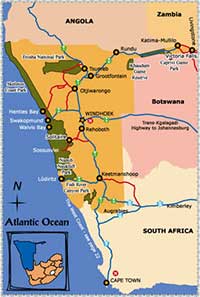
| 25,000 people rallied in Namibia for freedom from South African colonial rule. In June, 1971 the International Court of Justice had ruled the South African presence in Namibia to be illegal. Eventually, open elections for a 72-member Constituent Assembly were held under U.N. supervision in November, 1989. Three months later Namibia gained its independence, and maintains it today. |
 |
| More on Namibia’s independence |
 Namibian flag Namibian flag |
|
The United States and the Soviet Union, represented by President George H.W. Bush and General Secretary Mikhail Gorbachev, signed the Strategic Arms Reduction Treaty, known as START I. It was the first agreement to actually reduce (by 25-35%) and verify both countries’ stockpiles of nuclear weapons at equal aggregate levels in strategic offensive arms.
The Soviet Union dissolved several months later, but Russia and the U.S. met their goals by December, 2001. Three other former republics of the U.S.S.R., Kazakhstan, Belarus and Ukraine, have eliminated these weapons from their territory altogether. |
| Comprehensive
info from the Federation of American Scientists: |
|
JULY 1 2 3 4 5 6 7 8 9 10 11 12 13 14 15 16 17 18 19 20 21 22 23 24 25 26 27 28 29 30 31
visit
another month
Jan
• Feb
• March • April
• May • June
• July
• Aug • Sept
• Oct • Nov
• Dec |
We make custom buttons
your design or ours
email your idea and info |
|
If you are not already on our email list and would like to have our free calendar delivered to your inbox then please . . .
|
 |
Sign up for our
Peace and Social Justice history newsletter.
Just send me an email |
|
|
Please
support this newsletter visit
peacebuttons.info
Because of your support peacebuttons has been able to donate to
several peace and justice organizations.
see list
Thank you ! |
|
| |
|


 Irene Morgan


