| |
 |
William
Lloyd Garrison first published The Liberator (four hundred
copies printed in the middle of
the night using borrowed type), which became the leading abolitionist
paper in the United States. He labeled slave-holding a crime
and called for immediate abolition.
From the first issue: “I
will be harsh as truth, and uncompromising as justice. On this
subject, I do not wish to think, or speak, or write with moderation. |
| William
Lloyd Garrison |
“Assenting
to the ‘self-evident truth’ maintained in
the American Declaration of Independence, ‘that
all men are created equal, and endowed by their Creator
with certain unalienable rights—among which are
life, liberty,
|
 |
| and the pursuit of happiness,’ I
shall strenuously contend for the immediate enfranchisement
of our slave population.” |
Selections from The Liberator 
|
The Liberator achives |
|
Michigan
became the first state – the first government in the
English-speaking world – to abolish capital punishment
(for all crimes except treason). This was done by a vote
of the legislature, and was not a part of the state’s
constitution until 1964. |
How
it happened: |
|
32-year-old
lawyer Fidel Castro led Cuban revolutionaries to victory
over the corrupt government of Fulgencio Batista who
had fled the island the day before. Batista, a former
army sergeant, had seized power in a coup, canceling
an election, in 1952.
|
 Fidel Castro Fidel Castro |
| More
on pre-Castro Cuba: |
The
news at the time |
| Perspective
of a U.S. intelligence agent: |
|
44
women scaled a 12-foot fence at dawn, breaking into a cruise
missile base at Greenham Common in Great Britain, and danced
on a missile silo. |
| The
lyrics to their “Silo Song”: |
|
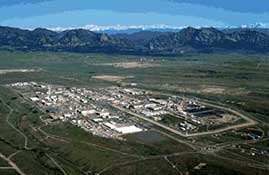
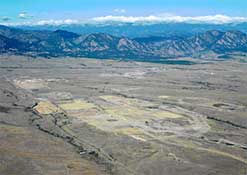
| Ten
anti-nuclear activists were arrested for trespassing at
the Nevada Test Site, the culmination of a 54-day encampment
at the main Test Site gate. The camp established momentum
for what became a movement ultimately involving over 10,000
arrests in numerous Test Site protests over the following
years in the campaign to achieve a freeze of all nuclear
weapons testing.
|
 Nevada test site landscape Nevada test site landscape |
| The Nevada site includes more than 14,000 sq. km. (nearly 6000
sq. miles, larger than the state of Connecticut) of uninhabited
land where atmospheric, and later underground, nuclear testing
had been conducted since the 1950s. |
| About
the the Nevada Test Site |
|
| 
|
Kees
Koning, a former army chaplain and priest, and Co van Melle,
a medical doctor working with homeless people and illegal
refugees, entered the Woensdrecht airbase (for a second
time), and began the “conversion” of NF-5B
fighter airplanes by beating them with sledgehammers into
ploughshares. The Dutch planned to sell the NF-5B to Turkey,
for use against the Kurdish nationalists as part of a NATO
aid program which involved shipping 60 fighter planes to
Turkey. Koning and van Melle were charged with trespass,
sabotage and $350,000 damage; they were convicted, and
both sentenced to a few months in jail. |
| Kees
Koning |
| Read
more about the plowshares movement |
|
| Early
in the morning Moana Cole, a Catholic Worker from New Zealand,
Ciaron O’Reilly,
a Catholic Worker from Australia, and Susan Frankel and Bill
Streit, members of the Dorothy Day Catholic Worker community
in Washington, D.C., calling themselves the ANZUS (Australia,
New Zealand and U.S.) Peace Force Plowshares, entered the Griffiss
Air Force Base in Rome, New York. |
|

|
After
cutting through several fences, Frankel and Streit entered
a deadly force area, and
hammered and poured blood on a KC-135 (a refueling plane
for B-52s), and then hammered and poured blood on the engine
of a nearby cruise missile-armed B-52 bomber. They presented
their action statement to base security who encircled them
moments later. |
| Moana
Cole |
| About Moana Cole |
|
| The North American Free Trade Agreement (NAFTA) took effect.
A treaty among Canada, the U.S. and Mexico, it called for
all three countries to follow similar policies for environmental,
safety and investment regulation, apart from laws passed
by their respective legislatures. |
|
On
the day NAFTA (see above) took effect, more than 2,000 native
Mayans in Mexico’s Chiapas state marched into the state
capital, San Cristóbal de las Casas, and five neighboring
towns, and seized control. Calling themselves Zapatistas,
or the Zapatista Army of National Liberation (EZLN), a "declaration
of war" was issued.
Chiapas is among the poorest parts of Mexico. The indigenous
peoples of Mexico long suffered as second-class citizens due
to the dominance of the Roman Catholic church and the traditional
Mestizo (mixed Spanish and Indian ancestry) political leadership
of the country. The EZLN was certain that NAFTA would permanently
lock in the top-down economic situation in Mexico. The Zapatistas’ slogan
was !Ya basta! ("Enough is enough").
Employees at the Mexican stock exchange were evacuated by riot
police. 25,000 Mexican soldiers arrived in Chiapas equipped
with automatic weapons, tanks, helicopters and airplanes. 145
deaths were reported, mostly civilians. Massive arrests and
subsequent torture of prisoners by the government took place. |
|
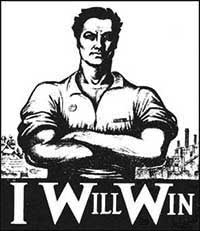
The
Conference of Industrial Unionists in Chicago formed
the Industrial Workers of the World (IWW), frequently
known as The Wobblies. The IWW mission was to form “One
Big Union” among industrial workers. |
|
 |
IWW
home |
|
| U.S. Attorney General Alexander
Palmer, in what were called the Palmer or Red raids, ordered
the arrest and detention without trial of 6,000 Americans,
including suspected anarchists, communists, unionists and others
considered radicals, including many members of the IWW. |
| 
|
This followed a mass arrest of thousands two months earlier
based on Palmer’s belief that Communist agents
from Russia were planning to overthrow the American
government.
A suicide bomber had blown off the front door of the newly
appointed Palmer the previous June, one in a series of coordinated
attacks that day on judges, politicians, law enforcement
officials, and others in eight cities nationwide. Palmer
put a young lawyer, J. Edgar Hoover, in charge of investigating
the bombings, collecting information on potentially violent
anarchists, and coordinating the mass arrests. |
| Attorney
General Alexander Palmer |
| More on the Palmer raids |
FBI
perspective |
|
|
A
U.S. Court ruled that John Lennon and his lawyers be given
access to Department of Immigration and Naturalization
files regarding his deportation case, to determine if the
government case was based on his 1968 British drug conviction,
or his anti-establishment comments during the years of
the Nixon administration.
On October 5, 1975, the U.S. Court of Appeals overturned
the order to deport Lennon, and he was granted permanent
residency status. |

|
| Watch
the trailer for the documentary, “The U.S. v. John
Lennon” |
 |
John Lennon pin |
| 1" diameter - satin finish |
| Union printed - made in Detroit. |
 |
|
|
|
 Khaleda
Zia Khaleda
Zia
|
An
estimated 100,000 Bangladeshi women traveled from the countryside
to attend a rally in Dacca, the capital, to protest Islamist
clerics' attacks on women's education and employment.
Khaleda
Zia, the country’s first female prime minister, had
introduced compulsory free primary education, free education
for girls up to class ten, a stipend for the girl students,
and food for the education program.
|
| About Khaleda Zia |
|
| A
nuclear reactor exploded at the National Reactor Testing
Station in Idaho Falls, Idaho, killing three military technicians,
and released radioactivity which, in the words of John A.
McCone, Director of the Atomic Energy Commission, was "largely
confined" to the reactor building. One technician was
blown to the ceiling of the containment dome and impaled
on a control rod. His body remained there until it was taken
down six days later. The men were so heavily exposed to radiation
that their hands and heads had to be buried separately with
other radioactive waste. |
|
| 
|
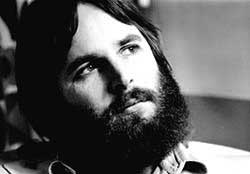
Carl Wilson of the the Beach Boys
was indicted for draft evasion.
Claiming conscientious objector
status, he eventually won his battle against the charges. |
Carl
Wilson |
|
| On
her first day as a member of Congress, Bella Abzug (D-New
York) introduced a resolution calling for the withdrawal
of troops from Southeast Asia. |
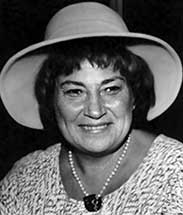 |
Born in the Bronx in 1920,
one month after the passage of the U.S. Constitution’s
19th amendment granting women the right to vote, she was
the first Jewish woman elected to Congress. After attending
Columbia University Law School, she practiced civil rights
and labor law for twenty-three years. Throughout her career,
she was known as one of the most vocal proponents of civil
rights for women, as well as for gays and lesbians. |
| Bella
Abzug |
| Background on the indomitable
Bella |
|
The
United States of America and the Russian Federation agreed
to cut the number of their nuclear warheads to between
3,000 and 3,500 (nearly half). |
U.S.
President George H.W. Bush, just before leaving office,
and his Russian counterpart, Boris Yeltsin, signed the
second Strategic Arms Reduction Treaty – Start II – in
Moscow. Start II marked the biggest reduction in nuclear
arms ever agreed, eliminating land-based multiple warhead
missiles, and putting limits on submarine-based missiles. |

|
| Read more |
|
| 
|
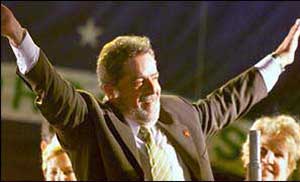
Brazil’s
new leftist president, Luiz Inacio Lula da Silva, suspended
purchase of 12 new fighter planes, saying money could be
better used to relieve hunger. |
| More about Luiz Inacio Lula da Silva |
|
|
The longest recorded labor strike ended after 33 years: Danish
barbers' assistants had begun their strike in 1938 in
Copenhagen. |
|
| The
Free Speech Movement held its first legal rally in Sproul
Plaza of the University of California at Berkeley. |
|
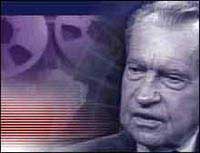
President
Richard Nixon refused to release tape recordings of Oval
Office discussions and other documents subpoenaed by the
Senate Watergate Committee investigating illegal activities
of the president’s re-election committee.
Nixon's attempted suppression didn't work. |
 |
| Listen
to the "smoking gun": |
|
|
With the Great War (World War I) entering its third year, British Prime Minister Herbert Asquith introduced the first conscription law in British history to the House of Commons, the Military Service Act. |
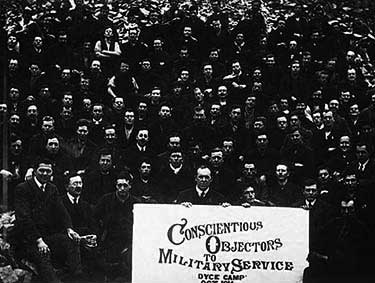 |
About 16,000 conscientious objectors refused to fight. Most
believed that even during wartime it was wrong to
kill another human being. About 7,000 agreed to perform
non-combat service; more than 1,500 refused all compulsory
service. They were usually drafted into military
units and, upon refusing to obey orders, were court-martialed. |
| World War I Conscientious Objectors, Dyce Camp, UK |
| Consequences of conscription |
|
| A
mass movement advocating political and economic reforms,
including increased freedom of speech, travel and an end
to state censorship, began in Czechoslovakia when Alexander
Dubcek came to power as the head of the Czechoslovakian
Communist Party. "We shall have to remove everything
that strangles artistic and scientific creativeness," he
said. The time later became known as “Prague Spring.”
|
Alexander
Dubcek 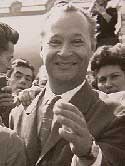 ”Socialism
with a human face” |
|
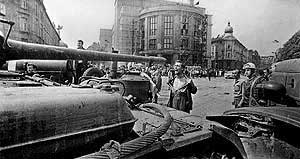
Soviet
tanks enter Prague, August 1968 |
| Read
more |
|
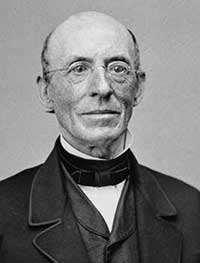
| William Lloyd Garrison, along with 15 others, founded the
New England Anti-Slavery Society at the African Meeting
House in Boston. |
| 
|
By 1833, Garrison helped establish
the American Anti-Slavery Society with fellow abolitionists
Arthur Tappan, Lewis Tappan, and Theodore Dwight
Weld. This organization sent lecturers across the
North to convince whites of slavery's brutality.
Garrison went on to be publisher of The Liberator, a newspaper
dedicated to education about, and the abolition of, slavery.
He published it until passage of the 13th Amendment which
made the practice unconstitutional.
|
William
Lloyd Garrison |
| Read
about the Anti-Slavery Society today |
About
William Lloyd Garrison |
|
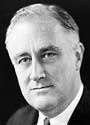
President
Franklin D. Roosevelt, in his 1941 State of the Union address,
introduced the idea of the "Four Freedoms": freedom
of speech and expression; freedom of every person to worship
God in his own way; freedom from want; and freedom from
fear. |
 |
| Excerpt
from his speech to the Joint Session of Congress: |
The
full text (pdf) |
|
|
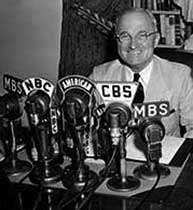
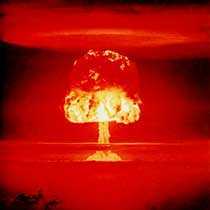
President Harry S. Truman
announced in his State of the Union address that the United
States had developed a hydrogen (fusion) bomb. |
 |
|
| The
U.S. District Court of Appeals ordered William Ruckelshaus,
the Environmental Protection Agency's first administrator,
to begin the de-registration procedure for DDT so that
it could no longer be used. |
| 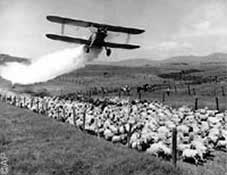 DDT
being sprayed next to livestock DDT
being sprayed next to livestock
|
It was a widely used pesticide in agriculture (principally
cotton).
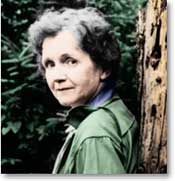
This happened nine years after the publication
of Rachel Carson's “Silent Spring”, a
book which cautioned about the dangers of excessive
use of pesticides and other industrial chemicals
to plants and animals, and humans.
|
Rachel
Carson |
Read
more about Rachel Carson |
|
Vietnamese
troops seized the Cambodian capital of Phnom Penh, toppling
the regime of Pol Pot and his Khmer Rouge, the Cambodian
Communist party. Pol Pot and his allies had been directly
responsible for the death of 25% of Cambodia’s population.
When he seized power in 1975, capitalism, Western culture,
city life, religion, and all foreign influences were to be
extinguished in favor of an extreme form of peasant Communism. |
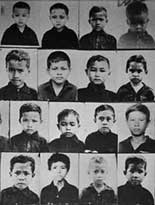 |
| Some
of the child victims of the Khmer Rouge |
|
All
foreigners were thus expelled, embassies closed, and any
foreign economic or medical assistance was refused. The use
of foreign languages was banned. Newspapers and television
stations were shut down, radios and bicycles confiscated,
and mail and telephone usage curtailed. Money was forbidden.
All businesses were shuttered, religion banned, education
halted, health care eliminated, and parental authority revoked.
Thus Cambodia was sealed off from the outside world.
|
|
All
of Cambodia's cities were then forcibly evacuated. At
Phnom Penh, two million inhabitants were evacuated on
foot into the countryside at gunpoint. As many as 20,000
died along the way. |
|
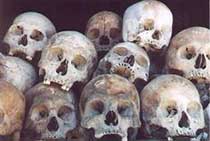
| Pol
Pot's legacy: Skulls of the killing fields |
|
 |
The
African National Congress was founded in South Africa.
The ANC (now multi-racial) was the first black political
organization in South Africa. It was formed to combat the
racially separatist system known in the Afrikaans language
as apartheid. The ANC is now the majority party in the
South African government. |
African National Congress history |
|
| The people
of France voted to grant Algeria its independence in a
referendum. This followed more than 130 years of French
colonial control of the north African country. The result
was a clear majority for self-determination, with 75% voting
in favor. |
Read
more |
|
| U.S. National
Security Advisor Henry Kissinger and North Vietnam's Le
Duc Tho resumed secret peace negotiations near Paris. |
| After the South Vietnamese had blunted the massive North Vietnamese
invasion launched in the spring of 1972, Kissinger and the
North Vietnamese had finally made some progress on reaching
a negotiated end to the war. However, a recalcitrant South
Vietnamese President Nguyen Van Thieu had inserted several
demands into the negotiations that caused the North Vietnamese
negotiators to walk out of the talks a month earlier. |
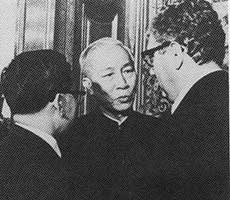 Le Duc Tho and Henry Kissinger Le Duc Tho and Henry Kissinger |
|
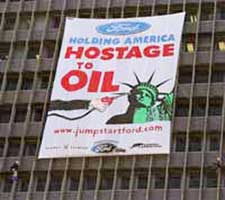 |
Three
activists, including Kate Berrigan (daughter of Phil)
and Liz McAlister,
rappelled down a 32-story skyscraper near the Los Angeles
Auto Show and unfurled a banner reading “Ford: Holding
America Hostage To Oil.” They had chosen Ford due
to its having the lowest average fuel economy of any auto
manufacturer, and that it was not living up to the reputation
it put forth as being an environmental car company. |
| Frida Berrigan tells the
story |
|
| Anti-U.S.
rioting broke out in the Panama Canal Zone, resulting in
the deaths of 21 Panamanians and three U.S. soldiers. The
immediate issue was whether both the U.S. and Panamanian
flags would fly at Canal Zone facilities, as ordered by
President John F. Kennedy. |
|
James
Jenkins, a 17-year-old senior at Balboa High School in the
Canal Zone:
"I guess you could say I'm the guy that started this
whole thing. I'm sort of the ringleader. I circulated the
petition to keep our flag flying. Then me and the others raised
the flag. The school authorities left it up because they knew
we'd walk out."
On the third day, demonstrating Panamanian students entered
the school grounds and sang their national anthem, but the
Balboa students blocked them from raising their flag. there
was a scuffle -- and the Panamanians retreated in outrage,
claiming that their flag had been ripped by the Zonians.
|
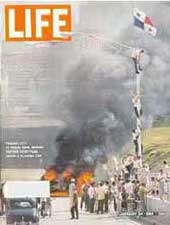 |
|
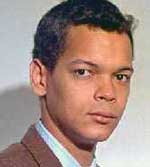
| Julian
Bond, elected more than a year before, was finally sworn
in as a member of
the Georgia House of Representatives. |
The
legislature had refused to allow him to take his seat because
of his opposition to the Vietnam War and specifically his
endorsement of a Student Nonviolent Coordinating Committee
(SNCC) statement accusing the United States of violating
international law in Vietnam. Bond had been the director
of SNCC.
Following his election in 1965, the Georgia House refused
to seat him. He was re-elected to his “vacant seat” and
the House refused again. He was then elected to the same office for a third time.
But not until the U.S. Supreme Court ruled unanimously in his
favor was the legislature forced to relent. |
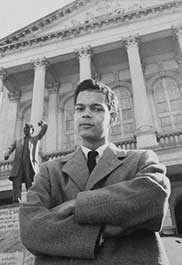 |
| Julian
Bond in 1966 waiting to be seated in the General Assembly |
|
|
The White House released the presidential finding – signed
by President Ronald Reagan on January 17, 1986 – which
authorized the sale of arms to Iran (to encourage the release
of hostages) and ordered the CIA not to tell Congress. This
was done retroactively after several shipments, including
18 HAWK (Homing-All-the-Way-Killer) surface-to-air missiles,
had already been transferred to the Iranians, then at war
with Saddam Hussein’s Iraq.
|
| Read
the actual document authorizing the arms sales |
More |
| Outline,
key players and selected Iran-Contra documents from the
National Security Archive |
|
| 
|
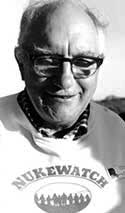
The day after the start of
the U.S. bombing of Iraq, ten peace activists were arrested
at Fort McCoy, Wisconsin, for handing out written warnings
to military reservists about participation in war crimes.
Long-time peace activist Sam Day was sentenced to four
months for his participation. |
| Remembering
Sam Day |
| Sam
Day |
|
| 
|
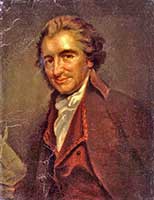
Thomas
Paine anonymously published his influential pamphlet, "Common
Sense". In it Paine questioned the fundamental legitimacy
of the rule of kings, and advocated the doctrine of independence
for Americans, and the rights of mankind. |
| The entire text: |
Thomas
Paine |
|
|
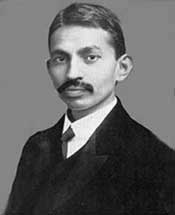
A prominent young Indian lawyer, Mohandas Gandhi, was jailed
for the first time. He had refused to register as an
Asian in Johannesburg, South Africa.
He
was released three weeks later. |
|
| Gandhi and how his time in South Africa affected his life |
| Gandhi,
1906 |
|
The
National Women’s
Party began regular picketing of the White House, advocating
the right to vote for women.
|
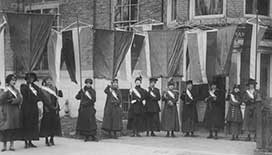 |
| The first suffrage picket
line leaving Congressional Union headquarters to march to
the White House gates. |
|
The
League of Nations formally came into being when its Covenant
(part of the Treaty of Versailles), ratified by 42 nations
in 1919, took effect.
In 1914, a political assassination in Sarajevo set off a chain
of events that led to the outbreak of the most costly war ever
fought to that date. As more and more young men were sent down
into the trenches, influential voices in the United States
and Britain began calling for the establishment of a permanent
international body to promote international cooperation and
to achieve international peace and security.
Though strongly supported by President Woodrow Wilson (who served
as Chairman of the Committee that developed the Covenant),
the U.S. never joined. |
| Photo archives of the League of Nations: |
|
| In December
1928, Mohandas Gandhi attended a session of the Indian National
Congress Party in Calcutta where it called for complete Indian
independence from Great Britain. This was to be achieved
through peaceful means, specifically complete noncooperation
with the governmental apparatus of colonial British rule,
known as the Raj.
On this day, Gandhi drafted the declaration, which stated,
in part:
"The
British government in India has not only deprived the Indian
people of their freedom but has based itself on the exploitation
of the masses, and has ruined India economically, politically,
culturally and spiritually. . . . Therefore . . . India must
sever the British connection and attain Purna Swaraj, or complete
independence."
|
|
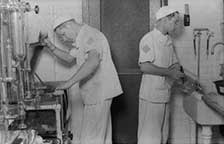
| Members
of the Brethren, Mennonites and Friends religious groups
sent a message to Presidend Franklin Roosevelt requesting alternative
service in the event of war. |
|
The Selective Training and Service Act of 1940 proclaimed
that all persons who “by reason of religious
training and belief were conscientiously opposed
to all forms of military service, should, if conscripted
for service, be assigned to work of national importance
under civilian direction.”
|
| Civilian Public Service workers
Clark and Kriebel in the Duke University's hospital sterilizer
room. |
| More
on those who refused to serve in the “good war” |
|
 |
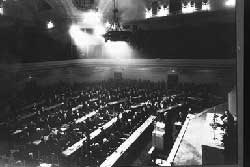
The
first General Assembly of the United Nations convened at
Westminster Central Hall in London, England, and included
51 nations.
|
|
On January
24, the General Assembly adopted its first resolution,
a measure calling for the peaceful uses of atomic energy
and the elimination of atomic and other weapons of mass
destruction. |
 |
|
| Vernon
Dahmer, a businessman and farmer in Hattiesburg, Mississippi,
offered to pay the poll tax for those who couldn’t
afford the fee that was then required before a citizen
could vote (and which was made unconstitutional in federal
elections by the 24th Amendment). |
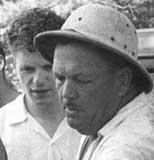 |
| Vernon
Dahmer (foreground) |
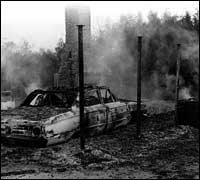 |
Dahmer
was known for saying, "If you don't vote, you don't count."
The night after a radio station broadcasted Dahmer’s
offer, his home and store were firebombed. Dahmer died later
from severe burns. The man responsible for the arson attack,
Ku Klux Klan Wizard Sam Bowers, was not tried and convicted
until 32 years later. |
| former home of Vernon Dahmer |
| The
poll tax and other means of disenfranchising African Americans |
|
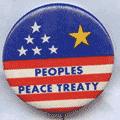
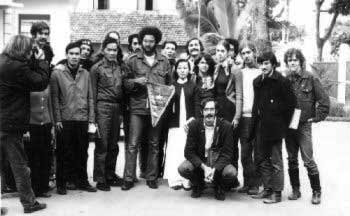
The Peoples' Peace Treaty
between the citizens of the U.S. and Vietnam was endorsed
by 130 organizations.
Several million North Americans later
signed it.
|
 |
| 
|
The treaty
had been signed in December by leaders from the South Vietnam
National Student Union, South Vietnam Liberation Student
Union, North Vietnam Student Union, and the (U.S.) National
Student Association in Saigon, Hanoi and Paris. It was
adopted this day by the New University Conference and Chicago
Movement meeting. |
| Peoples'
Peace Treaty organizers |
| Text
of
the treaty |
The People Make the Peace book |
| Article from
New York Review of Books by the National Student Association
with the text of the Treaty |
|
|
Guatemalan government officials and leftist guerilla movement
leaders agreed to negotiate to end 36 years of violent
conflict. |
|
|
The Peace Pledge Union organized "Operation Gandhi," which
became the first British protest against nuclear weapons. Ten
members staged a "sit-down" at the War Office in London. |
|
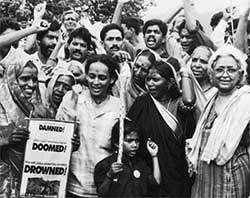
| Twenty-five
thousand occupied the site of one of 30 dams to be built
on the Narmada River in India. |
|
|
They objected to a World
Bank-funded project to build 30 large, 135 medium and
3000 small dams to harness the waters of the Narmada
and its tributaries to provide electrical power and irrigation
to Gujarat and Rajasthan provinces.Local
residents known as Narmada Bachao Andolan (Save the Narmada
movement), organized as they became concerned about their
livelihoods, the dams’ environmental impact and a
host of other issues.
|
| The
largest proposed dam, Sardar Sarovar, would submerge 61 villages
and displace more than 320,000 people. |
| A
Brief Introduction to the Narmada Issue |
International Rivers project |
|
| The
first of the detainees/enemy combatants arrived at Guantánamo
Bay, the U.S. military base on the southeastern coast of Cuba. |
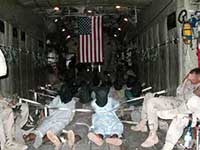 |
| Detailed
report of the status of Guantánamo detainees |
| Detainees in a plane on their
way to Guantanamo |
|
| Secretary
of State John Foster Dulles announced U.S. would go beyond
of President Harry Truman's doctrine of "containing
Communism" for a new policy: “. . . there is no
local defense which alone will contain the mighty landpower
of the Communist world. Local defenses must be reinforced
by the further deterrent of massive [nuclear] retaliatory
power.” |
| Dulles’s
complete speech to the Council on Foreign Relations |
|
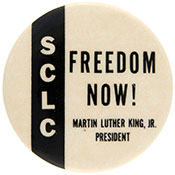
The
Southern Christian Leadership Conference (SCLC) was founded
by Dr. Martin Luther King, Jr. and other African-American
clergymen who wanted to press for civil rights long denied
members of their community. |
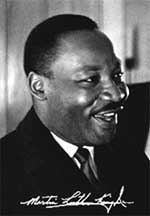
|
Sixty black ministers from
ten states went to Atlanta, Georgia, to set up the coordinating
group.
They elected King as its first president, with the
Reverend Ralph David Abernathy as treasurer. |
 |
| SCLC
history |
|
Federal
workers were guaranteed the the right to join unions and
bargain collectively after President John F. Kennedy signed
Executive Order 10988. |
| “Employees of the Federal
Government shall have, and shall be protected in the exercise
of, the right, freely and without feel of penalty or reprisal,
to form, join and assist any employee organization or to
refrain from any such activity.”
Eventually, regulation of labor-management relations in the
federal government was codified under the Civil Service
Reform
Act of 1978.
|
 President Kennedy signing
executive order President Kennedy signing
executive order |
|
| Reverend
Philip F. Berrigan, founder of the Catholic Peace Fellowship
anti-Vietnam War organization, was indicted along with five
others on charges of conspiring to kidnap National Security
Advisor Henry Kissinger, and to bomb the tunnels of federal
buildings in Washington, D.C. They became known as the Harrisburg
Seven. |
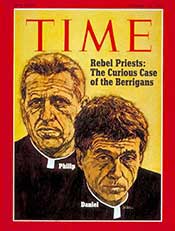 |
At the time, Berrigan was serving a six-year sentence at
a federal prison in Connecticut with his brother,
Daniel, for their destruction of military draft records
in Maryland during 1967-68. The Berrigans’ ethic
of nonviolence towards others made the charges questionable,
and eventually all six were acquitted of the conspiracy
charges.
Phil Berrigan and Elisabeth McAllister, later his wife, were
ultimately convicted and sentenced on just one count of smuggling
mail out of a federal penitentiary, the only person in history
to be prosecuted on such a charge.
|
| The
trial and the thin evidence presented |
More
about Philip Berrigan |
|
| 
|
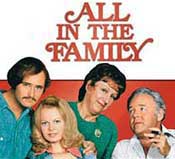
"All in the Family" premiered on CBS-TV. The sitcom
focused on the major social and political issues of the day
such as racism, war, homosexuality and the role of women.
|
In-depth background on the show |
|
|
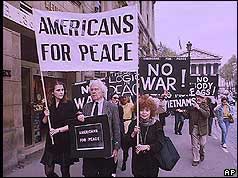
Twenty West German judges were arrested for blockading the
U.S. Air Force base at Mutlangen, West Germany where
Pershing II nuclear-armed cruise missiles were deployed.
Judge Ulf Panzer stated:
"Fifty
years ago, during the time of Nazi fascism, we judges and
prosecutors allegedly
'did
not know anything.' By closing our eyes and ears, our hearts
and minds, we became a docile instrument of suppression, and
many judges committed cruel crimes under the cloak of the
law. We have been guilty of complicity. Today we are on the
way to becoming guilty again, to being abused again.
By
our passivity, but also by applying laws, we legitimize terror:
nuclear terror.
Today
we do know...”
|
More
on "Judges and Prosecutors for Peace” |
|
|
The
United States Congress voted to authorize the use of
military force against Iraq to end its occupation of
Kuwait. House: 250-183; Senate: 52-47. |
| The
military, political and diplomatic situation at the time |
|
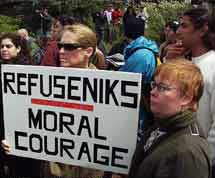
The "Refusenik" movement
began when 53 Israeli soldiers signed an ad refusing to
serve in the West Bank or Gaza Strip.
Their
letter concluded:
• We shall not continue to fight beyond the 1967 borders in order to dominate,
expel, starve and humiliate an entire people.
• We hereby declare that we shall continue serving in the Israel Defense
Forces in any mission that serves Israel’s defense.
|
 |
• The
missions of occupation and oppression do not serve this
purpose – and
we shall take no part in them.
[The term originally referred to Jews in the Soviet Union who had applied to
emigrate but were delayed or refused by the Communist government, in one case
for more than 22 years.] |
| Video interview with Yonatan Shapira, refusenik and former
captain
in the Israeli Air Force |
|
|
The
depression of 1873-1877 left 3 million people unemployed.
The depression began when railroad owner Jay Cooke was found
to have issued millions of dollars of worthless stock. Investors
panicked and banks closed. The unbalanced, overextended new
economy collapsed.
In the winter of 1873, 900 people starved to death, and 3,000
deserted their infants on doorsteps. A public meeting was called
in New York City's Tompkins Square Park to lobby for public
works projects to provide jobs; the city’s unemployment
rate was approaching 25% at the time. |
| 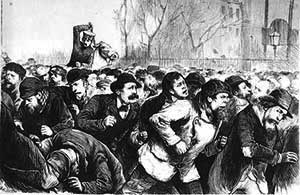
The
Tompkins Park Massacre |
The night before, the City secretly voided the permit for
the gathering. The next morning, mounted police charged
into the crowd of 10,000, indiscriminately clubbing
adults and children, leaving hundreds of casualties.
Police
commissioner Abram Duryee commented, "It
was the most glorious sight I have ever seen .
. . ."
|
| The
Tompkins Square event was part of a wave of parades of the
unemployed and bread riots across the nation. In Chicago,
20,000 people marched. Even under police attack, workers
in New York, Omaha, and Cincinnati refused to disperse. |
|
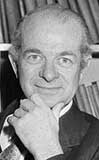 Linus Pauling Linus Pauling |
Linus
Pauling presented the “Scientists’ Test Ban Petition”
to
the United Nations, signed by over 11,000 scientists (including
36 Nobel laureates) from 49 countries. It called for an end
to nuclear weapons testing for its detrimental health, especially
genetic, and ecological effects, among other reasons. In
reaction to his efforts, Pauling was forced to resign as
Chairman of the Division of Chemistry and Chemical Engineering
at Caltech (California Institute of Technology) after having
served in that role for 22 years. |
|
| One hundred fifty
members of the Scottish Committee of 100 (an anti-nuclear
group) began a sit-down protest at the U.S. consulate in
Glasgow, Scotland. |
|
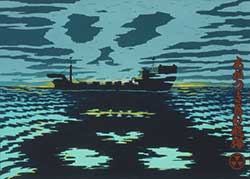
| A vigil was held opposing
the arrival of a ship bringing nearly two metric tons of
plutonium for a pilot fuel reprocessing plant in Tokai, Japan.
The specially constructed ship, the Akatsuki Maru, had carried
it 25,000 km (15,500 miles) from Cherbourg, France. |
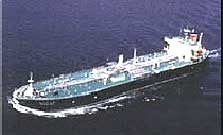 |
| Akatsuki
Maru |
 |
Many
objected to the maritime transport of the highly radioactive
material due to the risk of sinking, hijacking and the
resultant risk of further nuclear proliferation. The
original plan called for air transport over the United
States.
|
| The
Voyage Of The Akatsuki Maru by Mario Uribe |
The Hottest Import
To Hit Japan |
|
Roman
Catholic church authorities burned sacred Hebrew books
in Rome during the
papacy of Clement VIII. He had forbidden Jews from reading
the Talmud (a collection of centuries of interpretation
of Jewish law). He had confirmed Pope Paul III’s
relegation of Jews to a Roman ghetto (a walled-in portion
of the city), and their banning from residence in papal-controlled
states by Pope Pius V.
Other papal enemies of Jewish books included Innocent IV (1243-1254),
Clement IV (1256-1268), John XXII (1316-1334), Paul IV (1555-1559), and Pius V (1566-1572). |
|
The
Confederation Congress, meeting in Annapolis, Maryland,
ratified the Treaty of Paris with England, ending the
Revolutionary War. |
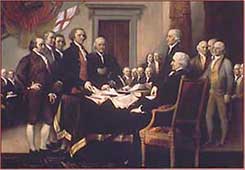 Signing the Treaty of Paris Signing the Treaty of Paris |
By its terms, "His Britannic
Majesty" was bound to withdraw his armies without "carrying
away any Negroes or other property of American inhabitants."
The treaty was negotiated by John Adams, John Jay and Benjamin
Franklin for the colonies, and David Hartley representing
the King of England, George III. |
|
| The
U.S. Supreme Court upheld the constitutionality of the
selective service law,
affirming all criminal charges arising from non-compliance
with the draft during World War I. In Arver v. United States,
the Court found that a draft does not violate the 13th
Amendment’s prohibition of involuntary servitude. |
|
A.
Philip Randolph, president of the Brotherhood of Sleeping Car
Porters union, and widely considered de facto chief spokesperson
for the African-American working class, called for a march
on Washington, demanding racial integration of the military
and equal access to defense-industry jobs.
|
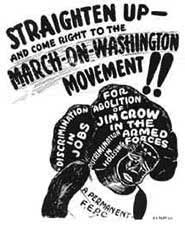 |
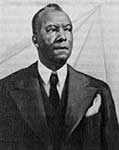 |
"On to Washington,
ten thousand black Americans!" Randolph urged. He said
in the fight to "stop discrimination in National Defense
. . . While conferences have merit, they won't get desired
results by themselves." |
| Asa
Philip Randolph, Detail from painting by Betsy G. Reyneau |
|
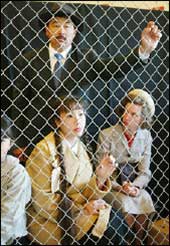
| President
Franklin D. Roosevelt issued Presidential Proclamation
No. 2537, which required aliens from World War II enemy
countries – Italy, Germany and Japan – to register
with the United States Department of Justice.
Registered persons received a “Certificate of Identification
for Aliens of Enemy Nationality.” This proclamation
facilitated the beginning of large-scale internment of Japanese
Americans the following month. |
 |
|
| George
Wallace was sworn in as Governor of Alabama. In his inaugural
address he called for "segregation now; segregation
tomorrow; segregation forever!" |
| “The
true brotherhood of America, of respecting the separateness
of others — and uniting in effort — has been
so twisted and distorted from its original concept that
there is a small wonder that communism is winning the world.
We invite the negro citizens of Alabama to work with us
from his separate racial station — as we will work with him — to
develop, to grow in individual freedom and enrichment. We want
jobs and a good future for BOTH races — the tubercular
and the infirm. This is the basic heritage of my religion,
of which I make full practice — for we are all the handiwork
of God.”
|
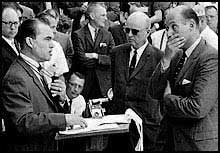
George C. Wallace, left, blocked the University of Alabama
doorway to prevent its desegregation later in 1963. U.S. Marshal
Peyton Norville, center, and U.S. Deputy Attorney General Nicholas
deB. Katzenbach listened. (File/A/P) |
| The
entire speech: |
|
| 
|
A march
in Atlanta was held to protest the ouster of Julian Bond,
an African American, from the Georgia House of Representatives.
Members of the General Assembly considered him unfit to
serve after he endorsed a statement critical of U.S. involvement
in Vietnam issued by the Student Non-Violent
Coordinating
Committee (SNCC). |
|
An
agreement was signed for Russia and the U.S. to assist
newly independent Ukraine in ridding itself of nuclear
weapons. |
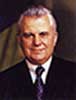
| Following
the break-up of the Soviet Union, Ukraine’s leader Leonid
Kravchuk found his country with the world’s third largest
nuclear arsenal, including multiple-warhead long-range missiles
and bombers, and 3000 tactical (battlefield or short-range) nuclear
weapons. |
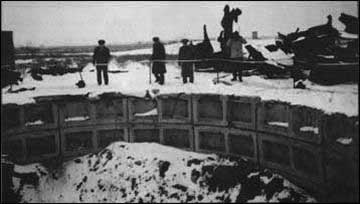 former
Ukranian missle silo former
Ukranian missle silo |
| 
|
Kravchuk
and his government had decided to eliminate all nuclear
weapons from Ukrainian territory. Ukraine was the first
country to go non-nuclear. |
Leonid
Kravchuk |
|
| Sixteen
protesters were arrested in a winter blockade of the rural
Wisconsin site (in the Chequamegon National Forest) of
the U.S. Navy's ELF (Extremely Low Frequency) transmitter,
which communicated (one-way) with deeply submerged U.S.
submarines. Nearly 400 were arrested in 24 actions opposing
ELF between 1991 and 1996.
|
|
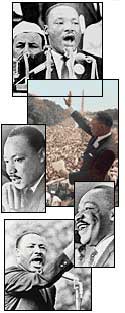 |
Martin
Luther King, Jr. was born in Atlanta, Georgia. The son
of a Baptist pastor, he followed in his father’s
footsteps, then went on to lead the American civil rights
movement in the 1950s and '60s, and to speak out against
the Vietnam war.
In 1955 Dr. King organized the first major protest of the civil
rights movement: the successful Montgomery Bus Boycott. Influenced
by Mohandas Gandhi, he advocated nonviolent civil disobedience
to end racial segregation. The peaceful protests he led throughout
the American South were often met with violence and arrest,
but King and his followers persisted.
His inspiration, leadership and eloquence helped tens of millions
claim the fundamental rights of citizenship, and changed the
face of a nation. |
Dr. Martin Luther King
Jr. biographical sketch |
Since 1986, the
third Monday in January has been designated a federal holiday
honoring the greatness and sacrifice of Dr. Martin Luther King,
Jr.
A chronology:
April 4, 1968 Dr. King was assassinated. Shortly thereafter,
U.S. Representative John Conyers (D-Michigan) introduced legislation
to create a federal holiday to commemorate Dr. King’s
life and work.
January, 1973 Illinois became the first state to adopt MLK
Day as a state holiday.
January, 1983 Rep. Conyers’s law was passed after 15
years
January, 1986 The United States first officially observed the
federal King Day holiday.
January, 1987 Arizona Governor Evan Mecham rescinded state
recognition of MLK Day as his first act in office, setting
off a national boycott of the state.
January, 1993 Martin
Luther King Day holiday was observed in all 50 states for the
first time. |
Brief
biography of Dr. King |
|
| The
Jeanette Rankin Brigade marched on Washington to protest
the war in Vietnam. |
It was led by 87-year-old Rankin herself,
the first U.S. Congresswoman (R-Montana), and the only
member of Congress to vote against U.S. entry to both world
wars. After the march’s arrival in Washington, D.C.
the New York Radical Women staged a "Burial of Traditional
Womanhood." |
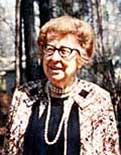 Jeanette
Rankin Jeanette
Rankin
|
More
on Jeanette Rankin |
Documents
from the New York Radical Women including Funeral
Oration for the Burial of Traditional Womanhood by Kathy
Amatniek (who
coined “Sisterhood is Powerful”)
|
|
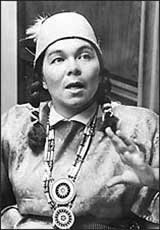 Janet
McCloud Janet
McCloud |
Janet
McCloud, her husband Don and four others from the Tulalip
Indian tribe were tried for one of their "fish-ins" on
the Nisqually River in Washington state. The Nisqually
empties into Puget sound on the Tulalip reservation. Despite
century-old treaties granting them half the salmon catch
in their ancestral waters, state game officials harassed
and arrested Indian fishermen. However, all were found
not guilty.
In a decision not reached for five years, U.S. District Judge
George Boldt ruled in favor of 14 treaty tribes, including
the Tulalip, upholding the language
of their treaties. |
|
| 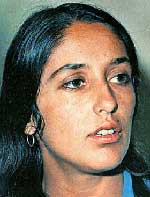 Joan
Baez Joan
Baez
|
Folksinger
Joan Baez was sentenced to 10 days in jail for participating
in a protest which blocked the entrance to the Armed
Forces Induction Center in Oakland, California. She was
part of an action to impede the drafting of young men
for the U.S. war in Vietnam. |
| Joan Baez Press Conference On Vietnam War (1966) |
| Read
more about Joan Baez |
|
| Faced
with strikes, violent demonstrations, an army mutiny
and clerical opposition
to his repressive rule, the Shah of Iran, its hereditary
monarch since 1941, was forced to flee the country. He
had been installed in a CIA- and British-engineered 1953
coup which overthrew elected Prime Minister Mohammad Mossadeq.
Mossadeq’s government had voted to nationalize Iran’s
oil industry, displacing the Anglo-Iranian Oil Company. |
|
The
U.S. gave substantial and continuous military and intelligence
support to the Shah throughout his regime. Despite
having imposed martial law the previous October, Mohammad
Reza Shah Pahlavi fled the Peacock Throne for Egypt
and, later, the U.S. for medical care. Following the
subsequent revolutionary overthrow, an Islamist state
under Ayatollah Ruhollah Khomeini was established.
|
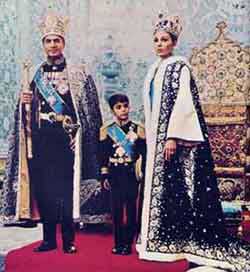
|
| The
Shah and family |
| Chronology of Iran in the 20th century: |
More on the Shah |
|
Eight
members of the Nanoose Conversion Campaign were acquitted
of trespassing on Canadian Department of National Defence
property.
The group had picnicked on Winchelsea Island, part
of the Canadian Forces Maritime Experimental and Test Ranges,
where both Canadian and U.S. weapons are tested, in the Georgia
Strait along the
British Columbia coast. |
|
The
government of El Salvador and rebel leaders signed a pact
in Mexico City ending 12 years of civil war that had killed
at least 75,000 people. |
|
|
Eight
Greenpeace activists were arrested by Gibraltar police
as they boarded a damaged British nuclear submarine.
The HMS Tireless was considered a radioactivity hazard
because of a cracked pipe in its reactor’s
cooling system. Those living near Gibraltar Harbour
and in Spain were concerned for their safety as the
ship had been docked for more than six months awaiting
repair.
The problem was serious enough that Great Britain removed
twelve comparable subs from service until they could be checked
for similar problems. Greenpeace unfurled a banner just before the arrests reading
Mares Libres del Peligro Nuclear, or “For a Nuclear-Free
Sea.”
|
|
Queen Lili`uokalani of the independent kingdom of Hawai`i
was overthrown as she was arrested at gunpoint by
U.S. Marines. |
| 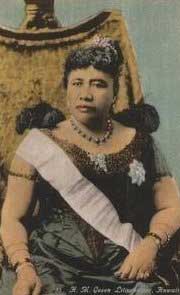 Queen
Lilluokalani Queen
Lilluokalani
|
American businessmen, particularly
sugar plantation owners, led by Lorrin Thurston,
had supported annexation of the islands to the United
States. The Queen had been working on a new constitution
that would restore voting rights to native Hawaiians.
|
A
new provisional government was installed with Sanford B.
Dole as president. The troops had landed the day before,
providing support "to protect American lives and property."
In
1898, President William McKinley signed a joint resolution of
Congress authorizing the annexation. |
 |
| Sanford Dole |
| The
overthrow of the monarchy |
More
on Queen Lili`uokalani |
|
| Native
Hawai’ians demonstrated against U.S. control of their
homeland on the 100th anniversary of the U.S.-backed overthrow
of the independent Hawai'ian government. |
|
|
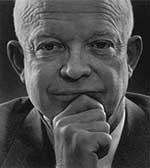
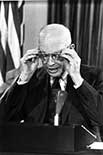
President
Dwight Eisenhower in his farewell address, delivered
via television and radio, warned
the nation: "In the councils of government, we must
guard against the acquisition of unwarranted influence,
whether sought or unsought, by the military-industrial
complex. The potential for the disastrous rise of misplaced
power exists and will persist." |
 |
| President
Dwight D. Eisenhower |
President Eisenhower
delivering his farewell address |
| The
speech |
Watch
a video |
|
| A
nuclear-armed B-52 bomber collided with the fueling boom
of an Air Force KC-135 jet tanker while refueling over the
coast of Spain (the 4-member tanker crew was lost, as were
three of seven in the bomber). |
Two 70-kiloton hydrogen bombs ruptured when they hit the
ground, scattering radioactive material including
plutonium dust; a third landed intact near the village
of Palomares; the fourth was found, also intact,
by a submarine after weeks of searching.
|
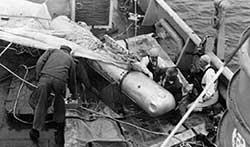 |
| Nuclear bomb recovered off the Spanish coast |
The U.S. tried first to cover it up, then downplayed the
seriousness of the incident. Fourteen hundred tons of radioactive
soil and plant material were removed to the U.S. for burial.
For
decades, the U.S. Air Force’s Strategic Air Command
flew nuclear-armed bombers on full-time continuous airborne
patrol as one of the three legs of the U.S. nuclear deterrent
triad (the others being submarine-launched and intercontinental
ballistic missiles). The B-52 lost over Spain was returning
to its base in North Carolina from such a mission. |
| The
whole story |
|
| 
|
Some 300 Chicano activists gathered in Crystal City, Texas,
to form an independent political party. La Raza Unida
(The United People) Party addressed a broad cross-section
of issues – restoration of land grants, farm
workers’ rights, enhanced education, voting
and political rights. The party eventually became
a political force in California, Texas, Colorado,
and elsewhere in the southwest. |
| Read
more |
| The
party's name means "the United People." |
|
| 5,000
rallied and about 200 were arrested while protesting the
first test launch of the Trident II missile at Cape Canaveral,
Florida. The Trident D-5 is a submarine-launched long-range
(12,000 km or 7,456 miles) multiple-warhead nuclear missile.
Trident submarines are one leg of the U.S. nuclear deterrent
triad, and part of Great Britain’s.
|
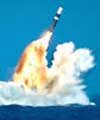
|
| a
Trident missile launching from submarine |
|
| The peace conference to negotiate
the end of the Great War (now know as World War I) opened in
Paris, France. President Woodrow Wilson spent several months in
Europe personally negotiating details of what became the Treaty
of Versailles with heads of the allied powers or their foreign
ministers. |
|
| The
U.S. began spraying herbicides on foliage in Vietnam to
eliminate jungle canopy cover for Viet Cong guerrillas
(a policy known as "territory denial"). |
|
The U.S. ultimately dropped more than 20 million
gallons of such defoliants, sparking charges the
United States was violating international treaties
against using chemical weapons. Many of the herbicides,
particularly Agent Orange, manufactured by Dow Chemical,
Monsanto and others, were later found to cause birth
defects and rare forms of cancer in humans. |
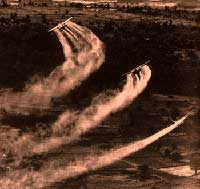
|
| Agent Orange: An Ongoing Atrocity |
|
| Invited
to a Women Doers luncheon at the Johnson White House, Eartha
Kitt, singer
and actor, spoke out about the effect of the Vietnam War on
America’s youth. Lady Bird Johnson had convened 50 whites
and Negroes to discuss President Lyndon Johnson’s anti-crime
proposals.Ms.
Kitt first asked the President, “what do you do about
delinquent parents, those who have to work and are too
busy to look after their children?" He said that there
was Social Security money for day care, and the group should
discuss such issues. |
Later,
she told the women that young Americans were "angry
because their parents are angry . . . because there is
a war going on that they don't understand
. . . You send the best of this country off to be shot and maimed. They rebel
in the street. They will take pot . . . and they will get high. They don't want
to go to school because they're going to be snatched off from their mothers to
be shot in Vietnam."
|
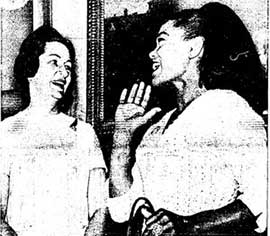 Eartha Kitt and Lady Bird Johnson Eartha Kitt and Lady Bird Johnson |
Eartha Kitt’s career took a severe downturn after this; for years afterward,
Kitt performed almost exclusively overseas, while being investigated by several
federal agencies.
"The thing that hurts, that became anger, was when I realized that if you
tell the truth – in a country that says you're entitled to tell the truth – you
get your face slapped and you get put out of work," Kitt told Essence magazine
two decades later. |
|
| In a televised
speech, Senator George S. McGovern (D-South Dakota) began his
anti-war campaign for the 1972 Democratic presidential nomination.
He vowed to bring home all U.S. soldiers from Vietnam if elected.
McGovern had served in the Army Air Corps during World War
II, earning the Silver Star and the Distinguished Flying Cross. |
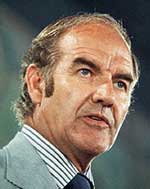 George
McGovern George
McGovern |
“.
. . we must have the courage to admit that however sincere
our motives,
we made a dreadful mistake in trying to settle the affairs
of the Vietnamese people with American troops and bombers
. . . .
“
But while our problems are great, certain steps can be taken
to recover the confidence of the nation. The greatness
of our nation is not confined to the past, but beckons us to
the future.
|
| Text
of Senator McGovern’s declaration of candidacy |
|
|
Though
a member of the World Court since 1946, the United States
walked out during a case. The Court had charged the U.S.
was in violation of international law through its support
of paramilitary (Contra) activities against the Nicaraguan
government. Efforts to undermine the Sandinista government
in Nicaragua had been a keystone of Pres. Reagan’s
anti-communist foreign policy from its inception.
Congressman Michael Barnes (D-Maryland) said he was "shocked
and saddened that the Reagan Administration had so little
confidence in its own policies that it chose not even to
defend them [in the World Court].”
The Court still heard Nicaragua's case and decided against
the United States, and ordered it to pay reparations to Nicaragua
in June 1986.
|
|
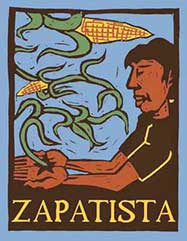
The Zapatista National Liberation
Army (EZLN) and the Mexican government reached an agreement
in San Andres to recognize and guarantee the constitutional,
political, social, cultural, and economic rights of indigenous
peoples in Mexico. Treated as second-class citizens since the
first colonial entry into their country, the document guaranteed
the autonomy and right to self-determination of native communities
within the pluricultural Mexican nation.
The Zapatistas tokks their name from Emilano Zapata who played
a major role in the Mexican Revolution early in the 20th century. |
When
they began their revolt in Chiapas state on New Year’s Day of 1994, They wrote:
"We have nothing to lose, absolutely nothing,
no decent roof over our heads, no land, no work, poor health,
no food, no education, no right to freely and democratically
choose our leaders, no independence from foreign interests, and
no justice for ourselves or our children.
But we say enough is
enough! We are the descendants of those who truly built this
nation, we are millions of dispossessed, and we call upon all
our brethren to join our crusade, the only option to avoid dying
of starvation!"
The Mexican government, despite their signature on the agreement, refused later
to implement it.
|
 |
| More
background on the Zapatistas |
|
 |
In
frigid temperatures, 500,000 converged on Washington, D.C.
There were also joined by many more elsewhere around the
world to oppose the threatened U.S. war on Iraq. |
 |
| Anti-war protesters march past the
U.S. Capitol during the start of an anti-war protest that will
culminate by a march to the Washington Naval Yard. |
Egyptian
riot police and anti-war demonstrators face off in Cairo,
Egypt.
Banners at top read, " Iraq . . . Another war for oil
and American supremacy." |
| This
was the largest U.S. peace demonstration since the Vietnam
era. |
 |
|
 |
| < Pakistani
peace activists hold a rally in Karachi. |
| |
| > Crowds
estimated at 80,000 fill the civic center of San Francisco,
California |
|
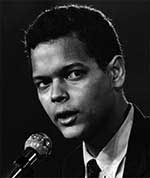
| The Georgia
State House of Representatives refused to seat black state
representative Julian Bond despite his election the previous
November. |
Their stated objection was his endorsement of a Student
Nonviolent Coordinating Committee statement accusing
the United States of violating international law
in Vietnam.
In December 1966, the U.S. Supreme Court ruled Bond’s
exclusion unconstitutional, and Bond was finally sworn
in the following month. |
|
| Julian
Bond |
|
| 25,000 marched in Washington,
D.C. to protest massive U.S. bombing of Iraq in the first Gulf
war, Operation Desert Storm. |
|
 |
American
Civil Liberties Union (ACLU) was founded by Roger Baldwin,
Congresswoman Jeannette Rankin, labor leaders Rose Schneiderman
and Duncan McDonald, Rabbi Judah Magnes, and others. |
The
ACLU was organized to protect the rights guaranteed in
the the Constitution, particularly the Bill of Rights.
Prior to this the first ten amendments had not been enforced.
The ACLU has paid particular attention to
• First Amendment rights: freedom of speech, association and
assembly, freedom of the press, and freedom of religion as
well as a bar against establishment of a state religion.
•
One’s right to equal protection under the law – equal
treatment regardless of race, sex, religion or national origin.
•
One’s right to due process – fair treatment for
citizens by the government whenever the loss of liberty or
property is at stake.
•
One’s right to privacy – freedom from unwarranted
government intrusion into one’s personal and private
affairs. |
ACLU
history |
The
ACLU today |
|
| Nazi
Party and German government officials arrived at what they
called the "final solution to the Jewish question
in Europe."They developed plans for the coordinated
and systematic extermination of all Europe's Jews during
a meeting at a villa near Lake Wannsee in Berlin. |
| Notes
of the meeting recorded by Adolf Eichmann used vague terms
such as "transportation to the east" or "evacuation
to the east" (nach dem Osten abgeshoben). But at his
trial for genocide Eichmann testified of the meeting that "the
discussion covered killing, elimination, and annihilation." |
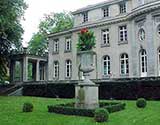 |
| The villa on Lake Wannsee,
now a holocaust museum. |
| More
on the Wannsee conference |
|
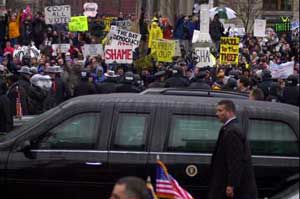
Tens of
thousands lining Pennsylvania Avenue to protest the legitimacy
of the inauguration of President George W. Bush were systematically
excluded from almost all media coverage of the event. They
called attention to the election irregularities in Florida,
the dispute over a recount, and the ultimate effective
choice of the president by a 5-4 majority of the Supreme
Court. |
|
|
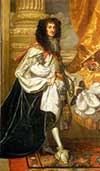 |
The
Quaker (Society of Friends) Peace Testimony was presented
to King Charles II of England.
The testimony begins: "We utterly deny all outward
wars and strife and fightings with outward weapons, for
any end or under any pretence whatsoever. And this is our
testimony to the whole world....” |
| King
Charles II |
|
| The
first atomic-powered submarine, the USS Nautilus, built
by Electric Boat Company, was launched at Groton, Connecticut.
All previous submarines were powered by batteries which
had to be periodically recharged by diesel-powered generators
which could only run if the sub surfaced. |
| The
nuclear power plant, developed under the leadership of
Captain Hyman Rickover,
and its ability to produce its own fresh water, allowed
Nautilus and its successors to remain underwater and undetectable
for weeks rather than hours. It carried only conventional
torpedoes.
It has been completely restored and can be seen at the Submarine
Force Museum in Groton. |
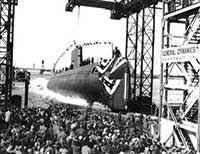 |
| nautilus
submarine launch |
|
| The
day after his inauguration President Jimmy Carter declared
an unconditional amnesty for draft resisters, both the
accused and those who might have faced possible prosecution. |
Carter's pardon |
|
| A
Women’s Peace Camp
was set up near Volkel Airbase in The Netherlands to protest
siting of U.S. nuclear weapons there. |
|
The Arthur Miller drama, ''The Crucible,''
opened on Broadway.
It was a parable that reflected the climate
of fear that pervaded American society and the politics of
its time, witchcraft in the late 17th century, communism in
the mid-20th. In both times there existed also the fear of
false accusation. |
|
From
the New York Times review of the Broadway revival in
November 2001:
“Today,
the play is a cautionary tale of astounding immediacy.
Its themes include the pathology of rumor, the arrogance
of the religiously righteous, the dangers of private
panic in the face of public terror, and the individual's
difficulty in acting rationally in the face of mob
hysteria.”
|
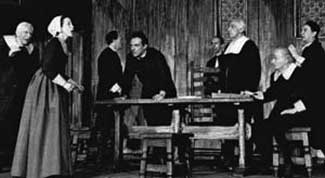 scene
from the original production scene
from the original production
|
| Read
the playwright’s reasons for writing it: |
|
|
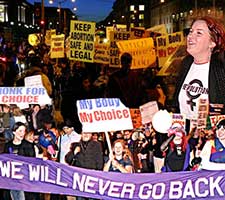
Women won control of their reproductive rights when
the U.S. Supreme Court ruled in Roe v. Wade that Americans
have a constitutional right to privacy, and thus women
may terminate a pregnancy before the last 10 weeks. Only
during the last trimester, when a fetus can survive outside
the womb, would states be permitted to regulate abortion
of a healthy pregnancy.
Prior to the Court’s ruling that the decision was
private and belonged to the pregnant woman, abortion was
essentially
illegal in all states except New York (as of 1970). |
|
| |
About
the decision |
|
History
of New York’s law |
|
|
President
George W. Bush signed a memorandum the day after his inauguration
reinstating full restrictions on U.S. overseas aid that
might go to any program that provided abortions or considered
them an option for women.
Known as the Mexico City policy, or global gag rule, first
signed by President Ronald Reagan, it had been withdrawn by President
Bill Clinton as soon as he took office. |
| More
on the global gag rule |
|
| The United Mine Workers
of America was formed through the amalgamation of the National
Progressive Union (organized 1888) and the mine locals under
the Knights of Labor, including all workers in the coal industry.
The workers faced unstable employment, the prevalence of
company towns (where the mine owners controlled all housing
and commerce), and extremely hazardous working conditions. |
| UMWA history |
|
 |
Fifteen members of the Committee of 100, the non-violent direct action
wing of the Campaign for Nuclear Disarmament (CND), sat in at the
British House of Commons demanding a halt to nuclear weapons testing.
|
| CND
history |
|
|
|
President
Richard Nixon announced a Vietnam peace deal. The president
appeared on national television and said that National
Security Adviser Henry A. Kissinger and North Vietnam's
chief negotiator, Le Duc Tho, had initialed an agreement
in Paris "to end the war and bring peace with honor
in Vietnam and Southeast Asia."
The agreement had
actually been initialed six days beforehand. |
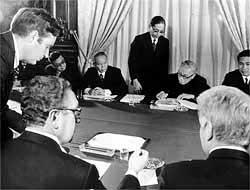
Henry
A. Kissinger and
Le
Duc Tho initial the agreement. |
| Read
more |
Listen
to Nixon’s announcement |
|
| The
Continental Walk for Disarmament & Social Justice began
in Ukiah, California, heading for Washington, D.C. Its
purposes were "to raise the issue of disarmament through
unilateral action . . . to educate about nonviolent resistance
as a means superior to armament . . . and to demonstrate
how global and domestic and economic problems are interconnected
with militarism and the causes of war . . . ." |
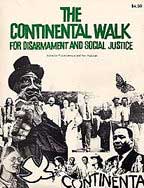 |
Initiated
by the War Resisters League, and co-sponsored by the
Fellowship of Reconciliation, American Friends Service
Committee, the Southern Christian Leadership Conference,
Catholic Peace Fellowship, Clergy and Laity Concerned,
SANE, and Women's International League for Peace and
Freedom, the walk took 10 months and covered 8,000 miles
through 34 states. |
Comprehensive
archive of the walk: |
|
|
John
Lennon & Yoko Ono cropped their hair
short for the first time in years, declaring 1970 "Year
One for Peace" and helped organize a Toronto Peace
Festival. |
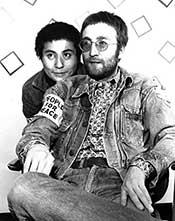
|
| An interview with John later that year |
| John & Yoko |
|
| The
TV mini-series ''Roots,'' based on the Alex Haley novel,
began airing on ABC. |
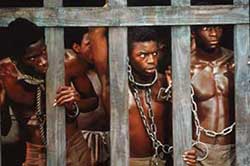
|
The story followed
an African sold into slavery, and his family’s history
through emancipation. It won numerous awards and drew an
enormous and broad-based audience (third-highest Nielsen
ratings ever for its final episode). 85 percent of all Americans
watched at least some part of the series.
|
| LeVar
Burton portrayed Kunta Kinte, a young man captured in Africa
and shipped to America to be a slave, in "Roots." |
Listen
to thoughts on Roots 30 years later |
|
| Mohandas
Gandhi, Jawaharlal Nehru and other leaders of the anti-colonial
movement in India pledged to achieve complete independence,
or Purna Swaraj, from Great Britain. |
Nehru said:
“The British Government in India has not only deprived the Indian
people of their freedom but has based itself on the exploitation of the
masses, and has ruined India economically, politically, culturally and
spiritually . . . We hold it to be a crime against men and God to submit
any longer to a rule that has caused this fourfold disaster to our country.” |
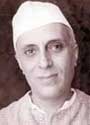 Jawaharlal Nehru Jawaharlal Nehru |
|
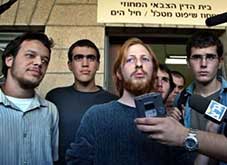 |
A
group of Israeli reservists issued a declaration saying
they would not serve the Israeli Defense Force (IDF) if
assigned to the occupied West Bank or Gaza Strip. It was
called the Combatants’ Letter, and the organization
Courage to Refuse grew out of their resistance |
| Israeli
refuseniks |
| Captain
David Zonshein and Lieutenant Yaniv Itzkovits, officers in an elite
unit, realized the missions assigned to them as commanders
in the IDF had in fact nothing to do with the defense of
the State of Israel, but were rather intended to maintain
control of the occupied territories at the price of oppressing
the local Palestinian population. |
 |
Within
three months, 69 such refuseniks had been jailed. 629 Israeli
soldiers ultimately signed the pledge. Over 280 members
of Courage to Refuse were court-martialed and jailed for
periods of up to 35 days as a result of their refusal. |
 |
| The Israeli refusnik movement today |
|
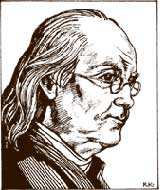
| Benjamin
Franklin, noting the bald eagle was "a bird of bad moral character" who
lived "by sharping and robbing," expressed regret
it had been selected to be the U.S. national symbol. |
 Benjamin
Franklin Benjamin
Franklin
|
Franklin
proposed the wild turkey, "a much more respectable
Bird and a true original Native of America." He
said the eastern wild turkey, known for its intelligence,
cunning and boldness, was a far better symbol of the
United States.
In a 1775 letter published in a magazine, Franklin made a good
case for the rattlesnake as an appropriate symbolHow the bald
eagle became our national birdof "the
temper and conduct of America." |
How the bald eagle became our national bird |
Frankin’s
letter on the rattlesnake |
|
Mohandas
Gandhi, Jawaharlal Nehru and other leaders of the anti-colonial
movement in India pledged to achieve complete independence,
or Purna Swaraj, from Great Britain.
Nehru said:
“The British Government in India has not only deprived the Indian
people of their freedom but has based itself on the exploitation of the
masses, and has ruined India economically, politically, culturally and
spiritually . . . We hold it to be a crime against men and God to submit
any longer to a rule that has caused this fourfold disaster to our country.” |
|
The
Indian Constitution became law and India proclaimed itself
a republic. The new president replaced the King of England
as head of state after nearly 100 years of British colonial
rule. The Republic of India considered its sovereignty
derived from the people, becoming the most populous democracy
in the world. The day is now celebrated as Republic Day.
The new President, Dr. Rajendra Prasad, after taking the oath
of office:
"Today,
for the first time in our long and chequered history, we find the whole
of this vast land . . . brought together under the jurisdiction of one
constitution and one union which takes over responsibility for the welfare
of more than 320 million men and women who inhabit it." |
| More about Republic Day |
|
| The
Reverend Martin Luther King, Jr. was arrested for the first
time, for driving 30 mph (48 kph) in a 25 mph (40 kph)
zone in Montgomery, Alabama. This occurred shortly after
the beginning of the citywide bus boycott he had helped
organize. His home was bombed a few days later. |
|
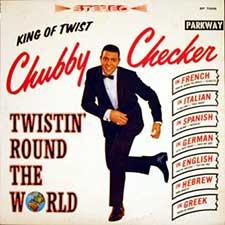 |
Bishop
Joseph A. Burke of the Buffalo, New York,
Catholic Diocese
banned a new song and dance,
“The Twist,” by
Chubby Checker.
It couldn’t be danced, sung, or listened
to in any Catholic school, parish, or youth event. Later
in the year, the Twist was banned from community center dances
in Tampa, Florida, as well. It was claimed the Twist was
actually a pagan fertility dance. |
“The Twist” by its originator
|
|
| Police
wielding truncheons and firing tear gas from pressure canisters
broke up a march by hundreds of demonstrators in central
Prague. |
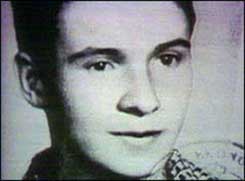 |
The
violence erupted as officers tried to disperse the crowd
gathered at the foot of the Wenceslas Statue to pay tribute
to Jan Palach, the student who burned himself to death in protest
at the Soviet invasion the previous summer, and their ongoing
occupation of Czechoslovakia. |
| Jan Palach |
More about Jan Palach |
|
| Germans
protested their country’s membership
in the coalition prosecuting the first Gulf War against Saddam
Hussein’s Iraq after he invaded Kuwait. Rallying out
in many cities, the largest turnout brought 200,000 to Bonn.
The number of those claiming conscientious objector status
jumped 35% in that month to 30,000. |
|
Several
hundred citizens of Marshall, Michigan, helped former slaves
escape to Canada
rather than be returned to their “owner” by bounty
hunters.
Adam Crosswhite and his family, escaped Kentucky
slaves, were tracked to the abolitionist town of Marshall
by Francis Troutman and others. Both black and white residents
detained the bounty hunters and threatened them with tar
and feathers. While Troutman was being charged with assault
and fined $100, the Crosswhites fled to Canada. |
 |
| Back in Kentucky,
the slaveowner stirred up intense excitement about “abolitionist
mobs” in Michigan. |
Since
1832, Michigan had had an active antislavery society. Quakers
in Cass County, Laura
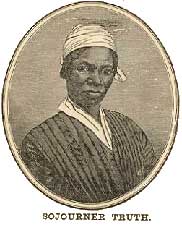
Haviland in Adrian and former slave Sojourner Truth in Battle
Creek were only a few of the many Michiganians who worked
on the Underground Railroad—an informal network that
assisted escaping slaves.
Southern concern over the Underground
Railroad led Congress to pass a more stringent Fugitive Slave
Law in 1850. In 1854 opposition to the extension of slavery
prompted Michigan citizens to meet in nearby Jackson to organize
the Republican Party. |
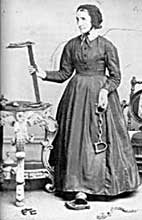 |
| Laura
Haviland with some artifacts of slavery |
| Sojourner
Truth |
|
The Red Army of the Soviet Union liberated the German Nazis' largest concentration camps: the Auschwitz main camp, the Birkenau death camp and the Monowitz labor camp in southwestern Poland. |
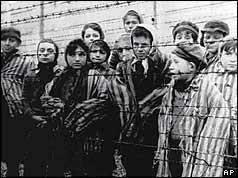 |
| Soviet
troops liberated the Nazi concentration camps Auschwitz
and Birkenau in Poland. |
|
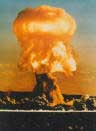 |
The first atomic test was conducted at the Nevada Proving Ground
as an Air Force plane dropped a one-kiloton bomb on Frenchman
Flats.
The Proving Ground was created by President Harry Truman on
January 11, 1951.
|
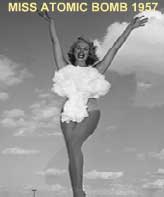 |
The final nuclear test, Divider, was conducted on September
23, 1992.
There were 99 above ground tests and over 800 below ground tests
there. |
| read more |
|
| In Detroit, African-American auto workers, known
as the Eldon Avenue Axle Plant Revolutionary Union Movement,
led a wildcat strike against racist practices and poor working
conditions at the Chrysler plant. |
Since
the 1967 Detroit riots, black workers had organized groups
in several Detroit auto plants critical of both the auto
companies and the United Auto Workers union leadership. These
groups combined Black-Power nationalism and workplace militancy,
and temporarily shut down more than a dozen inner-city plants.
The most well-known of these groups was the Dodge Revolutionary
Union Movement, or DRUM. They criticized both the seniority
system and grievance procedures as racist. Veterans of this
movement went on to lead many of the same local unions. |
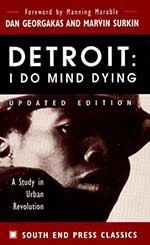 |
| Detroit: I Do Mind Dying A Study in Urban Revolution (pdf) |
|
| The
United States and North Vietnam signed "An Agreement Ending
the War and Restoring Peace in Vietnam" in Paris and all
U.S. troops were to leave Vietnam within 90 days. The United
States, South Vietnam, Viet Cong, and North Vietnam formally
sign but because South Vietnam was unwilling to recognize the
Viet Cong's Provisional Revolutionary Government, all references
to it were confined to the document signed by North Vietnam
and the United States. The same day, the United States announced
an end to the military draft. |
The
Vietnam War resulted in between three and four million Vietnamese
deaths with a countless number of Vietnamese casualties. It
cost the United States 58,000 lives and 350,000 casualties.
The financial cost to the United States came to something
over $150 billion dollars. |
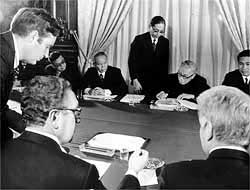 |
| Henry
A. Kissinger and Le Duc Thos initial the agreement. |
|
| The
Pentagon announced a “zero draft,” putting the
Selective Service System on standby after five years of continuous
operation. 1,728,344 men had been drafted in the previous
eight years (principally for the war in Vietnam), 25% of
all the armed forces. |
|
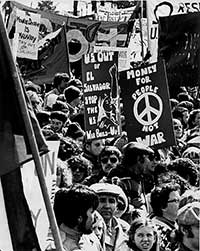
CISPIS
demo
May, 1981 Wash DC |
The
Center for Constitutional Rights revealed the FBI had spied
on numerous organizations critical of Reagan administration
policies in Central America. The principal target was the
Committee in Solidarity with the People of El Salvador (CISPES).
100 other groups were also investigated, including the Roman
Catholic Maryknoll Sisters, the United Auto Workers, the
United Steel Workers, and the National Education Association.
FBI Director William Sessions said the investigations were
an outgrowth of the belief that CISPES was aiding a "terrorist
organization." |
CISPES
today |
 |
| How
domestic surveillance multiplied under the label or preventing
terrorist attacks |
|
France performed its final nuclear weapons test. France exploded the last in a series of six underground nuclear devices in the South Pacific. The tests, ordered by President Jacques Chirac, ended a moratorium imposed by the former president, François Mitterand, but Chirac said France would accept the terms of the Comprehensive Nuclear
Test Ban Treaty. |
|
| Nuclear
production at the Rocky Flats Nuclear Arsenal – a
complex used for both power plants and nuclear weapon munition
manufacture – was permanently closed after repeated
revelations of environmental contamination in the surrounding
land and water supply, 25 miles northwest of Denver. Following
closure, the facilities were completely dismantled and
the site cleared. |
| The principal product of Rocky Flats was the fissionable
plutonium trigger or "pit" at the core of every
nuclear warhead in the U.S. arsenal. Since its construction
in 1951 it was managed at different times by Dow Chemical,
Rockwell International and EG&G. Dow and Rockwell paid
fines in the tens of millions of dollars and were ordered
to pay damages in the hundreds of millions to local residents
for the environmental damage. |
| Despite the residual plutonium contamination
on the 6500-acre site, it has been transferred by the Department
of Energy to the Fish and Wildlife Service (Interior) as the
Rocky Flats Wildlife Refuge. |
Rocky Flats Right to Know |
|
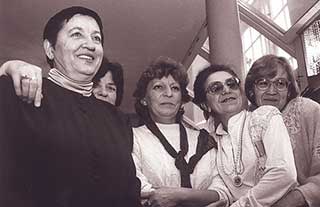 Soldiers'
Mothers Committee members Soldiers'
Mothers Committee members
|
Over 100 members of the Committee
of Soldiers' Mothers of Russia went to a Red Army
training camp to reclaim their sons. Since its founding in
1989 the Soldiers' Mothers Committee had worked to expose human
rights violations within the Russian military and has consistently
supported a true alternative service option for conscientious
objectors.
|
| The
Mothers Committee earned the 1996 Right Livelihood Award |
|
Three
Ploughshares activists, Lotta Kronlid, Andrea Needham and
Joanna Wlson, caused millions in damage and were arrested
in Warton, Lancashire, England, for disarming a British Aerospace
F-16 fighter jet destined to be sold to Indonesia for use
in its illegal occupation and genocide of the people of East
Timor.
|
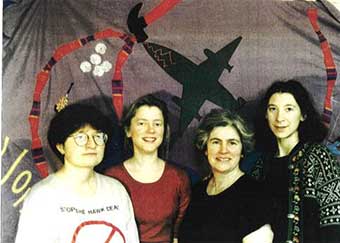 |
| Seeds
of Hope/East Timor Ploughshares activists |
Angie Zelter was arrested later for saying she planned to finish
what the other three had started. The four were later acquitted
of all charges on the grounds of preventing a greater crime. |
| Pax Christi’s history |
|
| Mohandas
K. Gandhi was killed in Delhi by an assassin, a fellow Hindu,
who fired three shots from a pistol at a range of three feet. |
| An
American reporter who saw it happen |
|
As
Martin Luther King, Jr. stood at the pulpit, leading a mass
meeting during the Montgomery, Alabama, bus boycott, his
home was bombed. King's wife and 10-week-old baby escaped
unharmed. Later in the evening, as thousands of angry African
Americans assembled on King's lawn, he appeared on his front
porch, and told them:
"If you have weapons, take them home . . . We cannot solve
this problem through retaliatory violence . . . We must love our
white brothers, no matter what they do to us." |
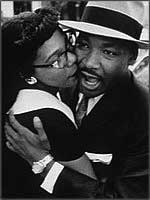 |
| Martin
Luther King, Jr. and wife Coretta Scott, 1960 |
|
The Tet (lunar new year) Offensive began
as North Vietnamese and Viet Cong forces launched surprise
attacks against major cities, provincial and district capitals
in South Vietnam.
Though an attack had been anticipated, half of the South’s
ARVN troops (Army of the Republic of Vietnam) were on leave
because of the holiday. There were attacks in Saigon (the South’s
capital) on the Independence Palace (the residence of the president),
the radio station, the ARVN's joint General Staff Compound,
Tan Son Nhut airfield, and the United States embassy, causing
considerable damage and throwing the city into turmoil. |
|
In
Londonderry (aka Derry), Northern Ireland, unarmed civil
rights demonstrators were shot dead by British Army paratroopers
in an event that became known as "Bloody Sunday." The
protesters, all Catholics, had been marching in protest of
the British policy of internment without trial of suspected
Irish nationalists.
British authorities had ordered the march banned, and sent
troops to confront the demonstrators when it went ahead. The
soldiers fired indiscriminately into the crowd of protesters,
ultimately killing 14 and wounding 17. By the end of the year
323 civilians and 144 military and paramilitary personnel would
be dead. |
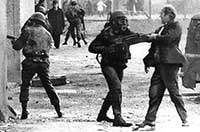
|
| Mural: Bloody Sunday martyrs> |
Eyewitness accounts |
|
|
Thousands of protesters from across Japan marched in central Tokyo to protest the U.S. military presence on Okinawa.
Some 47,000 U.S. troops are stationed in Japan, with more than half on the southern island of Okinawa. Residents have complained for years about noise, pollution and crime around the bases. |
News about the protest |
|
|
Fred Korematsu Day
Fred Korematsu, was born in Oakland, California, to a Japanese-American family. When World War II broke out Japanese-American citizens were subject to curfews and, following an executive order from Pres. Roosevelt,
were sent to internment camps. Fred Korematsu refused to go and was convicted and sent to a camp. |
| Fred Korematsu |
He challenged the constitutionality of Executive Order 9066 all the way to the Supreme Court. In 1944 the Supreme court ruled against him. Finally in 1983, a Federal court in San Francisco overturned the original conviction. In 1988 Congress passed legislation apologizing for the internments and awarded each survivor $20,000.
The "Fred Korematsu Day of Civil Liberties and the Constitution" is observed every January 30th and in an increasing number of states.
|
"Protest, but not with violence. Don't be afraid to speak up. One person can make a difference, even if it takes 40 years..." - Fred Korematsu |
More about Fred Korematsu |
|
The U.S. House of Representatives passed (119-56) the 13th constitutional amendment which abolished slavery, and sent it to the states for ratification (three-quarters of the states would do so by the end of the year). The Kentucky legislature didn't vote to ratify until 1976. Mississippi's legislature finally ratified it in 1995 but failed to submit the paperwork to the federal government until 2013.
Text of the amendment: “Neither
slavery nor involuntary servitude, except as a punishment for crime whereof the
party shall have been duly convicted,
shall exist within the United States, or any place subject
to their jurisdiction.” |
| More about the 13th Amendment |
|
 |
The U.S. government ordered that all Native Americans had to move to reservations
by this date or be declared hostile. Most Sioux did not even hear of the
ultimatum until after the deadline. |
Sitting
Bull: One of several chiefs who refused to comply. |
|
|
Private Eddie Slovik became the first American soldier since
the Civil War to be executed for desertion, and the only one
who suffered such a fate during World War II. |
Supreme
Allied Commander Dwight D. Eisenhower ordered Slovik's execution
be carried out, he said, to avoid further desertions in the
late stages of the war. |
Eisenhower |
| |
| Eddie
Slovik |
|
U.S.
President Harry S. Truman publicly announced his decision
to support the development of the hydrogen (fusion) bomb,
a weapon theorized to be hundreds of times more powerful
than the atomic (fission) bombs dropped on Japan at the
end of World War II. |
 |
|
The
Winter Soldier Hearings began in a Howard Johnson's motel
in Detroit. Sponsored by Vietnam Veterans Against the War,
the three days of hearings were an attempt by soldiers who
had served in Vietnam to inform the public of the realities
of U.S. conduct in the war.
The veterans testified that the
My Lai massacre was not an isolated incident, and that some
American troops had committed atrocities. |
 |
 |
Among those who
spoke about aspects of their service in Vietnam was John
Kerry, a former Navy lieutenant and future senator and presidential
candidate. More
than 100 veterans testified to sometimes brutal acts.
Oregon Senator Mark Hatfield later entered the transcript
of the Winter Soldier hearings into the Congressional
Record but, otherwise, the proceedings captured little
attention.
|
 |
| The
term “winter soldier” is
a play on words of Thomas Paine in 1776. He spoke of the “sunshine
patriot and summertime soldiers” who deserted at Valley
Forge because the going was rough. |
|
| 300,000 Berliners rallied to protest
attacks on immigrants, and against racism and renewed support
for Nazism on the 60th anniversary of Adolf Hitler's rise
to power. During the previous year there had been 2,285 racially
motivated attacks, including 77 against Jewish sites, and
the death of two young Turkish girls in an arson attack. |
|
January 1 2 3 4 5 6 7 8 9 10 11 12 13 14 15 16 17 18 19 20 21 22 23 24 25 26 27 28 29 30 31
visit
another month
Jan • Feb • March • April • May • June • July • Aug • Sept • Oct • Nov • Dec |
See what happened in the history of
Peace and Social Justice
|
 |
Subscribe to our FREE! e-newsletter
 |
| also announcements of new buttons and other cool stuff |
|
We make custom buttons
your design or ours
email your idea and info |
|
|
Please
support this newsletter visit
peacebuttons.info |
|
|
|
|